The team performed extensive solar analysis of HelioTrace system…
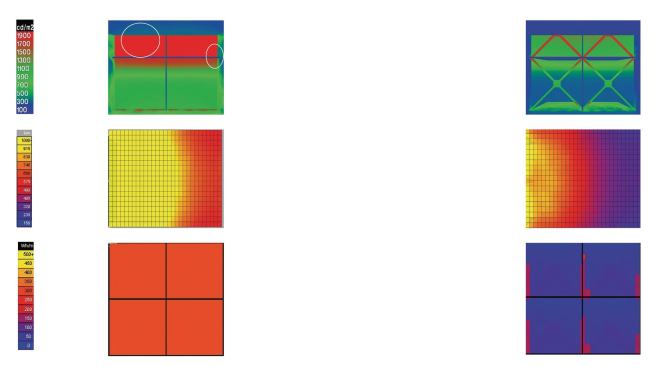
The team performed extensive solar analysis of HelioTrace system components, with three goals in mind: to minimize glare, maximize daylighting, and control solar heat gain. Glare studies (top, with baseline analysis at left and optimized analysis at right) sought to determine if the shading devices could maintain an exterior-interior light contrast level of 10:1, thereby cutting glare substantially. Daylight levels (middle) were calibrated to avoid excessive illumination (middle left)which can cause glareand to help yield energy savings, as well as promote user comfort. Finally, the problem of high solar gain (bottom left) was studied with reference to the systems external shades (both those parallel and perpendicular to the curtain wall), which together cut the peak solar gain by an estimated 81 percent. The teams parametric analysis was even more detailed, calculating the optimal deployment level of each shading device at specific times of day, in different seasons.
Courtesy Skidmore, Owings & Merrill
HelioTrace is composed of three systems: exterior shading (both …
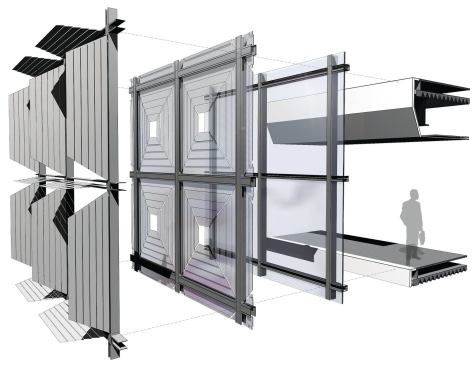
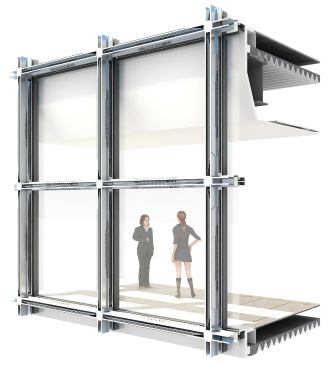
HelioTrace is composed of three systems: exterior shading (both shades that are perpendicular to the building, far left, and shades parallel to the façade, second from left); a high-performance curtain wall; and complementary M/E/P and building systems.
Courtesy Skidmore, Owings & Merrill
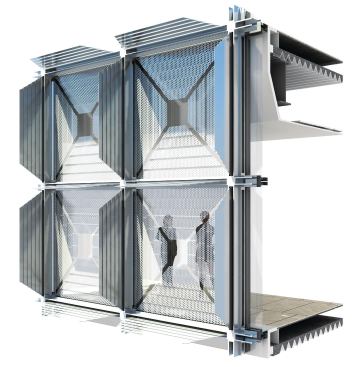
Fully deployed, the shades control glare and cut heat gain.
Courtesy Skidmore, Owings & Merrill
Partially deployed, the shades control glare while introducing d…
Partially deployed, the shades control glare while introducing daylight.
Courtesy Skidmore, Owings & Merrill
When the shades are fully retracted—during winter months—the…
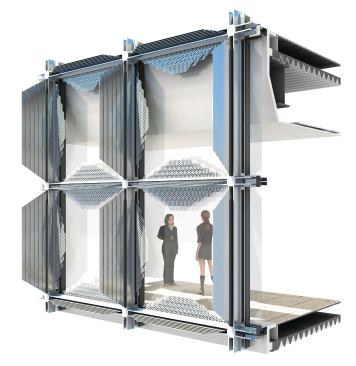
When the shades are fully retracted—during winter months—the system maximizes daylight and allows for passive heating.
The HelioTrace Façade system integrates three different systems—kinetic shades, the building enclosure, and internal mechanicals—into an adaptive façade that seeks to minimize energy use while maximizing user comfort. Its developers claim an effective shading level of 78 percent and an annual peak solar gain reduction of 81 percent.
In HelioTrace, a high-performance glass curtain wall is shaded by two exterior devices: opaque panels that project from the mullions, perpendicular to the façade; and 50-percent perforated panels deployed parallel to the building envelope. Both can be programmed to respond to solar movement and interior occupancy. Energy savings are enhanced by integrated interior systems: chilled ceilings and beams, and an underfloor dedicated outside air system.
Frank Barkow admired “the idea of a kinetic sunscreen,” and called the system a “skin job”—not in a pejorative way, either.
Project Credits
Architect Skidmore, Owings & Merrill, New York—Mark Bearak, Xiaojun Bu, Craig Burton, Kevin Cahill, Peter Glasson, Rebekah Kingsley, Julie Hiromoto, Nicholas Holt, Colin Koop, James Kraus, Kenneth A. Lewis, Donald Marmen, Cynthia Mirbach, Christopher Olsen, Samuel O’Meara, Alexandra Pollock, Teresa Rainey, Marzia Sedino
Contributors Permasteelisa Group—Alberto De Gobbi, Alberto Franceschet, Charles Ersando, Francois Beaupre; Adaptive Building Initiative—Chuck Hoberman, Matt Davis, Ziggy Drozdowski, Robin Dashnaw; Knoll—Doug Militzer