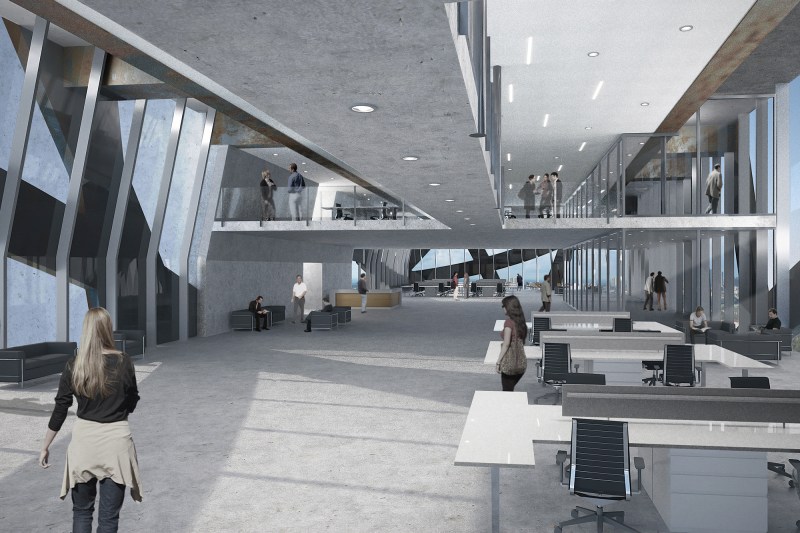
The tangle of steel arcs that wraps the forthcoming 16-story office tower (W)rapper, in Los Angeles, may look like superficial flourish, “but it’s fully structural,” says Dolan Daggett, project director at Eric Owen Moss Architects (EOMA), in Culver City, Calif.
Indeed, 11 of the 14 bands serve as the 230-foot-tall building’s primary load-bearing system and provide lateral stiffness. The exoskeleton also enables a column-free interior and variable floor-to-ceiling heights, and contributes to the unique views from each floor.
Though many buildings employ exoskeletons, the jury
was intrigued by EOMA’s use of a polar-coordinate system rather than the conventional rectilinear grid. “It is a very
interesting and exciting idea to have this kind of structural system,” juror
Joyce Hwang said. Meanwhile, juror Steven Rainville wondered how EOMA justified its approach to achieving a column-free floor plan. Daggett says the bands eschew the traditional Cartesian-grid layout to emphasize the building’s creative program. “It allows us to make a much more dynamic structure,” he says.
The project dates back to
1999, when the firm was asked to design a planned-creative office tower as part of an urban redesign project. EOMA
had previously explored the concept of structural arcs at an exhibition at the
Wexner Center for the Arts, in Columbus, Ohio, in which they installed curved
steel legs from the floors to the ceilings in a gallery, creating a makeshift center to a
building otherwise organized by overlapping grids.
Applying polar geometry to the largely rectangular (W)rapper tower is no easy task. Each band emerges from an exterior wall before sweeping across the building elevation following an arc with a unique radius and center point. The bands run parallel to the building face before turning 90 degrees at building corners, and ultimately terminate at grade. Detailing the bands’ corner joints was particularly difficult because the adjoining arc segments would be coming in at varying angles. The team developed a universal half-notched joint connection, similar to a lap joint in carpentry, that maintains the bands’ flush surface at corners regardless of the orientation of the incoming segments.
Made of built-up steel plates, the hollow bands are fixed in section at 5 feet by 1 foot, but vary in plate thickness to tune their load-bearing capacity. EOMA developed wrapping scripts with Digital Project software to test the band configurations for structural performance, creating a fully parametric digital model of the building. Working
with structural engineers at the local office of Arup, EOMA also devised a set of
structural elements, such as chords, that tie the bands to the tower’s floor plates to transfer the building’s gravity and lateral
loads.
The structural bands are resolved into five
hyberbolic support walls at grade. The resulting compact footprint of the tower enabled the use
of a base isolation system that Arup predicted
would reduce base shear forces by 70 percent—critical for the earthquake-prone area.
(W)rapper has been in a lengthy performance-based, peer-review
process for its custom structural system. Though Daggett says approvals will take longer
than a conventional project that complies with the prescriptive building code, this project demonstrates how buildings can be engineered for their
particular use.
See all the 2015 R+D Award winners here.
Project Credits
Client: Samitaur Constructs—Frederick and Laurie Samitaur Smith
Design Firm: Eric Owen Moss Architects, Culver City, Calif.—Eric Owen Moss, FAIA (architect), Dolan Daggett, Vanessa Jauregui, Nicholas Barger, Zarmine Nigohos, Sean Briski, Raul Garcia, Scott Nakao, Richard Yoo (project team)
Structural Engineer: Arup
Size: 183,000 square feet