The maximum cone size was based on the largest available sheet o…
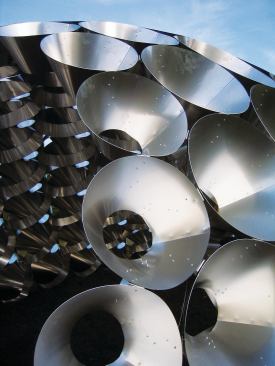
The maximum cone size was based on the largest available sheet of aluminum, and each piece was laser cut before being formed into the three-dimensional form. These cones were then grouped in subassemblies that were transported to the site where the pavilion was assembled. The cones on the bottom row were built to be filled with gravel and sealed, weighing down the structure and preventing uplift from winds on the site.
Courtesy PLY Architecture
Striving for material efficiency, the team conducted geometric s…
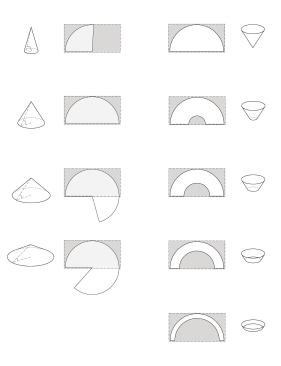
Striving for material efficiency, the team conducted geometric studies to identify the ideal angle and depth of the cones. The first set of studies (left) determined that the most efficient use of aluminum sheets resulted in a 60-degree cone. The second series of studies (right) investigated the material usage of various depths of cones, which then had to be weighed against the effect on light transmittance into the pavilion.
Courtesy PLY Architecture
The team investigated different grid configurations, including a…
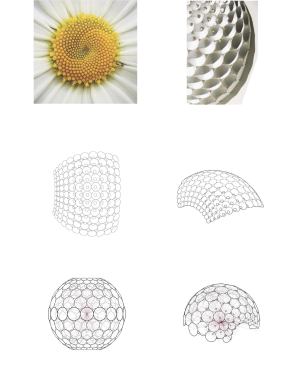
The team investigated different grid configurations, including a hexagonal grid (top) based on phyllotaxis, and a square grid (middle). The hexagonal grid won out because it offered more flexibility (with two additional connection points per cone), but through geometric modeling, the team determined that regardless of the grid pattern, the axes were similar for various shapes being explored (bottom).
Courtesy PLY Architecture
Scripting was used to help generate better understanding of the …
Scripting was used to help generate better understanding of the complex geometries and forces involved in the structure. Placing cones over a predetermined curved field helped the team to identify the connection points that give the double-layered surface of cones its strength, and to determine guide geometry that helped in modeling the ideal height of the cones. This ensured that the structure would be self-supporting and withstand any wind loads thrown at it.
Courtesy PLY Architecture
Rhino Script
Courtesy PLY Architecture
In order to achieve variation with something as static as a grid…
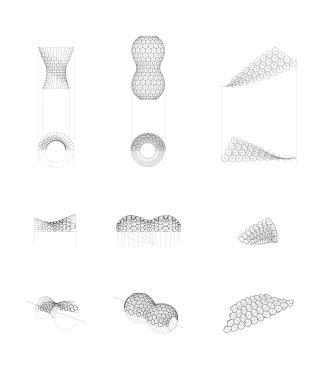
In order to achieve variation with something as static as a grid, the team looked to rotating the grid around different points and axes to change the form. By experimenting with vertical or slightly canted horizontal axes, the team was able to make the grid shift, bend, and twist in ways that informed the final geometry of the pavilion.
Courtesy PLY Architecture
This section shows the relationship between the height of the pa…
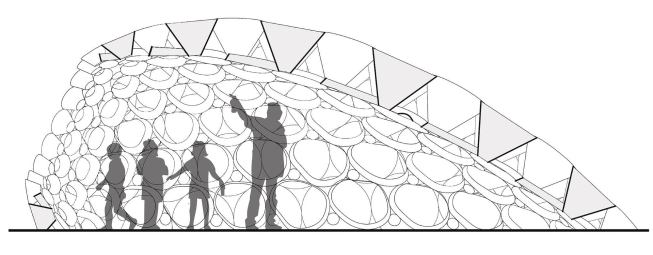
This section shows the relationship between the height of the pavilion and the height of the average visitor, an important consideration in designing a public space. By requiring visitors to step up and over a threshold to enter the space—and by sloping down to meet the ground at the rear of the structure—the pavilion creates a series of carefully framed views for people of different statures, both through the entry and through the apertures in the metal cones.
Courtesy PLY Architecture
The reflectivity of the aluminum cones picks up the colors of th…
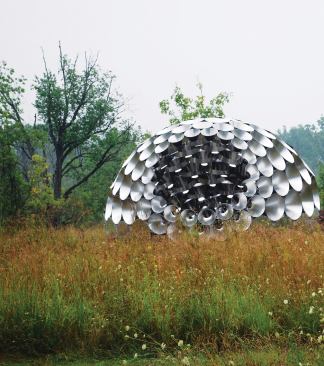
The reflectivity of the aluminum cones picks up the colors of the pavilion's environment. But the geometry of the cones themselves creates an interesting visual trick. The lower curve of each piece reflects the sky, and the upper curve reflects the ground plane, creating an inverse relationship with the surrounding landscape.
The Shadow Pavilion is both a structure and a space made entirely of holes. The surface of the pavilion, which is installed at the Matthaei Botanical Gardens at the University of Michigan, is made of 100-plus, laser-cut cones that vary in size. Beyond testing the limits of sheet aluminum, the cones funnel light, moisture, and sound to the interior space.
Yet the outcome seems almost beside the point: It was the process that most intrigued the jury. The design team, led by Karl Daubmann, a principal of PLY Architecture in Ann Arbor, Mich., and an associate professor at the University of Michigan, conducted an exhaustive study of geometric patterns and presented them compellingly in what juror Cristobal Correa called “a tight little book.” In addition to admiring the project’s formal investigations, the jury lauded the submission for embracing materials testing.
Drawing analogies from botany—specifically, the study of phyllotaxis, the arrangement of leaves—the underlying research set out to give material and process the upper hand, letting form emerge as the secondary result of experimentation. The team decided to work with aluminum because its low cost allowed for repeated study of different shapes and sizes. An abundance of local shops equipped with cutting technologies also aided that choice.
Early studies of circles and cones progressed quickly to complex three-dimensional plots. Shadow studies examined the effects of changes in the cone angle, depth, and arrangement. Additional exercises involved Rhino-scripting the cones onto a predetermined surface to analyze strength-giving connection points. To minimize waste, the team looked at which cone shapes (flat vs. steep) made the most efficient use of the material.
Initially, the jury regarded the project as mere sculpture—form, but no function. “But I like that it’s additive,” juror Frank Barkow said. “And the cone has a certain multitasking quality where it conditions the light. At the same time, it doesn’t require an extraneous structural system to hold it up.”
Project Credits
Architect PLY Architecture, Ann Arbor, Mich.—Karl Daubmann (principal); Ngoc Thy Phan, Alex Timmer (assistants); Chris Johnson, Peggy Chong, Jessica Mattson, Katie Santer, Dwight Song, Alex Watanabe (University of Michigan student construction assistants)
Client David Michener (curator, University of Michigan Matthaei Botanical Gardens and adjunct assistant professor, School of Natural Resources and Environment); Bob Grese (director, professor, University of Michigan Matthaei Botanical Gardens and School of Natural Resources and Environment)
Technology Collaborator (interactive lighting and robotics) Rootoftwo—John Marshall
Structural Engineer Structural Design—Andy Greco
Total Square Footage 450 square feet
Total Cost $20,000
This project was made possible by a Research Through Making Grant from the A. Alfred Taubman College of Architecture and Urban Planning at the University of Michigan and the generous support of Monica Ponce de Leon, dean.