The Chicago River plays an integral role in the history and continued development of its city. Originally, a marshy stream, the river was tamed and transformed into an “engineered channel” during Chicago’s industrial revolution at the turn of the century. Over the past decade, however, the city has looked to redefine the waterway “for the ecological, recreational, and economic benefit of the city.”

Kate Joyce
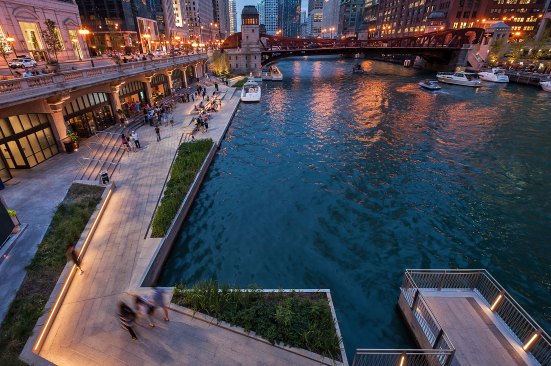
The River Theatre as seen from across the river. The space features illuminated stairs, ramps, and trees.
Christian Phillips
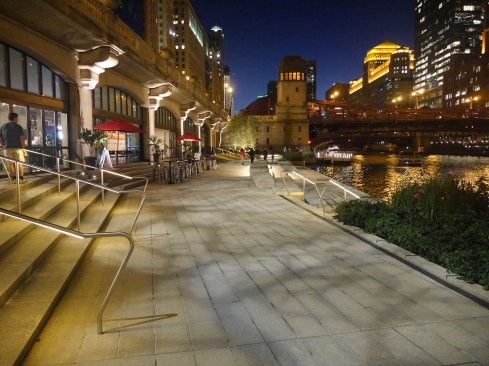
At The Cove, tree branch patterns are projected onto the walkway from pole-mounted, weatherproof theatrical fixtures located above at street level.
Schuler Shook
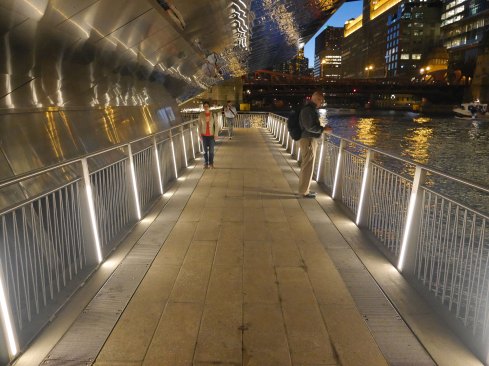
At The Cove, illuminated handrails use 3000K IP68-rated light tape in a channel with a frosted lens to protect and diffuse the source.
The Chicago Riverwalk project has been a multi-year, multi-phase, multi-team development. The site is at water level, and spans from “lower Wacker Drive, extending from Michigan Avenue west to Lake Street.” Work began on Phase One in 2009, and Phase Three was completed last year. The project is made up of five different themed spaces, or “rooms”: the Marina Plaza, the Cove, the River Theatre, the Water Plaza, and the Jetty. One of the main challenges of the project was that the design team had to work within a tight “permit-mandated 25-foot build out area” to allow for pedestrian zones and to coordinate with a series of underbridge areas. (There are approximately 175 drawbridges along the 156-mile-long waterway.)

Schuler Shook
The area prior to renovation.

Kate Joyce
The site was flooded a few days after the grand opening, proving that the submersible lighting and wiring solutions could stand up to the extreme project conditions.
Also of critical import was the need to respond to the river’s annual flood cycle, in which the water can swell to nearly 7 feet above normal. As a result, all luminaires needed to be “robust, rated for submersible applications, low maintenance, low glare, and well integrated into the architecture.” The city also wanted to limit the number of fixture types to keep budget and energy use in check.
Schuler Shook
Bridges linking the "rooms" are illuminated with linear LED fixtures and opal white lenses, yielding 1.8 footcandles, average, at grade.
Throughout the Riverwalk, walking paths are lit with 3000K linear LED fixtures so people feel comfortable and safe. Illuminated handrails incorporate 3000K IP68-rated LED tape light with a frosted lens to diffuse the source, and pedestrian bridges linking the different areas use linear LED fixtures that provide an average of 1.8 footcandles. Overall, the project successfully extends the city’s public space and allows people to enjoy the unique setting.
Christian Phillips
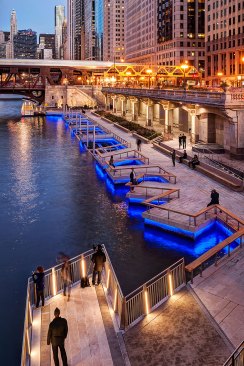
At The Jetty, IP68 color-changing LED tape is used to illuminate the area and highlight the edge profile where water meets land.
Jury Comments
Lovely. • Nicely done. • The lighting allows each space to have a distinctive look and feel, yet weaves the entire project together.
Details
Project: Chicago Riverwalk (Phase 2 and 3) • Client: Chicago Department of Transportation • Architect: Ross Barney Architects, Chicago • Landscape Architect: Sasaki, Watertown, Mass. • Lighting Designer: Schuler Shook, Chicago • Lighting Team Members: Jim Baney, Giulio Pedota • Photographers: Kate Joyce, Christian Phillips • Project Size: 90,000 square feet • Project Cost: $100 million • Lighting Cost: Withheld • Watts per Square Foot: 0.22 • Energy Code Compliance: Chicago Energy Code • Manufacturers: Acuity Brands/Hydrel and Winona Lighting, Bega, ETC, LED Linear, KW Industries, Kenall Manufacturing, Philips, MCI Group, Rosco
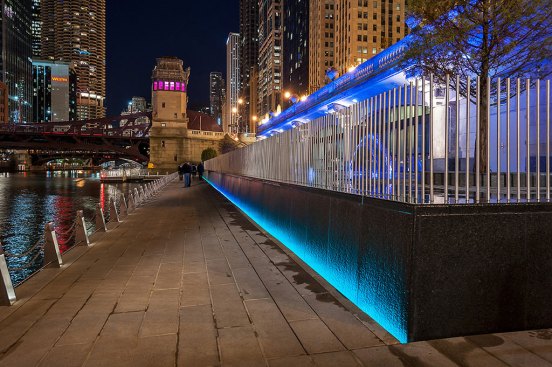
Christian Phillips
At The Water Plaza, color-changing linear LED fixtures are concealed in slots to highlight the stone wall of the water feature.