A view of the building entrance. The atrium beyond separates the…
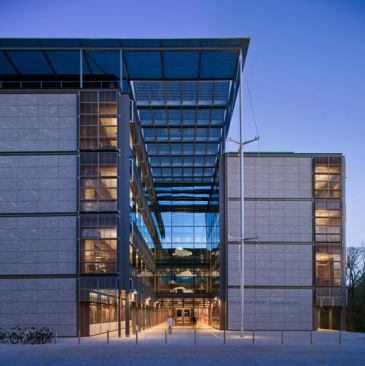
A view of the building entrance. The atrium beyond separates the office and laboratory wings. Photovoltaic panels above are angled to balance energy production, self-shadowing, and solar shading.
Warren Jagger Photography
In the atrium lobby, round, exterior-style luminaires are pair…
In the atrium lobby, round, exterior-style luminaires are paired on custom brackets that also serve as the ballast enclosure.
Warren Jagger Photography
The café serves the internal plaza area. The orange resin panel…
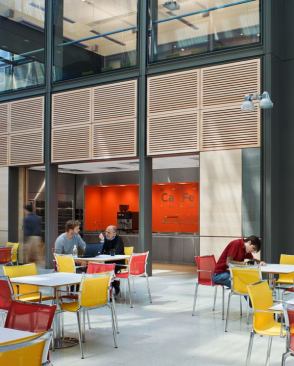
The café serves the internal plaza area. The orange resin panels are washed by lights recessed in the soffit.
Warren Jagger Photography
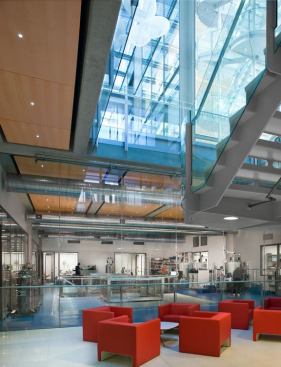
A view of the atrium. Downlights in custom-metal ceiling panels …
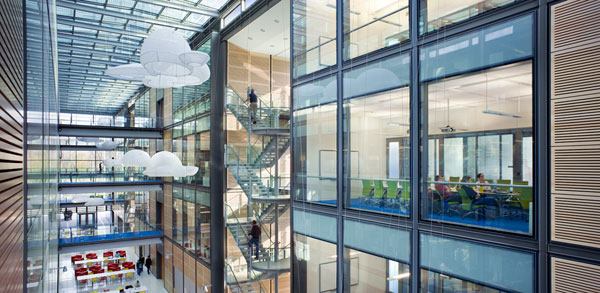
A view of the atrium. Downlights in custom-metal ceiling panels coordinate with the bridges and the stairs.
Warren Jagger Photography
The magnetic resonance laboratory is a featured lab with a p…
The magnetic resonance laboratory is a featured lab with a public aesthetic. Remote metal halide illuminators serve miniature fiber optic downlights to avoid metallic components and maintenance interruptions within the 24/7 facility.
Warren Jagger Photography
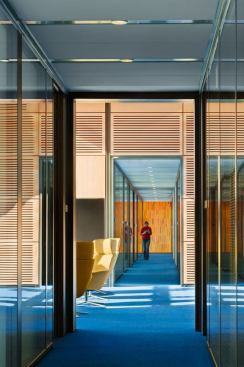
Artist-designed colored glass installations in the office corr…
Artist-designed colored glass installations in the office corridors are backlit by LED strips. 13W downlights in 6-inch metal ceiling strips organize the lighting within the corridors architectural spacing.
Warren Jagger Photography
In the labs, the perimeter desks have LED tasklights and uplig…
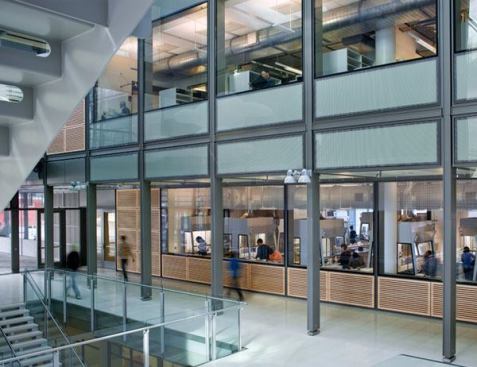
In the labs, the perimeter desks have LED tasklights and uplights that provide general and egress illumination.
Warren Jagger Photography
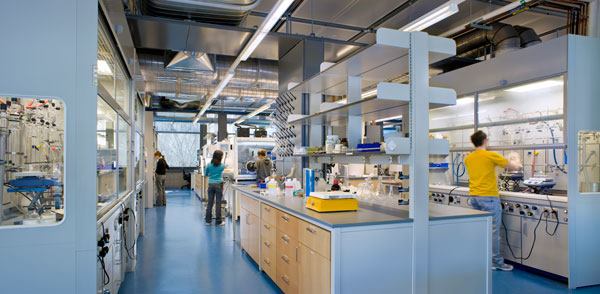
Direct lighting is aligned above each lab bench to provide 60 …
Direct lighting is aligned above each lab bench to provide 60 footcandles where M/E/P services and 12-foot ceilings do not facilitate indirect lighting. A busway mounting system allows for different layouts and can function independent of the specific power feed locations.
Warren Jagger Photography
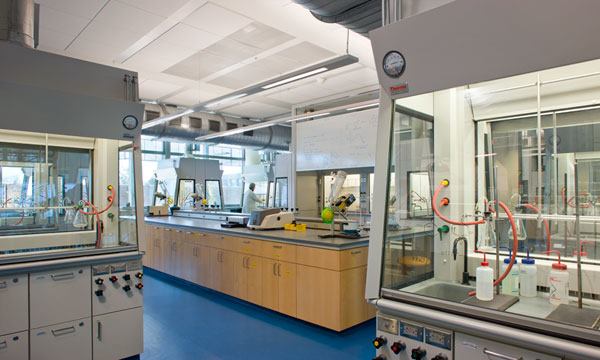
White ceilings and concealed services in teaching labs allow p…
White ceilings and concealed services in teaching labs allow pendant lights to downlight benches and also provide indirect light for the whiteboards.
Warren Jagger Photography
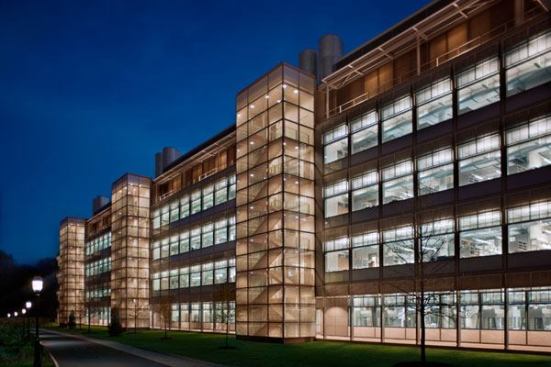
A view of the building at night.
The Frick Chemistry Laboratory at Princeton University rationally organizes office and laboratory space on either side of an open, central atrium topped by 216 photovoltaic-equipped skylights. The architecture indulges its mechanistic aspects with exposed-steel structural members and mechanical ducting, while also providing warmer touches in the form of wooden screens on the interior. Arup’s lighting design complements this orderly and stratified arrangement.
In the public areas, the lighting designers subtly soften the rectilinear vocabulary of the building by using round-shaped fixtures. The corridors are illuminated by recessed CFL downlights, while in the atrium, custom bracket-mounted CFL luminaires fall into the rhythm of the facility’s staircases and bridges. The office and lab wings feature linear T5 luminaires in both uplight and downlight applications. Arup further emphasized the difference between the spaces by using warmer 3000K lamps in all of the round fixtures and cooler 3500K lamps in the linear ones.
While these two luminaire types shoulder the bulk of the project’s electric lighting scheme, the designers took further measures to emphasize the architecture. LED fixtures accent every third column along the atrium colonnade, both exterior and interior. The designers also used LEDs for the laboratory tasklighting and LED strips to backlight artist-designed glass installations in the office corridors.
Jury Comments: The lighting is very in-step with the architecture. • It shows a clear understanding of light and how to use illumination to differentiate architectural space.