The Star-Spangled Banner, a national treasure and the central ar…
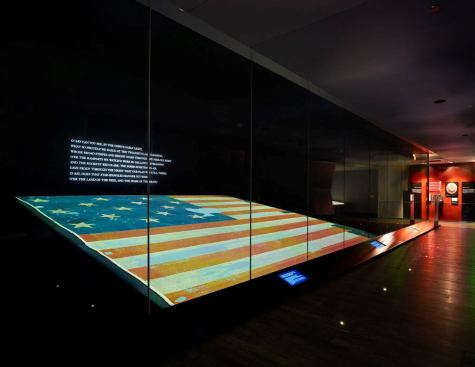
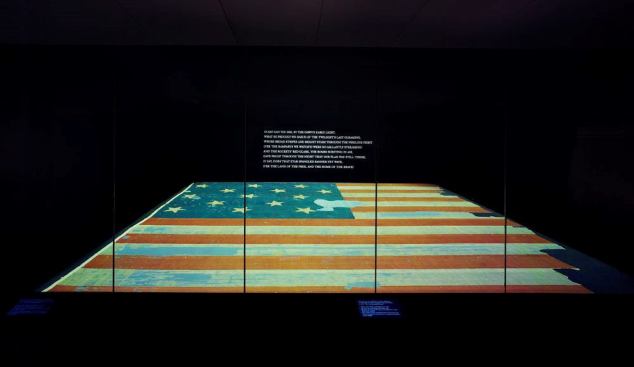
The Star-Spangled Banner, a national treasure and the central artifact of the Smithsonian's National Museum of American History, is displayed on a table with a slight incline for easy viewing in a carefully fabricated two-story high climate controlled case. Given the preservation requirements of minimized exposure to light, the lighting solution was to provide a uniformly illuminated level of one footcandle across the entire artifact. This is achieved with a single source of light that is carefully calibrated to maintain uniform light levels.
The viewing platform is by design the least illuminated zone in …
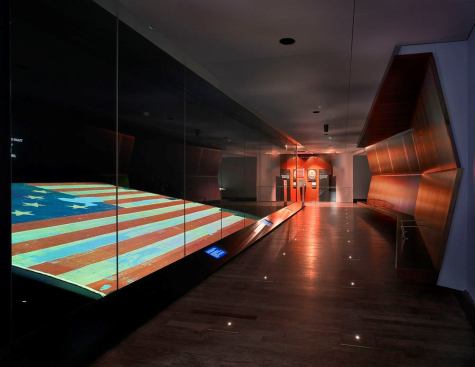
The viewing platform is by design the least illuminated zone in the exhibit dedicated to the Star-Spangled Banner. Finishes were strategically chosen by the design team to ensure that the Star-Spangled Banner could be viewed in a comfortable manner without distractions in the glass surface. The areas leading to and from the viewing area were carefully designed to foster smooth transitions for eye adaptation given the change in light levels.
The interior finishes and surface treatments at the viewing plat…
The interior finishes and surface treatments at the viewing platform were selected to absorb as much light as possible to provide appropriate levels of contrast and optimal viewing conditions of the artifact, which is illuminated according to conservation guidelines.
Given the historical significance of this object, all equipment …
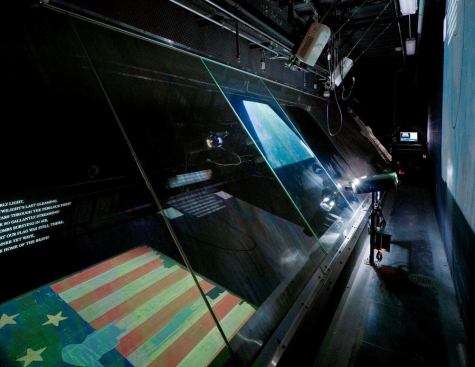
Given the historical significance of this object, all equipment and devices are external to the display environment. A light attic separated from the display case allows for illumination with good color rendering. The Star-Spangled Banner is lit using a single projector that carefully displays a calibrated image that function as a light reduction screen on the display table. This method of visible light control is capable of maintaining a uniformity of 1 footcandle with +/- 0.25 footcandle variation from this lighting baseline.
Lighting section detail at the light attic, showing the projecto…
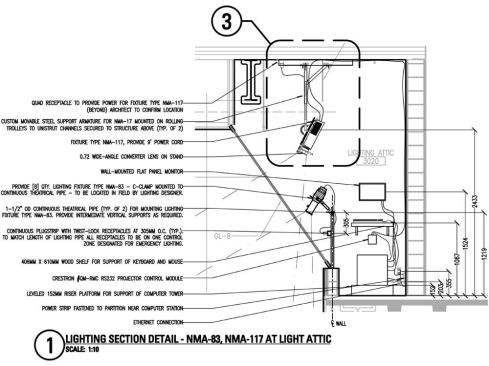
Lighting section detail at the light attic, showing the projector on a movable steel armature and wall-mounted monitor.
Lighting plan detail at the light attic, showing the projector o…
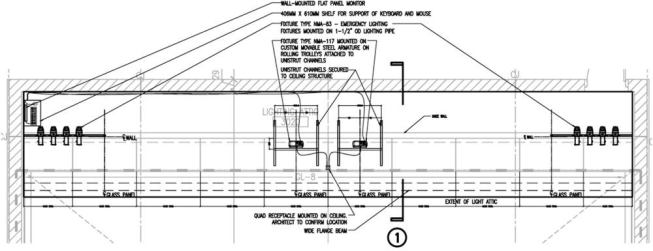
Lighting plan detail at the light attic, showing the projector on a movable steel armature and wall-mounted monitor.
Elevation of movable steel armature and projector stand, located…
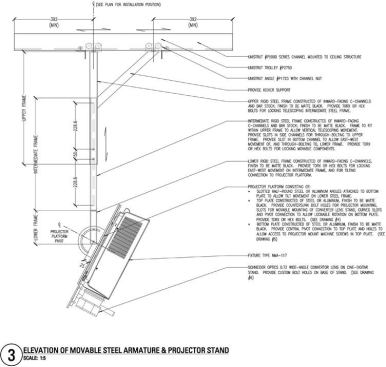
Elevation of movable steel armature and projector stand, located in the light attic.
Admired for its technical achievement in evenly illuminating the massive surface area of a fragile textile artifact within conservation guidelines, the Star Spangled Banner exhibit sets a new standard in exhibition lighting design. The new exhibit has been designed to showcase this iconic flag, the cornerstone of the National Museum of American History’s collection. Displayed in a climate-controlled case on a slightly inclined table for easy viewing, the textile receives a uniform light level of one footcandle from a single projector—with a 330W mercury arc lamp. Conservation requirements prevented the placement of electrical devices in the exhibit case, so the lighting team devised an “attic” space to house the luminaire equipment. The technical proficiency of this lighting solution ensures the continued preservation of this national treasure.
Manufacturers / Applications Christie: LX500 digital projector with 330W mercury arc projector lamp Crestron: Digital projector control module Schneider Optics: 0.72 wide-angle converter lens for digital projector
Elizabeth Donoff is Editor-at-Large of Architectural Lighting (AL). She served as Editor-in-Chief from 2006 to 2017. She joined the editorial team in 2003 and is a leading voice in the lighting community speaking at industry events such as Lightfair and the International Association of Lighting Designers Annual Enlighten Conference, and has twice served as a judge for the Illuminating Engineering Society New York City Section’s (IESNYC) Lumen Award program. In 2009, she received the Brilliance Award from the IESNYC for dedicated service and contribution to the New York City lighting community. Over the past 11 years, under her editorial direction, Architectural Lighting has received a number of prestigious B2B journalism awards. In 2017, Architectural Lighting was a Top Ten Finalist for Magazine of the Year from the American Society of Business Publication Editors' AZBEE Awards. In 2016, Donoff received the Jesse H. Neal Award for her Editor’s Comments in the category of Best Commentary/Blog, and in 2015, AL received a Jesse H. Neal Award for Best Media Brand (Overall Editorial Excellence).Prior to her entry into design journalism, Donoff worked in New York City architectural offices including FXFowle where she was part of the project teams for the Reuters Building at Three Times Square and the New York Times Headquarters. She is a graduate of Bates College in Lewiston, Me., and she earned her Master of Architecture degree from the School of Architecture at Washington University in St. Louis.