
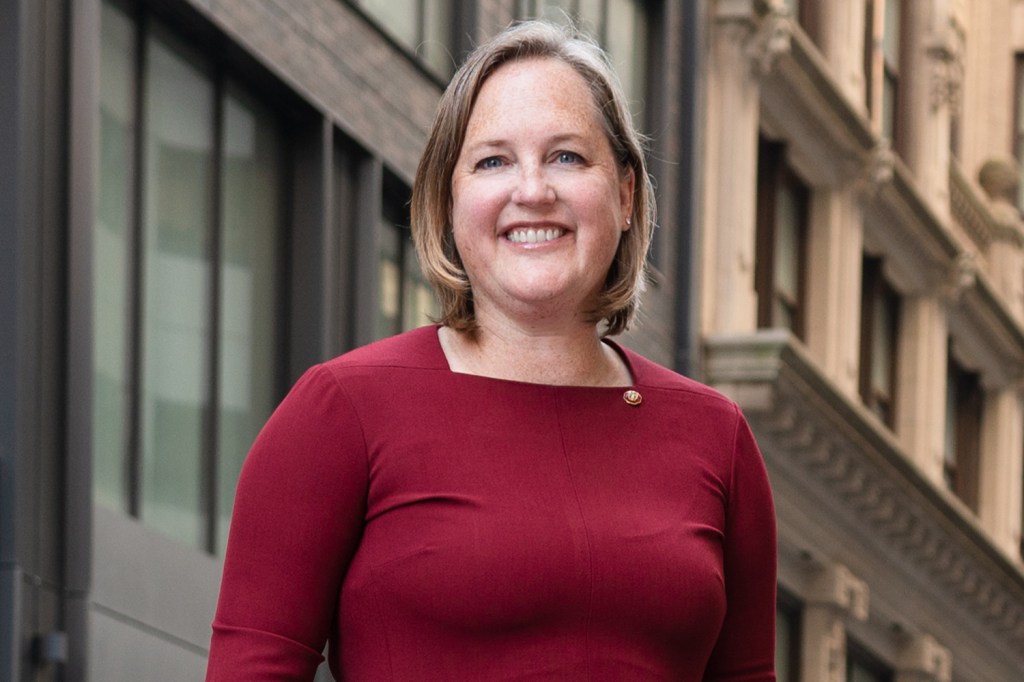
Emily Grandstaff-Rice, FAIA, will be sworn in as AIA’s 99th president in 2023. Currently a senior associate at Arrowstreet in Boston, Grandstaff-Rice has a broad range of experience with hospitality, institutional, and commercial projects. Recently, her focus has been on designing spaces in the public K–12 academic sphere. We spoke with Grandstaff-Rice about design for education and how school buildings can teach kindness.
There is nothing like the feeling of walking through a space that you had a hand in designing. That, for me, is one of the reasons I know the physical realm is important to me.
Because most of my work is public K–12 academic work now, I make a point to design for discovery—and that includes designing for both adults and children. I once had a client who said he measured success by giggles. I think about creating environments where children can allow their minds to question, to make sense of patterns, and make their own meaning. I think back [on] my experiences in school, what spaces made me feel comfortable, what spaces created meaning. I use that perspective to work with my clients to define the type of educational experience they want to provide. I see it as a great journey that I can [provide] for generations to come.
Sarah Williams Goldhagen, architecture critic and author, says, “There’s no such thing as a neutral space.” Spaces can either uplift or deflate the spirit. As architects, we always have a choice when we design even the most routine of spaces.
There is a lot of talk these days about what schools should and should not be. As architects, we have a choice to help our clients define what safety means to them—[whether it means] promoting socio-emotional learning, healthy spaces, community access, resiliency, or security.
Recently I was working with a client to think about the ways in which school buildings can teach kindness, especially small moments. What does kindness look like in a cafeteria? Responsibility on the playground? Or cooperation in the corridors? I talk with my clients about behaviors they want to see, and as experts in child development, they provide direction in how spaces can engage with educational pedagogy. Every school culture is different. I honor that by ensuring that our designs reflect their vision.
My perspective is diverse—I have family who are educators, members of law enforcement, victims of gun violence, and those affected by mental health issues. I hear many opinions about what school safety should be. I believe there is no amount of building fortification that will stop the bigger picture of what is happening in our society. School safety is also about feelings and emotions with some of our most vulnerable citizens. Schools need
to be welcoming and create a sense of belonging. School is where many children develop independence and skills. Again, as architects, we can uplift or deflate in the spaces we create. I choose to focus on creative, positive spaces.