
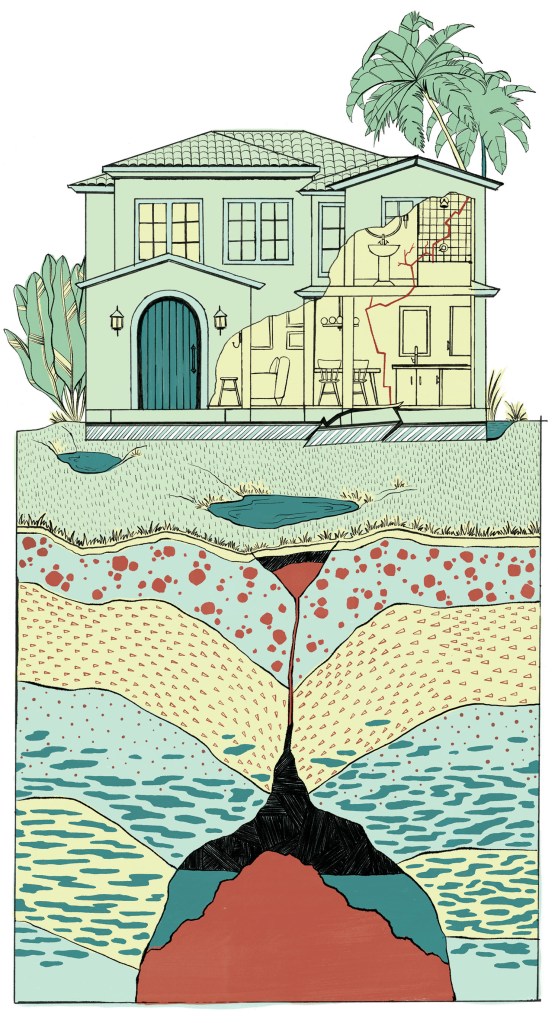
Natural sinkholes are a major challenge for the nearly 20 million people in Florida, given the state’s high water table and porous limestone below the sandy surface. Winter Park, an Orlando suburb, is famous for the May 1981 sinkhole that swallowed an Olympic-sized swimming pool and an entire car dealership—which caused no deaths but did make it into the record books as the largest sinkhole event that resulted from natural geological conditions.
In 2014, in order to predict future natural sinkholes, University of Central Florida scientists created a simulator that, ideally, will give residents and business owners enough time to vacate an area. And, also in 2014, NASA researchers claimed that satellite radar can provide clues about the likelihood of an area’s susceptibility. But if you’re a homeowner and you don’t have NASA scientists on speed dial, how can you tell if a sinkhole is forming in your yard? Well, just take a look around.
Six Salient Sinkhole Signs
- New small ponds that appear after rain
- Dips, depressions, slopes that appear in a yard
- Cracking or buckling of house’s concrete slab
- Cracks in interior walls
- Cracked tiles
- Uneven floors, warping of hardwood, bulging or sagging sections