
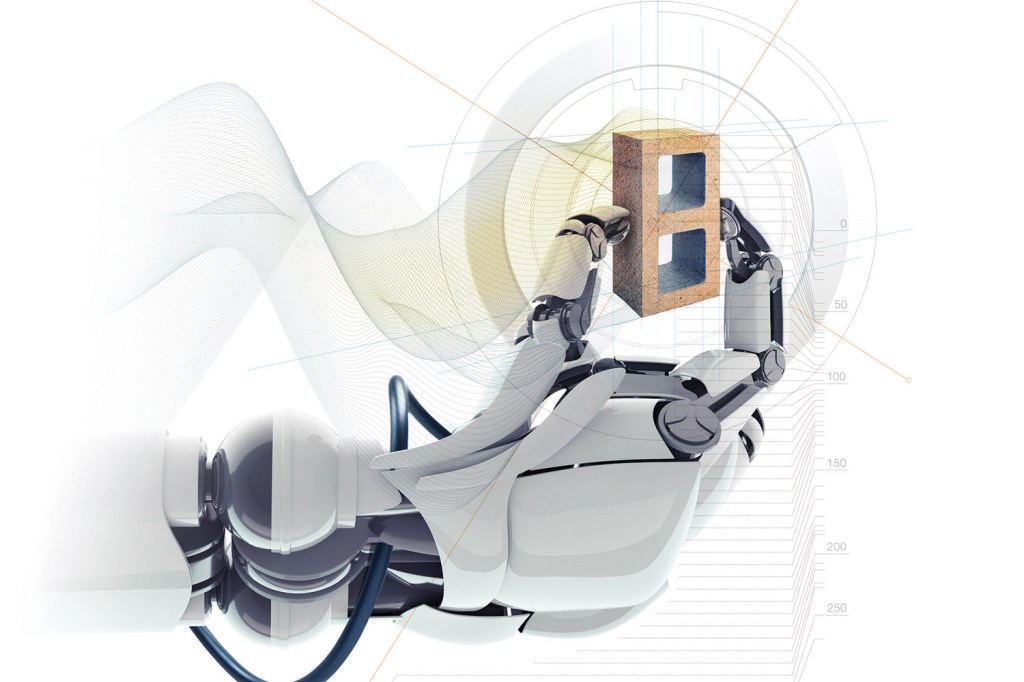
And a robot will lead architecture back to craft.
So could read the coda to “Augmented Craft: Combining META Glasses and BIM for Advanced Masonry Construction,” a 2014 AIA Upjohn Research Initiative grant–winning project from University of Buffalo School of Architecture and Planning professor Michael Silver. The Upjohn Research Initiative provides material support of up to $30,000 for projects that “enhance the value of design and professional practice knowledge.”
“Augmented Craft,” whose seedlings were planted during discussions in Silver’s classroom, started out as an exploration into how augmented reality tools—think Google Glass—could enhance and record the conditions of masonry construction. However, the project quickly snowballed into a blueprint for a smart device that meshes artificial intelligence (AI) and humanoid robotics with mechanical mastery. Silver likes to call these working machines “servant zombies”: intelligent robots that are capable of acting as extensions of “the bodies and desires of its owners.”
The Upjohn grant started “a chain reaction of interest,” Silver says, and the initial project has scaled up with additional support from Autodesk, the International Masonry Institute (IMI), and the National Science Foundation to aid in the creation of a robot that can be deployed on masonry construction sites. For Silver, these are robots that build, performing rote tasks such as dismantling bricks. In effect, though, their application could free the main individuals involved in architectural creation—the designer and the builder—to rededicate themselves to a nuanced sense of building as craft. Servant zombies, being insentient—and therefore incapable of expression—will embolden designer and builder toward a more realized artistic impulse in the art of building-making.
“Robots can make jobs easier,” Silver says. “The ‘servant zombies,’ they are tools to be exploited. The worker isn’t and shouldn’t be. The drudgery around hard labor is relieved. [Robots] become useful forms of new media.”
Silver is sensitive to the fact that AI and the encroachment of automated technologies threaten the trade industries, but believes that the promise of the robots—what they can technically accomplish—will actually draw individuals into masonry construction.
The support from the IMI is a heavy nod toward that sentiment. In 2015, Silver presented his concept to a group of union leaders at the group’s annual convention. He says the industry, knowing it is failing to attract younger workers, is increasingly looking toward new technologies as incentives to expand its workforce. “Any type of technological enhancement to craft will attract new members,” Silver says.
Momentum is building for the servant zombies’ premiere. Silver is hoping to produce an operating prototype of the robot next year. Equipped with LIDAR sensors and Wi-Fi, the 3D-printed titanium and machined aluminum robot will fold down itself into an easy transportable case, collapsing into an inert state when not activated for duty. Silver says he and his students spent “hours and hours looking at legs and mechanisms and the design of individual parts,” and they should soon all be observable in built form.
Scott Peters, president and cofounder of fabrication firm Construction Robotics, has partnered with Silver on “Augmented Craft” to “assist with the practical aspects of building hardware.” He sees his firm’s work as helping break down the disconnect between engineering and architecture, and helping people like Silver’s students—as well architects in general—“embrace the capabilities of tech as a practical application.”
Yet Silver sees potential even beyond the jobsite. “Architects, until now, have not been designing the means of production,” Silver says. “Architects are now developing systems at the material level, at the level of code. We’re developing a hardware and software ecology. This is a discursive project to think about the process of how new forms of architecture are made.”