
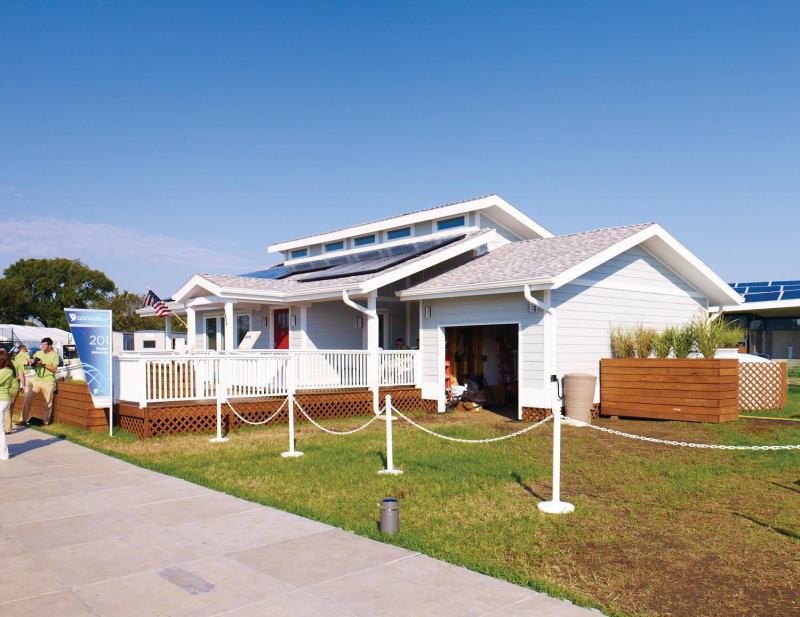
The Purdue team designed INhome (short for Indiana home) to appeal to “a typical Midwestern consumer.” The engineer-driven project—Purdue has no school of architecture—was intended to show that energy-efficient homes can be easy to live in and construct. “We would like a contractor to be able to walk in and say, ‘I know how to build this and make a profit,’ ” says Bill Hutzel, a professor of mechanical engineering technology. Purdue took a simple approach to controlling up-front costs by using off-the-shelf materials. The house is made of SIPs, with long-lasting, low-maintenance HardiePlank applied to the exterior. The roof features sun-reflective cool-roof shingles. The project also includes an innovative biowall, an air-purifying system based on NASA research that studied how plants can purify air in space.
Estimated cost: $257,853.70
2011 Solar Decathlon
For full coverage of every team, slide shows of the houses, video walkthroughs, interviews, and an essay by Lawrence Biemiller on the importance of the competition, click here.