While developing their structural systems, the team looked at tw…
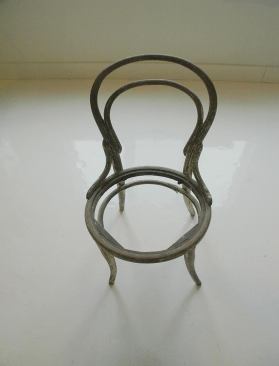
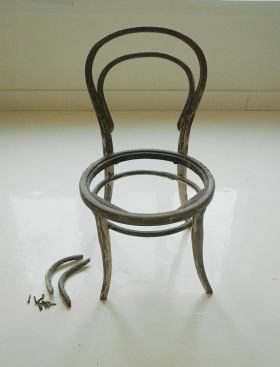
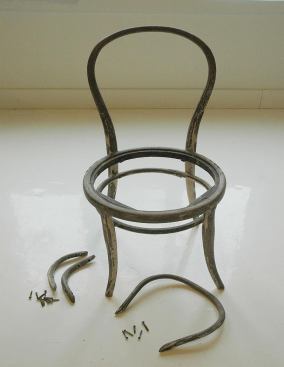
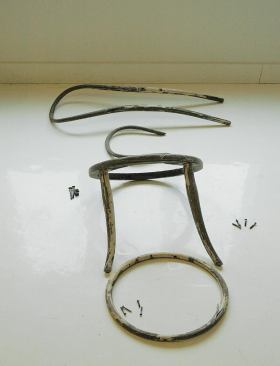
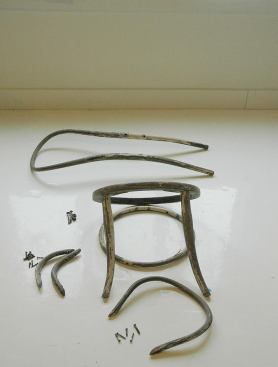
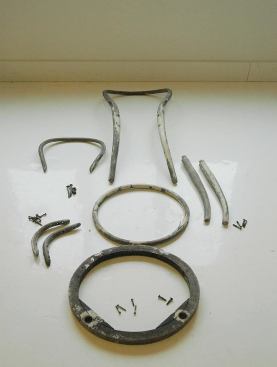
While developing their structural systems, the team looked at two steam-bent antecedents: Thonet's No. 14 chair and the bent-wood snowshoes and canoes made by craftsmen in the Great Lakes region. To fully understand the geometries and the bending required, a Thonet chair was deconstructed to its most basic parts.
Courtesy University of Michigan
Deconstructing Thonet
Courtesy University of Michigan
Deconstructing Thonet
Courtesy University of Michigan
Deconstructing Thonet
Courtesy University of Michigan
Deconstructing Thonet
Courtesy University of Michigan
Thonet Deconstructed.
Courtesy University of Michigan
Tests of various regional wood species—including white ash and…
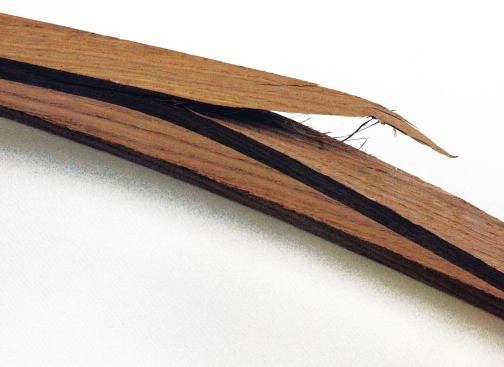
Tests of various regional wood species—including white ash and white cedar—and samples of wood species from further afield, suggested that white oak was the best option for creating the arcing wishbone structural system because of its superior flexibility and weather resistance. But this realization did not come without several failures along the way. Even after white oak was selected, the team continued to move back and forth between digital parametric models and physical models, using the breaking point of the wood to help develop the extent of the curve for the arched structural members.
Courtesy University of Michigan
Several parametric models were created to explore how the severi…
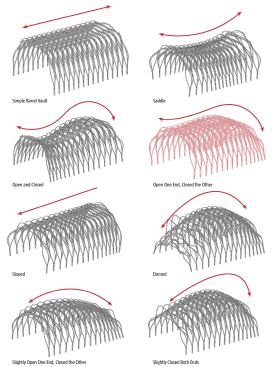
Several parametric models were created to explore how the severity of the curves of the individual structural components would affect the overall geometry. These models were combined with lessons learned from physical modeling to determine that the best form for the pavilion would be open on one end and closed on the other (shown in red). The parametric model was then run through a series of structural analyses that tested moderate loading, pre-failure, and failure loading to determine how the structure would perform under heavy wind loads.
Courtesy University of Michigan
The team determined that to create the wishbone structure it wou…
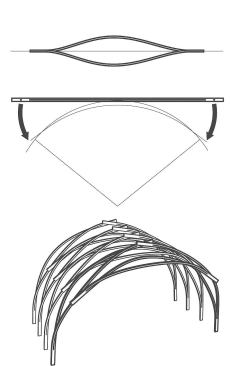
The team determined that to create the wishbone structure it would have to make each individual piece of white oak achieve a three-axis bend. Each piece of wood is split down the middle, nearly to the ends, then steamed open to form the initial shape, and bent over a barrel-shaped jig developed through parametric modeling. Each piece can be bent to a 1.6-meter radius before breaking. Pieces are then joined together to form the full arch of the structural system.
Courtesy University of Michigan
Once testing was completed and the structural system determined,…
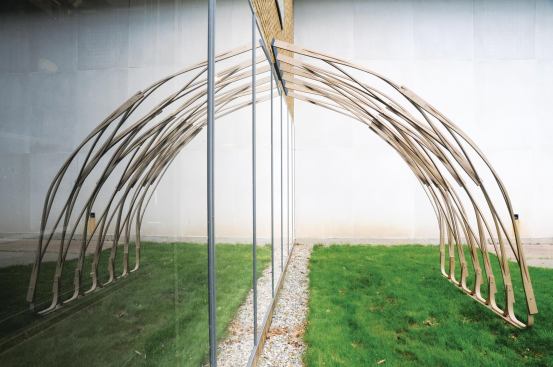
Once testing was completed and the structural system determined, the team built a full-scale prototype of one half of the potentially fully arched structure. In this partial form, the system can serve as a brise-soleil for an existing building.
Courtesy University of Michigan
Wood is biodegradable, so it can either be composted or used as …
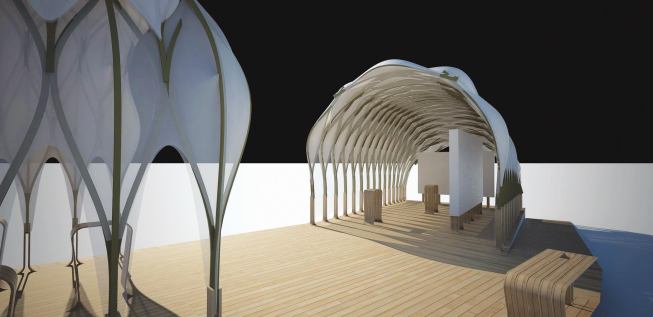
Wood is biodegradable, so it can either be composted or used as fuel for wood-burning stoves or heaters once a structure has reached its end of lifebut the complexities of the system are not a great fit for rapidly deployable structures such as disaster housing. However, the team is exploring the idea of using the system for temporary civic buildings, such as outdoor galleries. Covering the structure with a translucent fabric would allow daylight to filter in and create a sheltered space to view artwork.
Thonet, Aalto, Eames—these are some of the names that come to mind if you think of bending wood into complex forms through the application of steam. A research group at the University of Michigan decided to revisit this 19th century technique with 21st century digital tools. Using parametric modeling coupled with CNC technology, the group pushed the material to its limits, using a series of failure points as the basis for generating form. The group designed and tested two structural systems, one based on Michael Thonet’s iconic No. 14 bistro chair, and another based on a wishbone pattern found in the canoe construction techniques of the Great Lakes region. This wishbone system, now being considered for movable pavilion structures, has been built through to full-scale prototypes.
The research process impressed the jury, especially Jenny Wu: “There’s something nice in taking a known process and developing it and understanding it as a geometrical construct.” And the group did so using a combination of new and old technologies, discovering that the failures of the physical prototypes informed the parametic models, which improved the next physical models, and so on, until the final form was achieved.
More than just the formal research, the jury appreciated the team’s willingness to push the material as far as (or farther than) it can go, only to use those failures to inform the final design of the curvaceous structural members. Each wishbone is made from a piece of white oak that is formed over a barrel-shaped mold without a steel strap or additional supports. “You know, wood doesn’t like to do that,” Wu said. “And I think the detail is pretty elegant.” The team determined that each piece can be bent to a radius of 1.6 meters before failure. At that point, the arches are joined together to form a vaulted structure. The prototypes were analyzed with structural modeling software to determine if they can withstand both dead and live loads, and a skin is now in development.
Juror Frank Barkow liked the idea of using current technology to dialogue with the past: “The idea is interesting: digitally being able to revisit the … [Thonet] project, in a way, of how to modify plywood or wood.”
Project Credits
Final Research Team Steven Mankouche and Joshua Bard (principal investigators); Matthew Schulte (research assistant)
Funding Office of the Vice Provost of Research, University of Michigan
Starting Research Team Steven Mankouche, Joshua Bard, Tsz Yan Ng (principal investigators); Matthew Schulte, Sarah Dean, Richard Tursky, and Luke Somo (research assistants)
Funding Research Through Making Grant, A. Alfred Taubman College of Architecture and Urban Planning, University of Michigan
Structural Consultant Peter Van Bulow
All research was conducted at the University of Michigan’s A. Alfred Taubman College of Architecture and Urban Planning and the School of Art and Design.
We wish to thank Hardwoods of Michigan for access to their lumber mill.