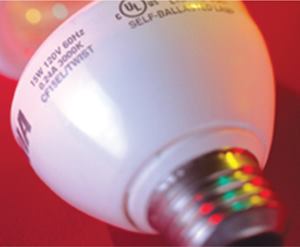
With general awareness about climate change increasing, consumers have sought to educate themselves further about energy-efficient practices. Manufacturers have responded to this increased demand by investigating new technologies and developing new products. Compact fluorescent light bulbs (CFLs), in particular, have been one of the first products in the marketplace to go mainstream, offering consumers one option on the road to greener solutions.
But most of the light fixtures in our homes still use incandescent sources, and they rely on a hardware infrastructure that does not necessarily correspond to the electrical needs of newer lighting technologies such as CFLs or light-emitting diodes (LEDs). Also, when new sources such as CFLs and LEDs are installed, there is no guarantee that the rest of the lighting equipment will be upgraded. Instead, the new technology is left to work with older hardware, which does not maximize its full functionality. Anyone who has ever replaced an incandescent light bulb with a CFL in an existing fixture can tell you that there is always a moment of trepidation when they flip the switch and wonder: Will everything still work properly or will it explode?
To address these concerns, Underwriters Laboratories (UL)—an independent product safety certification organization that has been testing products for more than a century—has recently made public the results from its CFL safety study. The findings indicate that CFLs do not pose any fire or shock hazards when used in a light fixture, controller, or switch that traditionally has been used for an incandescent source. “CFLs have become very popular,” says John Drengenberg, director of consumer safety at UL. “There was growing concern among the public as to whether or not simply switching from an incandescent to a CFL created any safety concerns. To date, there was only anecdotal evidence indicating it was a non-issue. Now we have substantiated findings.”
The study examined CFL substitution in a variety of fixture types and found that even a CFL with the highest heat output still emits less heat than a 40W incandescent bulb. UL also looked at a lamp’s end-of-life characteristics. This is an area of particular concern for consumers, since earlier generations of CFL products have been rumored to make popping sounds or produce smoke when installed in an incandescent socket. The study also explored what happens when CFLs are used in conjunction with lighting controls such as motion detectors, wireless controls, and dimmers. No safety issues were unearthed here, but the test did indicate that there were issues such as flashing, flickering, poor light output, and reduced lamp life that might impact consumer satisfaction with performance. UL is quick to note that a CFL’s lifespan will be reduced substantially when installed in fixtures where switches are turned off and on frequently.
According to UL, CFLs are installed in approximately 11 percent of available sockets found in homes in the U.S. UL hopes that the study’s findings, and confirmation that CFLs pose no electrical risks, will encourage consumers to use these energy-efficient sources in an even wider range of home installations. The CFL safety study is available online at uluniversity.us/thoughtleadership.