
Triptyque Architects and Nelson Kon from Archite cture of Change 2
Architecture firm Triptyque's project, “Harmonia 57,” receiv…
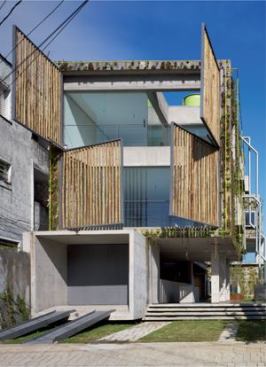
An intelligent, green façade based on organic concrete and a research project that lays out a map for New York City’s sustainable future are the two winning design recipients of the 2010 Zumtobel Group Award for Sustainability and Humanity in the Built Environment. French-Brazilian architecture firm Triptyque’s project, “Harmonia 57,” received the award in the “Built Environment” category, and New York–based nonprofit design firm Terrefuge/Terreform One’s project, “New York City Resource & Mobility,” received the award in the “Research & Initiative” category.
Some of the most influential experts in architecture, engineering, and sustainability nominated an international field of 40 projects. The two prize winners were determined by an independent seven-person jury composed of architects Enrique Norten, Yung Ho Chang, Colin Fournier, and Stefan Behnisch (who also served as jury chairman); engineer Brian Cody; UN Habitat general and executive director Anna Tibaijuka; and Zumtobel Group CEO Andreas Ludwig.
Triptyque’s “Harmonia 57” is an intelligent, green façade irrigated by a system installed on the outside of a building that sprays mist. The system collects rainwater and enhances the building’s indoor climate. The building, located in a São Paulo, Brazil, suburb, can also function as an open-air gallery due to its terraced design. The jury noted that the project “represents a very intelligent idea that gets by on simple means and a low budget.”
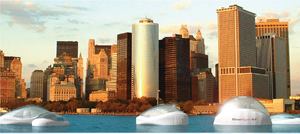
Terrefuge/Terreform One—an interdisciplinary research group of scientists, artists, architects, and students, founded by Mitchell Joachim and Maria Aiolova—was recognized for their research project that investigates the sustainable future of New York City. Examining scenarios that take into account rapid population growth, massive climate change, and rising sea levels, the project models a fully autonomous and self-sufficient New York City of the future. “New York City Resource & Mobility” looks at everything from infrastructure to waste recycling in its rethinking of urban planning. The jury was impressed with the project’s “rich source of interesting ideas of real substance” and the research team’s not being “afraid to think in whole new directions … in the urban development debate.”
The jury also selected eight honorable mentions—four projects in each of the two categories. In the “Built Environment” category, these included the High Line in New York; a center for women in Burkina Faso; the newly developed Elm Park suburb of Dublin, Ireland; and the new California Academy of Science building in San Francisco. In the “Research & Initiative” category, the honorable mentions went to a rural student project at the University of Talca in Chile; a U.S.-Mexico cross-border exchange program and symposium, “Political Equator II”; an office and studio building in Columbia; and a master plan for a wind park in the North Sea.
“Ensuring the efficient use of resources and arriving at pioneering solutions in the fields of architecture and urban planning are challenges that will accompany us for many years to come,” says Zumtobel’s Ludwig. “I am delighted that, in their selection this year, the jury [members] have sent out a clear signal that smaller projects which adopt innovative approaches can also prove an important source of inspiration.” The announcement of the †140,000 prize was delivered February at the Roden Crater in Arizona. The awards will be presented at a ceremony in Bregenz, Austria, on Sept. 9, and an exhibit of the winning projects will be curated by the Aedes Architecture Forum in Berlin. For more details about the Zumtobel Group Award go to zumtobel-group-award.com.