
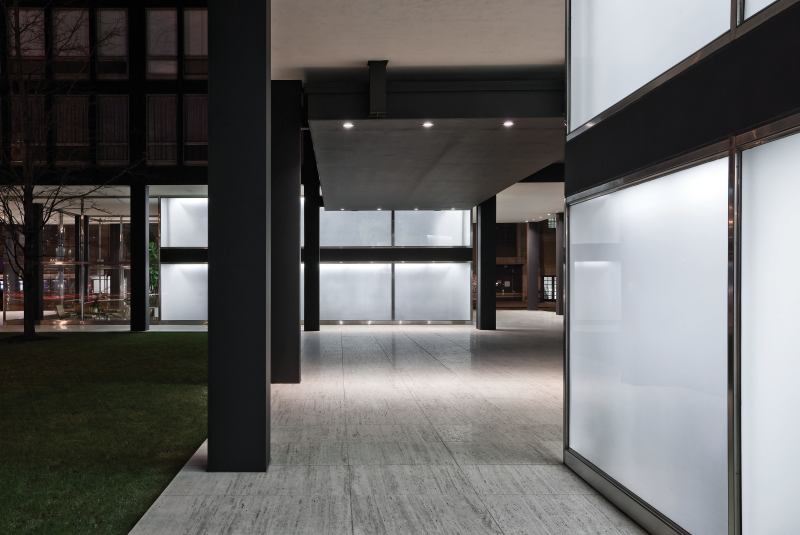
For nearly half a century, a pair of steel and glass apartment buildings at 860–880 Lake Shore Drive has towered coolly over Lake Michigan. Twin modernist masterpieces, the high-rises represent the essence of Ludwig Mies van der Rohe’s vision for residential architecture—reductive boxes poised on a travertine field. During the day, their gridded simplicity offers an understated sophistication, which was inexpertly copied across the globe throughout the ’50s and ’60s. In photographs from that era, the two buildings take on a different character come evening. The towers fade into the skyline, and their transparent lobbies glow—stage sets for modern living.
As a Chicago registered landmark, the project has weathered changing tastes and styles, but ultimately it was weather that finally caught up with the buildings and necessitated a major restoration of their two lobbies and shared plaza in 2008. Water had undermined the lobby façades; travertine tiles were crumbling; and the downlights that ring the underside of the buildings’ canopies were rusted. The residents of 860–880 Lake Shore Drive turned to a consulting team of Chicago-based architects and lighting designers to tackle the renovation: Krueck & Sexton Architects, historic preservation experts Harboe Architects, and lighting designers Schuler Shook.
Foremost in their minds was bringing back Mies’ design intent. Yet research into the original building documents uncovered a less well-known mid-century figure, lighting designer Richard Kelly. Restoring the lighting meant piecing together a modernist approach to illumination. Kelly graduated from the Yale School of Architecture in 1944 and went on with a select few to pioneer lighting design as a profession and to collaborate with Louis Kahn on the iconic Kimbell Art Museum, which opened in 1972. But before the Lake Shore Drive Apartments opened in 1951, Philip Johnson’s Glass House, completed in 1949, was Kelly’s most notable project.
Replacing the canopy lights meant finding a suitable substitute—one that captured the modernist “look” and fit into the existing soffit opening, but also met weather and present-day energy and maintenance requirements. The luminaire also needed a clear glass lens and a sealed doorframe to ward off birds, who liked to roost in the old housings. The new fixture takes a 39W 3000K ceramic metal halide lamp and restores the design intent at one-eighth the energy usage of the original incandescent lamps. Using full-scale, on-site mock-ups allowed the team to test aesthetic and functional options.
Strong exterior downlights are key to Kelly’s and Mies’ vision. Their modernist philosophy—the visual connection inside and outside—is maintained by illuminating the plaza. Without light on the travertine pavers, the glass panes would turn from transparent to dark reflective surfaces. The directional downlights bounce light into the lobby. “The light-colored floor becomes a large diffuse light source. Since the ceiling is also light-colored, you get the inter-reflections between the floor and the plaster ceiling,” explains lighting designer Jim Baney, partner at Schuler Shook. “There’s a perception of light glowing all around you.”
Approximating atmospherics is not without contention, especially when the residents of 860 and 880 take such pride in their historic landmark. As part of the renovation, non-original laminated glass panels were replaced with sandblasted glass, a material that the architects believed—from their renovation work of Mies’ Crown Hall at the Illinois Institute of Technology—was closer to the master’s specification. Kelly had designed custom asymmetric linear reflectors around T12 single-pin fluorescent lamps to backlight the glass, but building maintenance had replaced the lamps with T6s of a similar wattage and lumen output. The new glass was no match to diffuse these thinner, more intense sources that were now visible as bright strips behind the surface. Tenants complained. Since the existing reflectors designed by Kelly were in good shape and the restoration was at the end of its budget, the renovation team simply swapped the T6s back to T12s. This minimized lamp imaging and produced a softer, more uniform distribution of light.
“Mies’ ideas were so simple and so pure, but also rigorous. Every move reinforces itself. They have a richness to them in their simplicity, which could be a huge benefit to today’s architecture,” explains Tracey, whose team had to balance the building’s historic character with renovation costs. The overall budget ran close to $8 million.
“Working historically involves a lot more research. We need to make sure what we do is true to the original intent,” Baney says. Culling through archives and old drawings revealed that Kelly’s layout has its own kind of thriftiness that mirrors Mies’ well-known credo: “less is more.” Kelly’s lighting approach was so fully integrated into the overall original scheme, that it only took two types of strategically placed fixtures to illuminate the lobbies and surrounding plaza of 860–880 Lake Shore Drive. The buildings’ elegance comes from thoughtful restraint; it’s a historic lesson worth noting for the future.
DETAILS Project Restoration of 860-880 Lake Shore Drive, Chicago
Architect Krueck & Sexton Architects, Chicago
Lighting Designer Schuler Shook, Chicago
Historic Preservation Consultant Harboe Architects, Chicago
Photographer Mark Ballogg, Chicago (unless otherwise noted)
Manufacturers / Applications
Bega Recessed wall-mounted steplights with 18W 3000K lamps at parking garage entry ramp
Erco Recessed downlight with 39W 3000K ceramic metal halide lamps at canopy soffit
