Buckminster Fuller noted that technology gets smaller as it gets more sophisticated. Think of the evolution of the computer from the size of a room to the top of the desk to the palm of your hand. Today, this concept is most evident in one of construction’s simplest technologies: paint.
Since cavemen began drawing on walls 40,000 years ago, the purpose of paint has been either ornamental or functional in only a limited sense, as a protective coating. And until now, sustainability in finish coatings meant reducing the number of volatile organic compounds (VOCs) off-gassed. But with the development of “smart paints,” finishes are becoming more productive, replacing bulky components in filters, walls, and even mechanical systems.
Titanium dioxide coatings, such as Millennium Chemicals’ product “D-NOx,” absorb pollution—specifically, nitrogen oxides, which contribute to respiratory problems. Once embedded in the surface, the particulates react to ultraviolet light from the sun, break down, and become harmless. Shown to alleviate emissions by up to 60 percent, the product is being used in garages in England to reduce exhaust fumes, and Richard Meier’s Jubilee Church in Rome uses it to keep the exterior finish clean. Elegant Embellishments, a British design firm, is marketing a prefabricated 3-D tile system coated in titanium dioxide. Applied as brise soleil, its weblike shape maximizes surface area to suck up as many pollutants as possible.
Insulating paints, originally developed by the Army to camouflage tanks from heat-seeking missiles, reflect heat. ChemRex’s Radiance, for example, can cut a home’s HVAC costs by up to 20 percent. And thermochromic paints regulate temperature by changing color with the seasons—lighter in summer and darker in winter. Tested in Formula One racing as a warning system for overheated cars, thermochromic paints can be used as an architectural finish to alter indoor temperature by as much as 40 degrees.
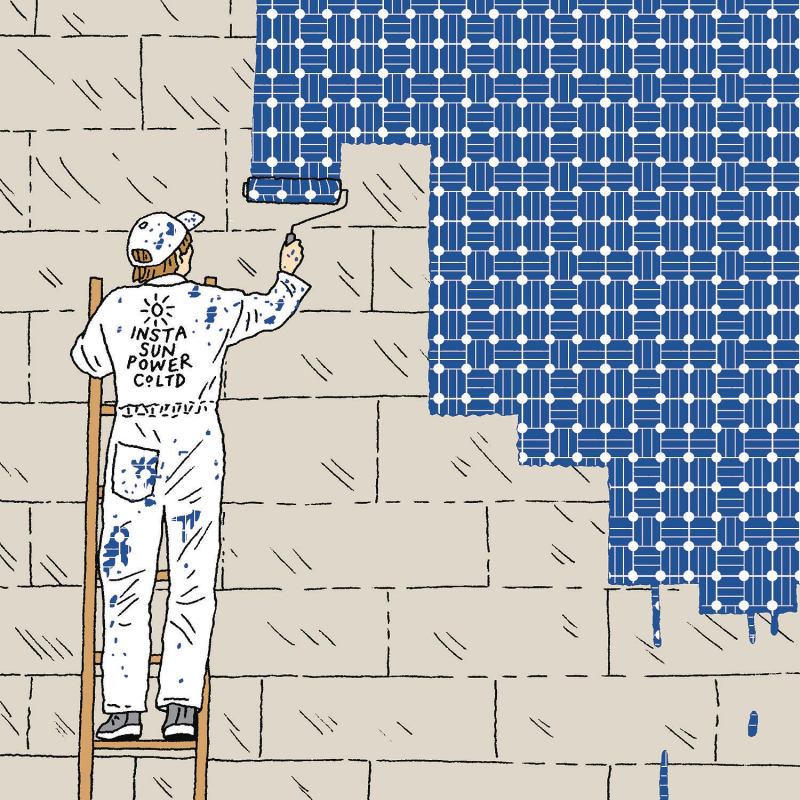
Nanosolar is perfecting a photovoltaic paint—a finish coating that converts sunlight into energy. Already an industry leader in thin-film solar cells, the company now uses microscopic semiconductors to create a paintable PV ink that can be spread like butter on bread. Soon any surface exposed to the sun—on buildings, bridges, even cars—can become a source of energy. By replacing inefficient and costly silicon-based panels—those awkward icons of ’70s-era energy conservation—photovoltaic paint promises to transform cumbersome technology into something literally skin-deep.
“Smart paint” may sound like a contradiction in terms, but it could give designers the freedom to explore sustainability’s effects independent of its forms.