Photo: Ake Lindman, Stockholm
AL070901031L2.jpgCLICK TO VIEW IMAGE GALLERY
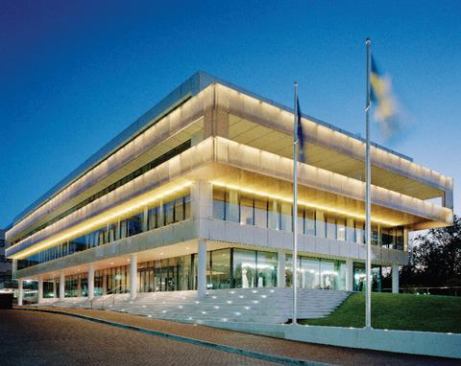
With the recently completed House of Sweden in Washington, D.C., this Nordic nation has created a “home away from home.” Located in Georgetown, on a prime waterfront site overlooking the banks of the Potomac River and bordering Rock Creek, the building celebrates the country’s Scandinavian traditions of environmental awareness and design aesthetics that include a material palette of light, wood, stone, and glass (see image gallery).
A competition-winning design by architects Tomas Hansen and Gert Wingardh, the project is owned by the National Property Board of Sweden, which following a 1960 parliamentary decree, has been responsible for all of the country’s official buildings outside of Sweden. The seven-story structure is sectionally divided into distinct programmatic areas: Public reception spaces on the ground floor; the embassy on levels 2 and 3; a below-grade conference center; corporate apartments on floors 4 and 5; and a rooftop terrace.
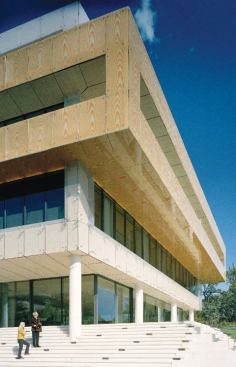
Called upon by the architects and the property board, Stockholm-based lighting design firm Ljusarkitektur had a challenging task before them—to realize an already very clearly defined concept of light as integrated into the architecture and the distinctive wood-patterned glass façade of the building’s upper-level balconies. As project principal Kai Piippo explains, “We had to make their [the architect’s] ideas real.”
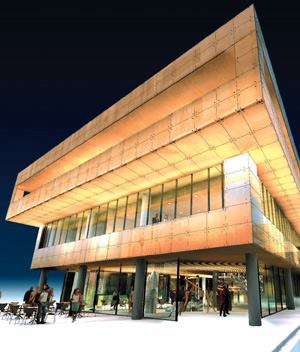
The lighting design starts at the building’s exterior. Taking almost a full year to define how they would create the luminous quality and effects as modeled in the architect’s original rendering of the building at night, the lighting design team embarked on a lengthy full-scale mockup process. The task was to create a building that would glow from the inside, reminiscent of traditional Swedish wood veneer lamps, yet still be clearly visible from a distance. The solution was a T5, 2700K fluorescent fixture, designed with Swedish lighting manufacturer Smedmarks, positioned in the 2nd floor balcony handrails to provide indirect light. Allowing the handrail to function as a reflector, light washes the glass panels and the underside of the balcony above. To illuminate the building’s corners, the designers used inground-recessed fixtures with metal halide lamps. Rounding out the exterior luminaires are downlights along the main entrance ramp and recessed LED fixtures in the entry steps.
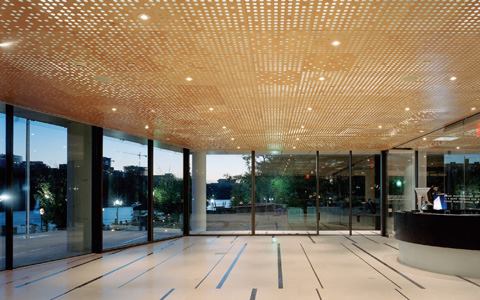
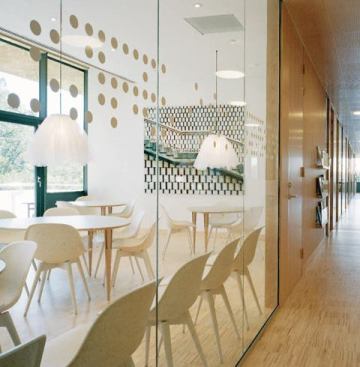
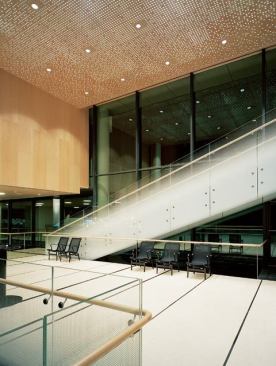
Continuing the idea of glowing light into the building’s interior, the ceiling plane is transformed into a shimmering luminous surface, what the designer’s refer to as the “cloud.” The perforated wooden ceiling, patterned with dimensionally thin holes, densely clustered in the center and randomly extending to the ceiling edges, is backlit with linear fluorescent tubes. A white acoustic fabric backs the wood and acts as a light diffuser. The dappled lighting effect creates a sense of movement across the ceiling and leads the visitor’s eye through the space. As lighting designer and project manager Eva Persson explains, ‘The presence of light is strongly felt without seeing a light fixture.” The “dot” motif, which recalls the early morning mist common to the Swedish natural landscape, is repeated elsewhere in the building, most noticeably as a frit pattern on the interior vertical glass planes of the stairway that leads to the below-grade conference center, and the interior glass walls that separate the embassy entrance from the public reception area.
The House of Sweden deftly marries architecture and light, creating a building that stays rooted in and promotes its cultural heritage. With large glass expanses, nature is drawn into the building’s interiors. Washington, D.C., is not generally known for innovative architecture, but as the House of Sweden proves, the city has an architectural future.
PROJECT: House of Sweden/Swedish Embassy LOCATION: Washington, D.C. CLIENT: The National Property Board, Stockholm ARCHITECT: Wingardh, Stockholm ARCHITECT OF RECORD: VOA Associates, Washington, D.C. LIGHTING DESIGNER: Ljusarkitektur, Stockholm BUILDING COST: $67 million PHOTOGRAPHER: Ake Lindman, Stockholm MANUFACTURERS: Artemide, DeltaLight, Erco, Fagerhult, Lightolier, Lithonia, Lucifer, Luxo, Selux, Smedmarks, Zumtobel