Ron Pollard
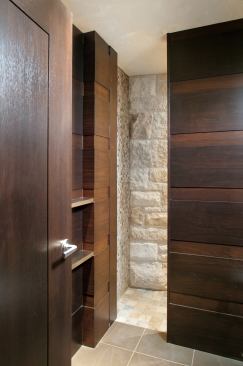
Stone clads this guest bath shower in three forms—large rough-…
A conventionally rugged material like stone doesn’t usually play a lead role in a contemporary palette. But Davis wanted the house to blend into, rather than dominate, the wide-open landscape. So concrete forms with a rough stone veneer slice through the house as both exterior and interior walls. The contrast between their jagged edges and the sheen of other materials is especially prominent in bathroom finishes.
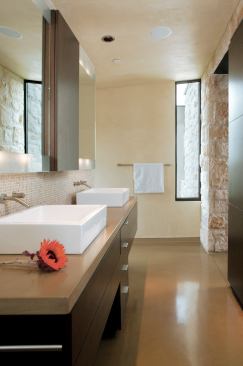
Slick, low-maintenance specs that smoothly shed water dominate the master bath. Polished stained-concrete floors found throughout the house continue into the bathroom. Simple flat doors and drawer fronts make up the millwork pieces. Plaster walls and ceilings come together without the crutch of trim or molding. Even the stone gets reinvented as sleek, small-scale tiles covering the wet walls behind the vanity and shower. Stone also plays off itself in the guest bath, where both rough and refined versions intersect via walls and flooring.
Davis says he selected the glossy finishes to emphasize the stone’s texture, rather than mitigate it. “We really wanted to express the stone as both an interior and exterior material, so we tucked a window up tight against the wall,” he says of the edgy master bath fenestration. Each rock had to be handmilled to receive the window frame and create a tight seal. The tall, slender window lets in abundant natural light, while its positioning preserves bathers’ decorum.