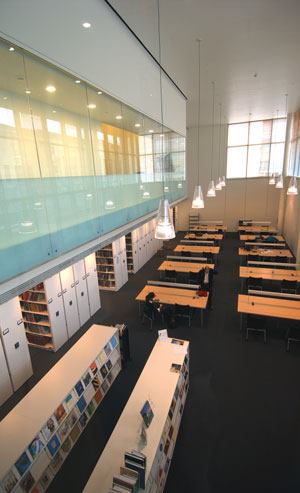
An individual and institutional evolution is taking shape on the campus of Washington University in St. Louis, and the author of that transformation–Pritzker prize-winning architect Fumihiko Maki–is once again at the helm. For the past 46 years the visual arts have occupied three separate buildings on the southwest corner of the campus–the beaux-arts style Givens Hall, home to the school of architecture, its twin Bixby Hall, home to the school of art, and the modernist-inspired Steinberg Hall, Maki’s first commission, anywhere. Maki designed the freestanding building with its signature folded-plate roof, to house the art and architecture library and art museum, while working in the Campus Planning office in 1960. A member of the School of Architecture faculty from 1956 to 1962, it seems only fitting that his architectural touch of geometric forms should once again transform these schools.
The three existing buildings, whose previous physical connection occurred only via enclosed second floor pedestrian bridges, are now joined by two new freestanding structures, and connected by a series of outdoor open spaces. Much in the way Maki’s placement of Steinberg Hall, literally in between Givens and Bixby, knitted the two together and created a physical presence, the new limestone-clad buildings–the Kemper Art Museum located across from Steinberg, and Walker Hall facing Bixby–will increase exhibition and art studio space, and provide a variety of internal and external spaces that foster communication and collaboration between the artistic disciplines. A mature expression of Maki’s interpretation of modernism, these light-filled, flexible floor-planned buildings serve as contemporary counterpoints to the existing structures, and help create an environment more indicative of the visual arts design process in the twenty-first century.
Maki is no stranger to light; it is an inherent part of his understanding of architecture. “Maki is interested in how architecture creates exterior spaces,” explains Alan Kawasaki, principal of Shah Kawasaki, the Oakland-based firm who acted as the architect of record for the project. “He is interested in the connection between things and how light can act as a juncture between space and form.” Angela McDonald, senior principal of Horton Lees Brogden (HLB) Lighting Design’s San Francisco office, the lighting design firm asked to provided technical expertise for the project concurs, “Maki’s office already has a strong opinion about light. There is a high level of integration. Fixtures are not meant as decorative elements or appendages.”
One of the greatest challenges for the design team was balancing electric sources to compliment the abundance of natural light throughout the two new buildings, while respecting the architectural aesthetic. The goal was to create luminous spaces, not to see light fixtures. Color temperature played an important role in helping to achieve this, and the overall palette of fixtures, which rely mostly on T5, T5HO, and T8 linear fluorescent lamps with halogen sources for the galleries, maintains a neutral 3,000K. The use of daylighting techniques and skylights is something Maki’s office is well versed in, and in the case of the Washington University buildings they took the lead specifying the glass assemblies and level of light transmittance. “Maki is an architect who understands how to light,” says Kawasaki. And that makes all the difference in this elegant architectural assembly whose quite touch speaks volumes about its architect and the importance of collaboration.
project: The Sam Fox School of Design & Visual Arts
location: Washington University in St. Louis
design architect: Maki and Associates, Tokyo
architect of record: Shah Kawasaki Architects, Oakland, California
lighting designer: Horton Lees Brogden Lighting Design, San Francisco
MEP engineer: William Tao & Associates, St. Louis
manufacturers: AAL, Bega, Delray, Erco, ETC, Focal Point, Gardco, Hess America, HK Lighting, Hydrel, Lightolier, Lighting Services Inc., Linear Lighting, Litelab, Louis Poulsen, Prudential, and Zumtobel
photographers: as noted