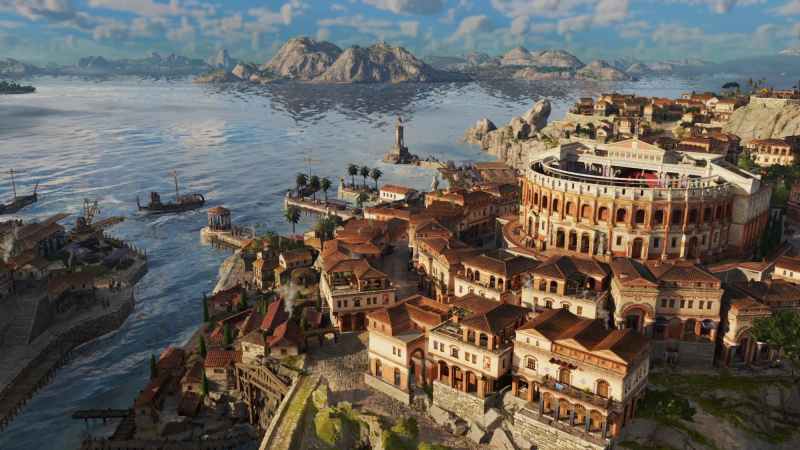
In the newly-released city-building game Anno 117: Pax Romana, players assume the role of a Roman governor, tasked with developing a province through economic management, urban planning, and diplomacy. But for architects and urban designers, the game poses a deeper question: Can a digital simulation accurately reflect the realities of ancient urbanism and the universal laws of city growth?
I sat down with Senior Game Writer Matt Cook and Art Director Reiko Gross to discuss how they balanced historical authenticity with gameplay, and what players can learn about the “metabolism” of cities—past and present.
Blaine Brownell: To begin, I’m curious about how your team approached research on Roman architecture and urban planning. How do you ensure historical accuracy within the narrative structure of the game?
Matt Cook: It is a huge topic for us. The first thing we acknowledge is that our game strives not for strict historical accuracy, but for a kind of underlying truth, authenticity, or atmospheric feeling. It is the writing department’s responsibility to conduct due diligence—consulting experts and mastering the topic—so that we can make confident decisions.
However, we often find it necessary to compromise to achieve a better outcome. Some simulations strictly adhere to Roman construction rules, but those experiences may not be as accessible or engaging. We want players to be able to access the world and, through that enjoyment, absorb the anecdotes and facts we’ve woven into it over time.
BB: Reiko, from an art direction standpoint, what principles guided the layout of the cities? Were there specific ancient cities you used as references?
RG: First, it is essential to note that the player is the one designing the city. We don’t design it for them; instead, we encourage specific approaches to building through game mechanics. For instance, a warehouse needs to be reachable by all the inhabitants to transport goods, so you naturally build higher density around industrial areas. Similarly, a market provides goods within a specific radius, so you are inclined to construct residential clusters around it. The city layout is rooted in game design logic.
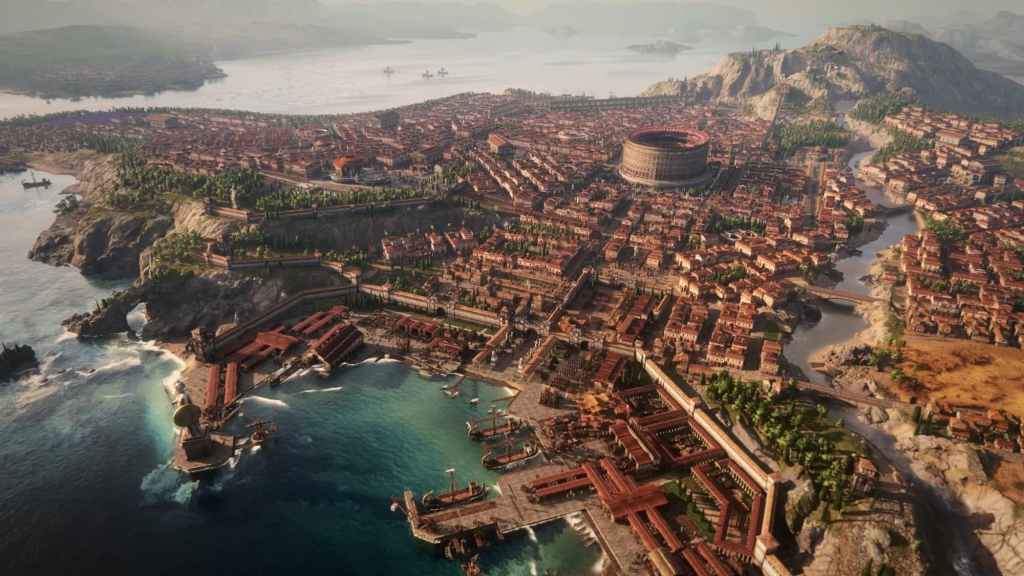
Visually, I like to invite people to close their eyes and imagine a massive Roman city from a bird’s-eye view. Apart from mega-structures like amphitheaters or aqueducts, what you see is a sea of red roofs—imbrex and tegula everywhere. From that height, you don’t have a clue if a building is a smithy or a bakery because they look the same.
We deliberately chose to move away from strictly accurate buildings, treating each structure as we would a character: we made them icons. You need to identify them immediately. If there is a big smoking chimney and glowing elements, it is a metalsmith.
MC: An interesting example of this is the school. In the real world, schooling was primarily done in public spaces; there was often no dedicated building. But we need a named building with that function so players understand it. Reiko’s team effectively “opened” the roof of the school so you can see people inside writing scrolls. Historically, no one would open a roof to let rain ruin their paper, but we do so to communicate function clearly.
The City as a Metabolic System
That leads to my next interest. Beyond the history, games like this teach universal principles of urban development. I’m reminded of Geoffrey West’s book Scale, which describes cities as metabolic entities with predictable patterns of growth. Do you view the game as a platform for learning how cities grow and function as living systems?
MC: Absolutely. The game’s economy, combined with its visual assets, creates rules that serendipitously overlap with real-world building logic. For example, a bakery is vital to the center of a city for wealth generation, but it is also a significant fire hazard. Naturally, the player has to manage that risk.
We also see parallels in how players plan for the future. We know the Romans would build an external perimeter first, leaving space inside for future public works. Advanced players do the same thing—they know the grid size of a future monument and leave that space empty while the city grows around it.
RG: I have thought about this “natural growth” a lot. In Germany, we have cities ending in “furt” (ford), like Frankfurt, which originated as shallow crossing points. These sites began as small shacks and markets out of necessity, eventually growing into major centers.
In our game, growth is often much faster than reality—players can reach 10,000 inhabitants in an hour of gameplay. However, the mechanics eventually take hold. You realize you need fire safety, or you need to manage pollution. Real-world logic “drips in” as the city expands.
Speaking of pollution, while playing the game, I found myself grappling with questions of sustainability. I have limited resources, and I have to decide where to locate polluting industries like coal production. I don’t want them near population centers because their health declines. How much did your team work through these balancing acts?
MC: We spent a long time on that. It is also a narrative and cultural question. In the game’s “Albion” (Britain) province, Roman culture is portrayed as the more industrializing force. In contrast, the local culture is presented as more environmentally friendly—though, in reality, both cultures engaged in deforestation.

RG: Getting that balance right took ages. We examined how pollution spreads—within a circular radius, irrespective of the streets. We realized that for transport, street distance matters most, but for environmental effects such as pollution, a radius may be more appropriate. There was considerable back-and-forth to ensure the “puzzling” aspect of the game remained enjoyable yet logical.
Takeaways for the Digital Governor
What are the main takeaways you hope players come away with after building their own Pax Romana?
RG: I hope that people engage so profoundly that they start questioning the history. We actually had players ask, “Why are all the statues gray? Roman statues were painted!” We knew that, of course, but we went with the prevailing expectation of white marble.
MC: If players request those changes—if they go to Google Maps, look at ruins, or read history books because they want to recreate a city as true to life as possible—then we have done something right.
In this way, I hope the game enriches people’s lives. We want to throw “spanners in the works” of their assumptions. We might include something that sounds fake—like elephants in Britain—and a player might check a source and realize, “Wait, that actually happened!” If the game inspires someone to investigate history further or to understand the logic behind how a city functions, that is a worthwhile experience.
RG: And I just hope they abuse the mechanics to no end. I love seeing the sneaky ways players manipulate our design to build the most efficient cities possible.
What’s Next – Volcanoes and Hubris
It is a fascinating blend of historical immersion and systems thinking. So what is next for both of you? What is in store for the future of the game?
RG: We are working on DLCs (downloadable content). The Volcano is the first one, and you might appreciate it because we have one of the most realistic depictions of volcanoes in video games. I actually read a scientific paper on the subject, which is why I can say that with confidence [laughs]. We are doing many things that games usually don’t do. After the volcano, we will turn to Egypt.
MC: The volcano was my passion in the project. We didn’t quite squeeze it into the initial release, so I am thrilled it is coming now. It allows us to explore interesting themes—specifically, hubris and the excesses of society. It aligns well with the idea of recapitulating history: creating your city under the shadow of the volcano or in the shadow of something that happened in the past.
Thank you both for your time and for your thoughtful contributions to our understanding of history and cities through games.