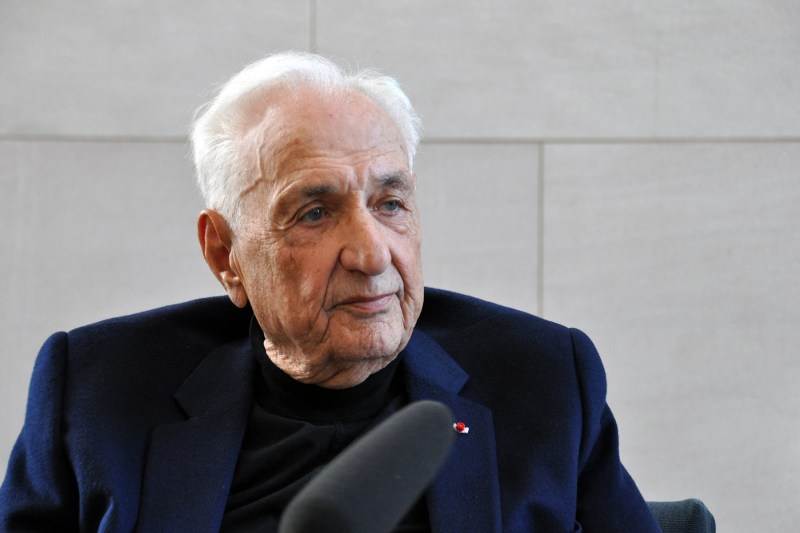
As soon as we rounded the corner and headed down into Bilbao from the airport, everybody in the bus started yelling and hooting. They had caught sight of the Guggenheim. This was not a group of architects, but of art collectors and design aficionados who supported the Department of Architecture and design at the San Francisco Museum of Modern Art, where I was then a curator. We were supposed to go first to the hotel so that everybody could freshen up and change clothes. But they all demanded we go straight to the museum, where they bought their own tickets, before I could even arrange to move up the time on our reservation, and streamed in. They were enrapt, drunk with the sight of the architecture.
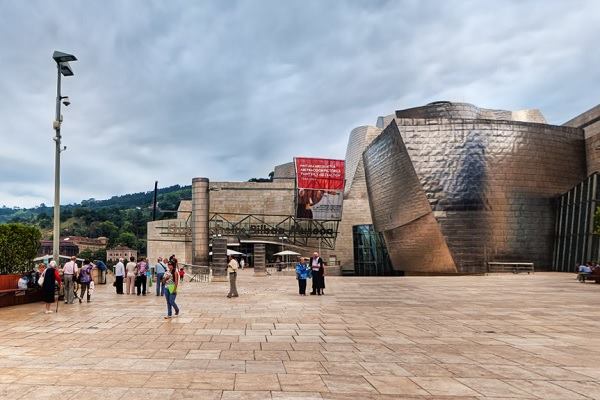
Who could blame them. My husband and I had had the same reaction a little more than a year earlier, when we flew in for a “friends and family” opening of the still not-quite finished building. What made the experience so astonishing was not only the spectacle of the form and spaces, which theBilbao Guggenheim delivered in its soon famous whips, whoops, curlicues, and curves, but the way, first, it drank in its context, from the harbor structures and the bridge under which the architect tucked the longest exhibition wing, to the staid structures on the city site, and second, the care with which the more “normal” galleries provided light and scale for art work. Frank Gehry (1929-2025), who died last week at the age of 96, was not just a maker of great dramatic abilities, but an architect who knew and cared more deeply about the programs that he fulfilled than any other designer I have known.
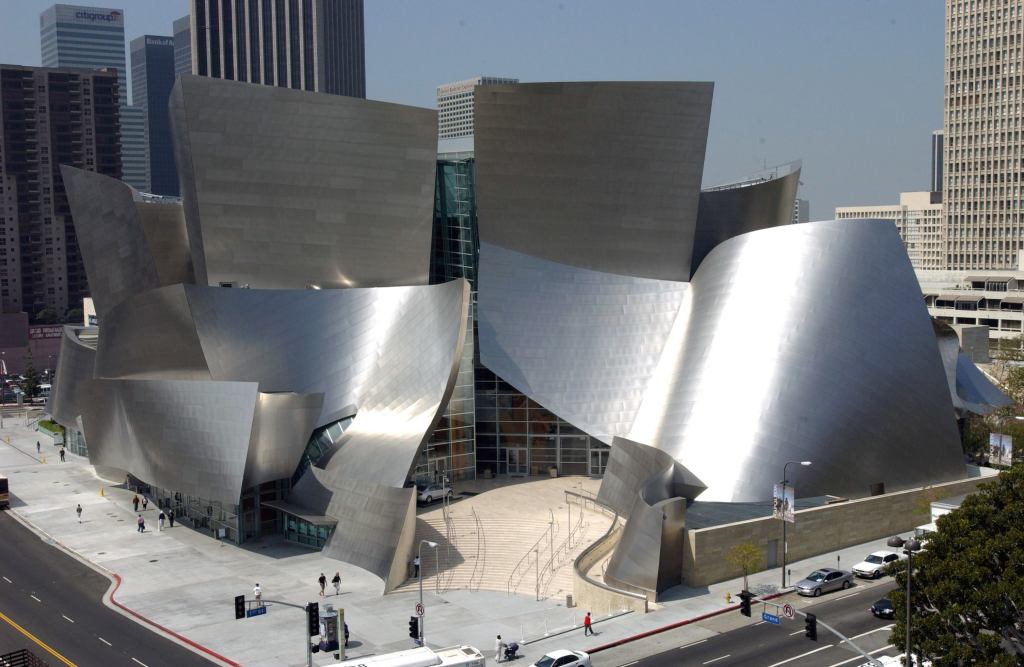
Several years later, Gehry invited me to join him and his wife, Berta, for a performance at the newly finished Disney Hall. We drove there, and the progression up from the underground parking lot into the lobby and then the ship of sound’s interior of a concert hall was already a wondrous tour of unfolding forms, but then I nestled in and the conductor Esa Peka Salonen raised his baton. As the L.A. Philharmonic started up, my mouth dropped open and I was only snapped out of my marvel at the sound’s fullness and clarity by Gehry giggling, poking Berta, and pointing at me.

My appreciation of how good’s Gehry’s architecture is in person had started decades earlier, when I woke up in the house he had designed for his family in Santa Monica after arriving for a party the evening before. I was jolted into reality by his youngest son, Sammy, who is now carrying on his father’s work at the firm, jumping through the stud wall that was all that was left of the original structure’s interior partitions after Gehry had finished opening it up, in his Superman costume and asking me who I was. I gathered myself, mumbled something about being a student, and started wandering through the revelation of structure, form, light, and material that the house presented. I then realized I had become somebody else. I set my sight on working for this architect and, a few years later, moved to L.A. to enter the office.
This was many years before he became famous beyond L.A. and the world of design cognoscenti. It is hard to imagine for me that Frank Gehry was about my age when he designed the Guggenheim. Those of us in architecture had known about him for decades, not only because of his house, but also because of the way he reinvented reuse with the Temporary Contemporary for L.A.’s Museum of Contemporary Art and made a beautiful school out of an assembly of rough and ready buildings for Loyola Law School in the same city.
As I got to know his work better, I realized that even before that he and his associates had produced decades worth of elegantly poised, precisely tuned, and just gorgeous work. Every five years or so, he changed his approach, often including materiality and formal language. He did so both in response to what was happening in the culture around him and to his own development. The latter was often a result of his experience with art. When I first went to work for him, I asked him who his favorite artist was; his answer was that it was the architect turned deconstructor of buildings Gordon Matta-Clark. When I reminded him of that answer a few decades later, he said: “Now I think it is Robert Ryman,” the painter of all-white works of art.
The architecture was, no matter its style or approach, always both astonishing and just right for its time and place, in so many ways that it is hard to remember how much of it was about making good spaces and forms both before and beyond the late flourishes that came after the Guggenheim and Disney Hall. That is not to say there were no misfires. Like all architects who become successful and wind up overseeing practices of hundreds of designers working on dozens of projects around the world, there were a few duds. It also turns out that giving Gehry an unlimited budget and not questioning his choices could lead to less than disciplined structures such as the Louis Vuitton Foundation in Paris or the empty tower at the LUMA Foundation in Arles.
The other limit on Gehry’s greatness was that his process was so personal and the work, especially in the last few decades, so expressive, that it buried its sources, both in terms of context and history, and in terms of collaboration, while it did not lead elsewhere. You had to find the references and intimations of site hidden in the buildings, while in the work of his imitators the architecture is just flash and bang.
Gehry relied on several generations of unsung designers and craftspeople, ranging from the inimitable Greg Walsh, whose chicken scratch drawings teased out more generous proportions and forms from every Gehry sketch, to lead designers such as Edwin Chan. Yet, unlike was the case with architects such as Eero Saarinen, for instance, the office did not produce many designers who were able to continue form that work to create their own mode.
Beyond the quality of the work, which sent me on pilgrimages all over the world as soon as a major work was finished, there was also Frank Gehry the person. As many observers have pointed out in recent days, he was a mensch –the Yiddish word for a good human being. His generosity, warmth, and wit, matched by Berta’s slightly more no-nonsense charm and caring, enveloped the people he cared about. That does not mean he could not be competitive or forgetful –there was the time when the police called him in the middle of the night because a member of the then twenty-odd office team had been caught trying to enter the office after he locked himself out during a late-night charrette and Gehry said he had no idea who he was; we had to pass a hat for bail money the next morning. But he cared deeply and fully about both his friends, family, and associates, and the wider world. He was generous but also wanted to figure out how his architecture could work for the good. One of his last great projects, entirely self-funded, was a comprehensive analysis of the L.A. River, leading to proposals for community projects for the neighborhoods along its banks. He designed (in the restrained manner of which he was always capable) and paid for the first one.
One of the last times I saw Gehry was the day after Christmas a few years ago. I went to the office to find only a skeleton crew there. He was sitting in the middle, futzing with a model for a new music center now under construction across the street from Disney Hall with the help of some designers and his inestimable Chief of Staff, Meaghan Lloyd. Between gossip (at which he was a master) and discussions about both his own architecture and the field in general, he asked me to hand him a piece of cardboard, as if I was still working there. It seemed natural. Here was an architect and a human being, focused on what he cared about most and was better at that anybody else living at the time, in his nineties, pursuing architecture with both passion and sense that it was normal.
In chatting on a mail group with some of my fellow alumni from the office, what comes out most is that there is a strange sense of anger we feel. We can’t believe Gehry is gone, though we knew it was coming, and we are just enraged that this force, this human being, this architect, has somehow been taken from us. Architecture will never be the same.