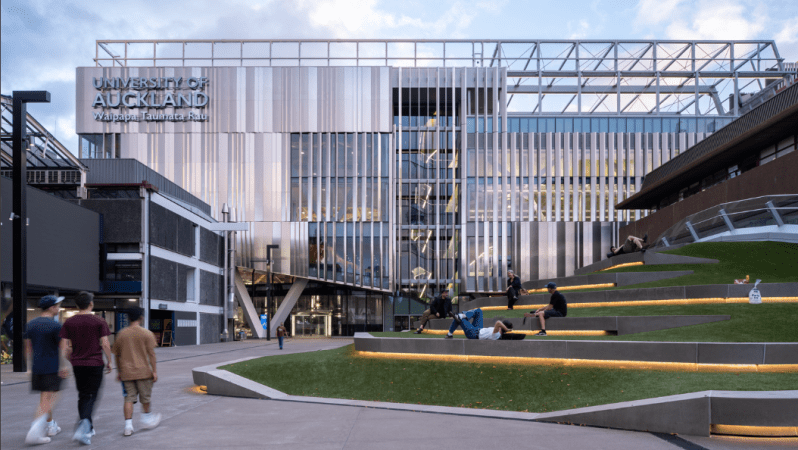
When the University of Auckland set out to replace its aging 1977 recreation complex, the brief was ambitious: put a much larger program on the same constrained urban site, fix serious accessibility issues, and create a new social heart for the city Auckland, New Zealand campus. At the same time, the project needed to reflect Māori worldviews and contemporary student life rather than treat culture as an afterthought. Māori—indigenous to Aotearoa New Zealand—maintain deeply rooted relationships to land, water, and sky, and those relationships became a key design framework rather than a layer of ornament.
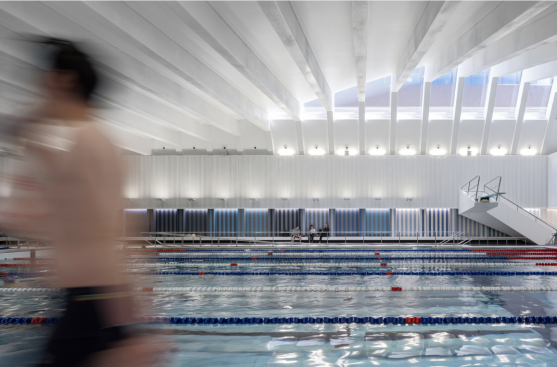
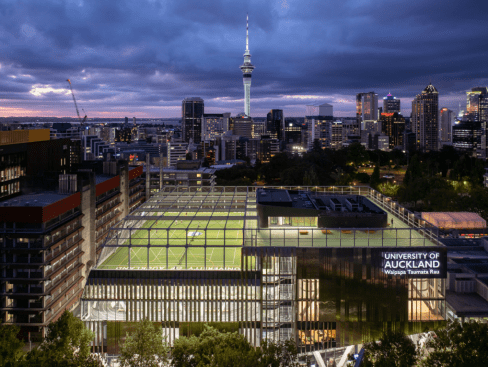
The result is the Hiwa Recreation Centre, an eight-story stacked recreation and wellness building by MJMA Architecture & Design with New Zealand–based Warren and Mahoney and cultural design studio Haumi. Sited on the volcanic topography of Tāmaki Makaurau (Auckland), the project turns a steep, challenging site into a vertical landscape: a loop that begins in a sunken pool hall and culminates on a rooftop track overlooking Rangitoto and the harbor.
Credit: Scott Norsworthy
Split, Stack, Stagger
The former facility occupied an internal block that effectively turned its corner of campus into a dead zone. The new building reverses that dynamic. By sinking the aquatics hall below grade and lifting the bulky dry-sport volumes above, the architects free the ground plane for an open, public plaza with clear through-routes. Students can cross the site, meet friends, or grab coffee without passing a turnstile, making Hiwa as much a campus commons as a recreation center.
To fit on a tight footprint, the team developed a “Split–Stack–Stagger” strategy. The large sports halls and fitness zones are split by a central vertical core, then stacked up the section and staggered to create double-height volumes and social terraces. Each level carries a primary use—event hall, courts, gyms, studios—anchored by generous informal spaces that spill into the circulation zone.
At the top, a stepped rooftop houses a running track and an outdoor turf field carved into the roofscape. Here, sunrise workouts, informal training, and casual hangouts share views out to the harbor and volcanic cones, completing the ascent from below-grade water to open sky.
Credit: Scott Norsworthy
Stairs as Fitness, Landmark, and Lifeline
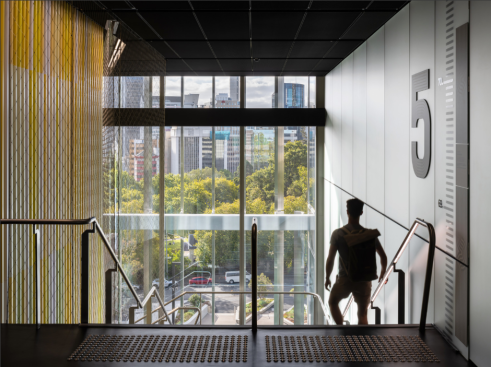
Hiwa’s most visible architectural move is its pair of three-meter-wide staircases that flank the central core. Technically, these are the building’s egress routes. But instead of hiding them as sealed fire stairs, the design keeps them open and daylit.
On the west side, the stair and adjacent lifts support everyday access to fitness levels. On the east, the stair becomes a dedicated fitness loop, giving students an alternative to the elevator and turning vertical movement into part of their workout. The circulation is meant to be legible at a glance: “Good architecture makes wayfinding intuitive, rather than solely relying on signage,” says MJMA partner Ted Watson. In Hiwa, that plays out as stairs that are visible, inviting, and clearly tied to the activity zones they serve.
These stairs also define the building’s identity. Wrapped in a gradient of colored aluminum battens, they track a conceptual journey from grotto to rainforest to volcanic peaks to sky. At night, the glow of movement behind the battens transforms the circulation core into a campus beacon. Operationally, the configuration allows the east stair to be isolated when the 1,500-seat event hall hosts ticketed competitions, while the rest of the building stays open for daily use.
Credit: Scott Norsworthy
Fast and Slow, Performance and Pause
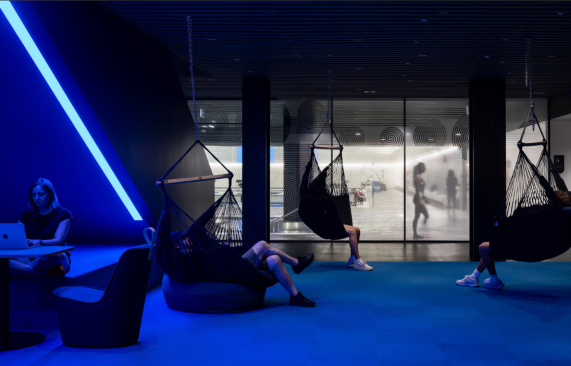
While Hiwa is a nationally significant piece of sport infrastructure, it is equally a wellness and social building. University research in the previous facility documented a strong link between recreation and academic performance, particularly for Māori and Pasifika students. The design balances “fast” and “slow” space. Roughly a third of the floor area is deliberately set aside for non-performance uses: lounges, terraces, study nooks, recovery zones, and informal seating that buffer the more intense courts and studios. Performance spaces are lit and tuned for competition; in between, quieter pockets feature warmer materials and softer acoustics, giving students places to decompress or study between classes.
Hiwa is already logging hundreds of thousands of visits, suggesting that students see it as an everyday destination rather than a specialized facility.
The stairs are proving to be a fun and challenging fitness amenity.
“We do also have users following the full track and appreciating the challenge that the included stair climbs present, but in smaller numbers,” says Sean Smith, associate director – sport and recreation. “We even had the first half-marathon run around the complete vertical circuit loop within weeks of opening.”
Credit: Scott Norsworthy
Stainless Steel, Volcanic Ground
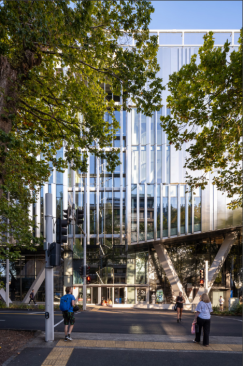
Externally, the building reads as a compact, faceted volume clad in stainless-steel panels and louvers. The reflective skin unifies the stacked mass while dematerializing its bulk, catching the shifting Auckland weather, the canopy of neighboring Albert Park, and the light of passing days. Integrated sunshades and deep reveals bring indirect daylight into large-span spaces—unusual in this typology—while preserving strong visual links to the city and landscape.
Along the street and plaza, a sculpted diagrid and zigzag pattern wrap the ground level, forming a deep overhang and sheltered threshold. This edge is more than structure and shading: it’s part of a “tether” motif that conceptually binds the elevated mass of stacked sports halls to the volcanic ground beneath.
Credit: Scott Norsworthy
Walking Through a Story
Hiwa takes its name from Hiwa-i-te-Rangi, the youngest star in the Matariki cluster and the “wishing star” where hopes for the coming year are placed. That celestial reference anchors a broader Māori cultural framework developed with Haumi and guided by Te Aranga principles, which articulate design strategies rooted in Mana Whenua relationships to land and water.
The cultural work isn’t confined to a single mural or artwork. Instead, it’s embedded in circulation, graphics, and touchpoints. Haumi’s Ao Kotahi (“A Connected World”) framework organizes these layers as a “world within a world” that students move through daily.

Credit: Scott Norsworthy
Three glazing and graphic patterns help define that journey. At the base and social arrival spaces, Ao Tukupū (“World with No Barriers”) uses scaled openings and patterns to frame views to campus and stars. Around the aquatics and more private areas, Ao Korikori (“movement”) creates a fluid gradient of opacity that suggests water while filtering views into napping pods and on-deck showers. Higher up, Ao Riporipro (“vibration”) marks dance studios, fitness rooms, and sports halls with rhythmic patterns that signal energy and motion.
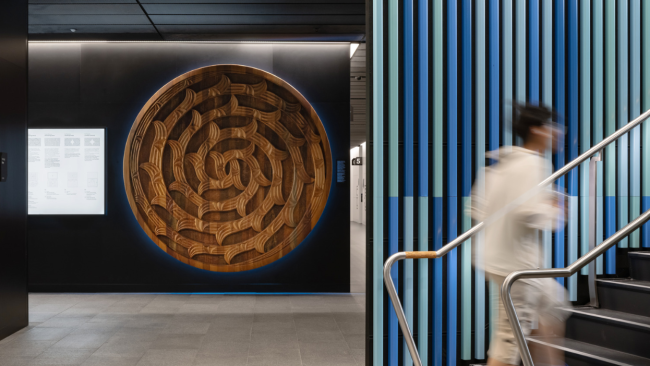
Smaller elements carry this narrative into everyday touch. Instead of standard code-required handrail indicators, carved wood cuffs made from repurposed pōhutukawa—trees removed from the site—are installed at stair landings. Each cuff has a pattern linked to its level’s activity and story, turning a tactile safety device into a cultural encounter. At the front desk and change-area entry, a large Takarangi double-spiral carving in ancient reclaimed swamp kauri marks a moment of arrival and connection.
Haumi’s custom typography for Hiwa appears in level numbers, signs, and even on courts and lockers. The university has since extended this graphic language to uniforms, digital interfaces, and merchandise, indicating how deeply the building’s cultural identity has been adopted.
Credit: Scott Norsworthy
A Model for the Vertical Campus
Hiwa is an efficient answer to a difficult brief: It fits a major recreation and event venue on a steep, tight site; opens up a previously closed campus block; and delivers elite sport infrastructure alongside everyday wellness and social space. But its larger contribution is experiential and social.
“We all know that great buildings transcend their spatial brief to reach for something more—and ultimately Hiwa is not just a sporting facility—it is about creating a welcoming, inclusive environment where students feel connected to each other, and to the wider campus community,” says Blair Johnston, principal at Warren Mahoney.