Water is becoming an increasingly scarce resource, diminishing in both quantity and quality across every continent. Climate volatility, expanding urbanization, and deteriorating infrastructure all exacerbate the problem, and the built environment presents both challenges and opportunities.
Why Hiding Water Infrastructure Is a Problem
Water is essentially rendered invisible in modern society. Pipes hidden within walls channel greywater to sewer systems, downspouts collect and funnel water off rooftops, and street gutters direct stormwater to drains that lead underground. This invisibility is part of the problem, for as long as water remains out of sight, it is out of mind. To change the ways we conserve and engage water, we must bring it into better view.
Designing with Water in Mind
Several recently developed building products and systems demonstrate the promise of this idea, making water cycles evident, engaging, and integral to the user’s experience in the built environment. From bathrooms to building envelopes, these contributions reveal how architecture can expose the flow of this vital resource and develop enhanced environmental awareness. To be most effective, such designs should not merely conserve water but transform our relationship with it.
W+W: Greywater Reuse in the Bathroom
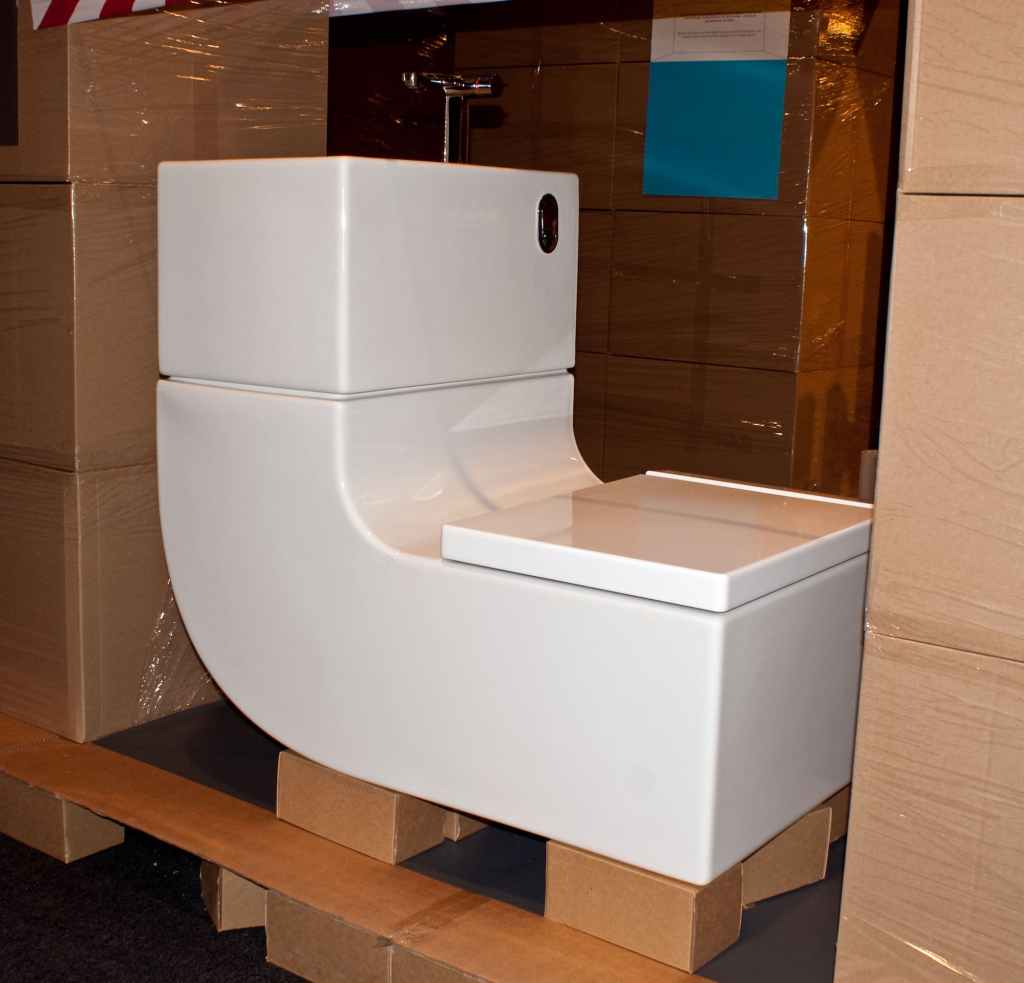
The W+W fixture takes a literal approach to emphasizing connections. Designed by Gabriele and Oscar Buratti in collaboration with Roca Innovation Lab, the eye-catching product joins a sink and a toilet in a single curved, angle-shaped enclosure. The vitreous China enclosure creates a clean, refined, and uniform effect, and its wall-mount installation provides clear floor space.
W+W’s logic is simple and is reflected in its form. Sink water is captured and filtered for reuse in flushing the toilet. The double-filtration system not only screens particulate matter but also eliminates bacteria and odors via chemical treatment. The toilet reservoir holds up to four liters of water, and any excess greywater overflows into the drain. (If the toilet tank is empty, the system will automatically use piped water.) An incorporated Singles Pro-tap cartridge always defaults to cold water to reduce unnecessary hot water use. According to the manufacturer, the W+W reduces water consumption by up to 25 percent compared to a traditional dual-flush toilet. The fixture makes greywater utilization evident and intuitive, inviting user participation in the reuse process.
Drop by Drop: A Plant-Based Water Distiller
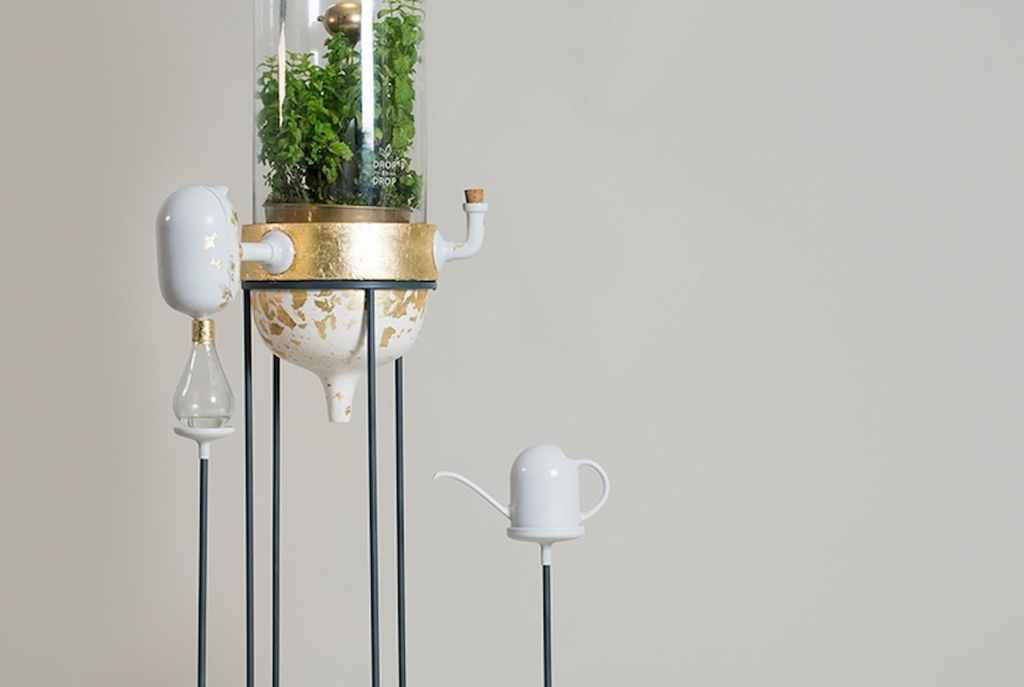
As W+W enhances the bathroom, Drop by Drop occupies the kitchen. Designed by Royal College of Art designer Pratik Ghosh, the indoor water purification system transforms kitchen-based wastewater into potable water. Common houseplants serve as the active purifying agents, occupying a cylindrical glass vitrine like a miniature rainforest. This enclosure includes a grow light that facilitates plant photosynthesis and transpiration. Wastewater poured into the device is taken up by the plant roots, and the plants eventually release this water vapor, which collects on the inside of the glass container. The moisture condenses and collects into another glass container as purified distilled water.
Drop by Drop inspires a daily ritual of water reuse. Greywater from the kitchen and other sources can be added at night, and by morning, the user awakens to pure water in a freshly oxygenated space. In an era of hidden tech and smart appliances, Drop by Drop’s analog approach offers a meditative experience that reconnects users to this fundamental natural cycle
Aquatecture: Water-Harvesting Building Facades
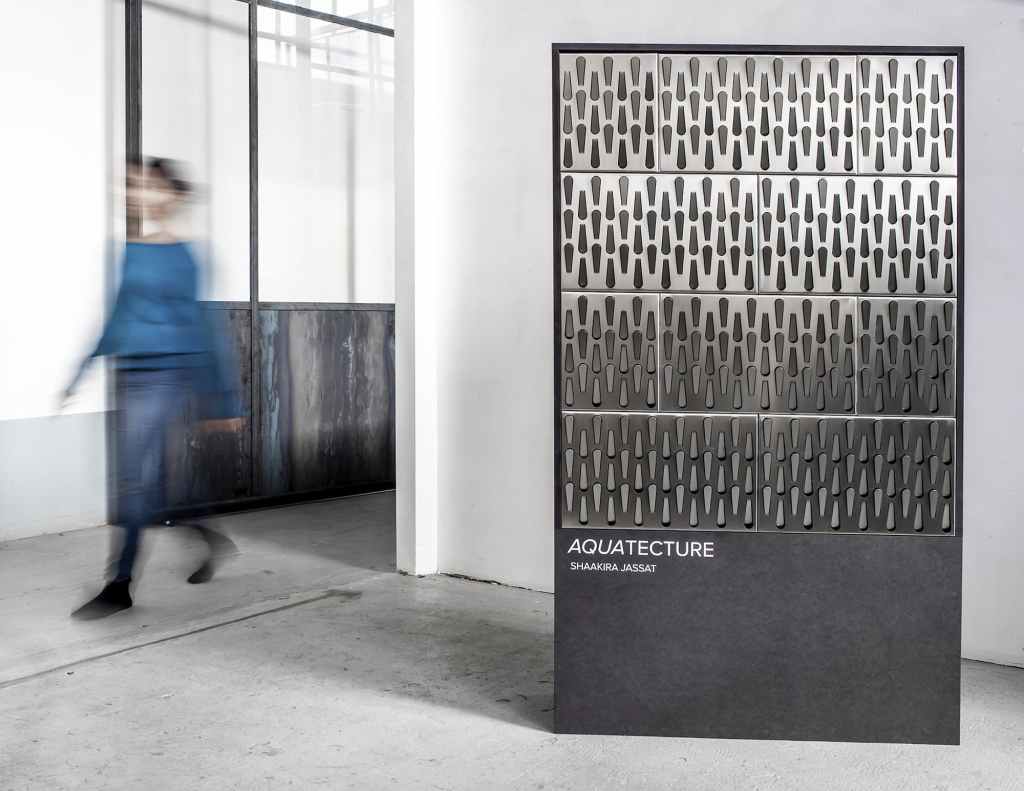
Building envelopes should also contribute to water conservation. Studio Sway’s Aquatecture is an outdoor water capture and reuse solution. The vertical façade panel system captures rainwater and condensation directly on buildings, transforming walls into active water-harvesting surfaces. The sleek stainless steel panels are perforated with lozenge-shaped openings and angled fins that guide water down the surface and into an integrated storage tank. Suitable for facades or as freestanding urban installations, Aquatecture offers a decentralized water solution ideal for dense cities facing space constraints and climate uncertainty.
Unlike traditional hidden systems, Aquatecture makes water collection visible and performative. It localizes sourcing, reduces reliance on vulnerable centralized infrastructure, and eliminates the energy-intensive pumping often required to move water over long distances. As precipitation patterns grow less predictable and infrastructure ages, designs like Aquatecture suggest how buildings can become both consumers and producers of water—engaging users while enhancing urban resilience.
WOTA BOX: A Mobile, Plug-and-Play Water Utility
WOTA BOX is a versatile indoor and outdoor solution for water reuse. Developed by Tokyo-based WOTA Corporation, the portable device enables small-scale, fully autonomous water treatment and recycling. The compact, 0.25 m3 device is a waist-high appliance on wheels, capable of providing continuous filtration and reuse of 98 percent of domestic greywater. The mobile water treatment plant cleans water through six filters, producing soft water for drinking and hygiene. The device incorporates a built-in pump and features a simple, direct plug-and-play interface—users connect a power cord and tubes before powering it up.
WOTA BOX is suitable for emergency response scenarios, providing potable supplies in contexts where running water is unavailable. A portable Outdoor Shower Kit includes a tent that serves as a private changing room. WOTA technology, which has supported post-disaster relief in 23 municipalities and 120 evacuation centers, offers promising applications beyond disaster relief. The ultra-efficient water treatment method is reportedly more cost-effective than water utilities in Northern Europe, and its decentralized format enables off-grid solutions. WOTA also offers a hand-washing device for locations without a water supply, and the company is currently developing a residential system that can recycle an entire household’s water supply.
Toward a Visible Water Future in Architecture
Visible water technologies like these represent an emerging era of decentralized, empowering, and conscious engagement with water resources. In all cases, water is no longer taken for granted, hidden behind walls or within sewers. These innovations recognize the flawed presumption that a centralized utility will reliably and consistently provide potable water and remove wastewater in unlimited quantities—a naive notion that is being undermined by increased water shortages and aging infrastructure.
Reframing Water as a Design Priority
This change has significant implications for architecture. Water should no longer be the sole concern of the plumbing engineer, but a fundamental design driver that invites enhanced collaboration across the entire AEC industry. Water must be treated as a priority architectural design component that is made evident, respected, experiential, and culturally significant.