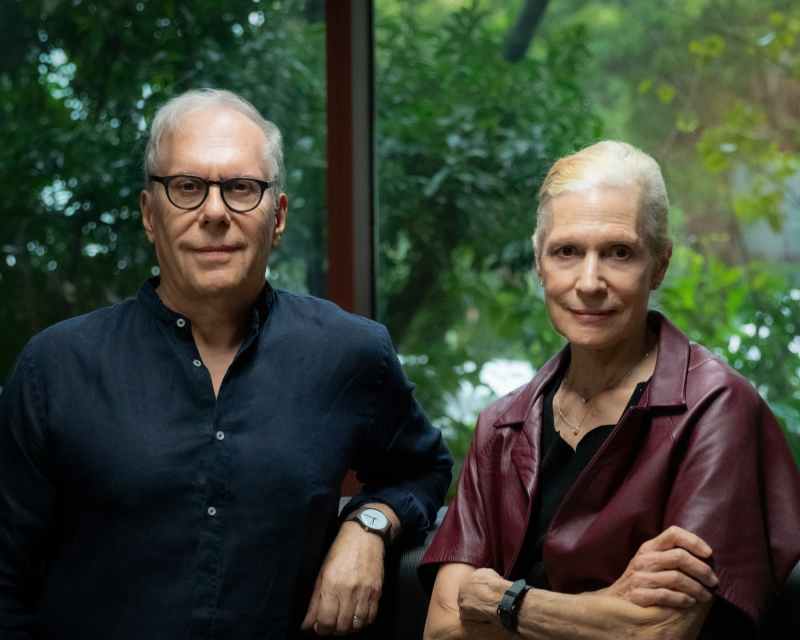
Few architectural partnerships have reshaped a city—and then exported that vision across the globe—with the force and clarity of Bernardo Fort-Brescia and Laurinda Spear. As the co-founders and guiding principals of Arquitectonica, they transformed Miami in the late 1970s and early 1980s from a sleepy resort town into a vibrant laboratory for bold, expressive modernism.
Their early work—defined by fearless geometry, saturated color, and an insistence on the emotional power of architecture—became synonymous with Miami’s cultural and economic renaissance. From that foundation, they built a practice whose influence now spans 59 countries across five continents, supported by 13 mid-sized, globally linked studios that still operate with the intimacy and spirit of a boutique family firm.
In 2025, as Zonda Elevate brings the design and development world to Miami for its annual industry summit, the conference recognizes Fort-Brescia and Spear as Architects of the Year—an honor that feels both inevitable and newly urgent. Arquitectonica’s impact can be traced from Paris to Hong Kong, from Lima to Dubai, from San Francisco to São Paulo, with landmarks such as Microsoft’s European Headquarters, the Bronx Museum, Hong Kong’s Festival Walk, the International Finance Center in Seoul, the Cosmopolitan of Las Vegas, Port Miami’s Virgin Voyages terminal, and the Miami Beach Convention Center redevelopment.
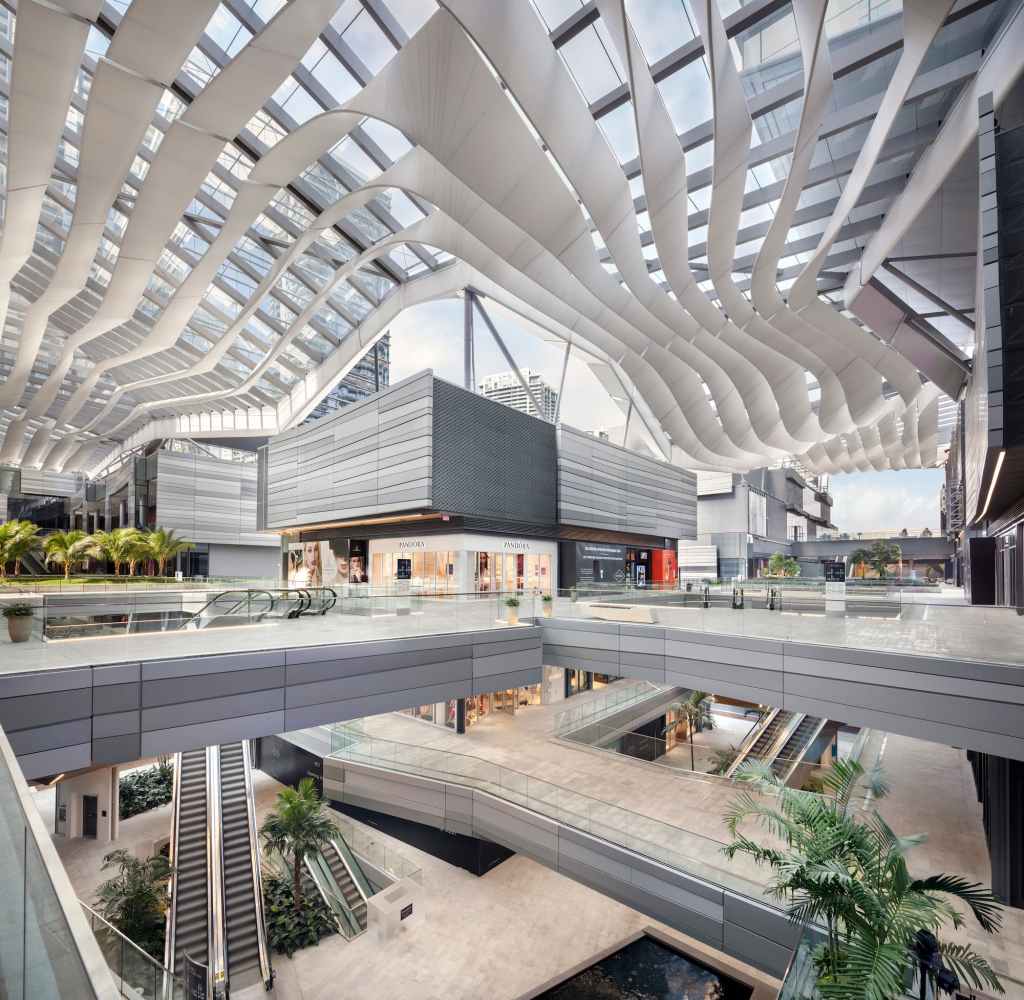
Yet what defines their work is not global reach alone, but a deeply rooted design ethos: a belief that form and function can be expressive and inseparable; that architecture must respond to climate, geography, and culture; and that the integration of landscape and the built environment is not optional, but essential.
Their story began in a recession, in a small Miami studio shared with future New Urbanists Andres Duany and Elizabeth Plater-Zyberk. But the design language Fort-Brescia and Spear forged—part sub-tropical modernism, part geometric surrealism, always grounded in functional intelligence—would propel Miami into the architectural imagination and usher in a new era of humanistic modern design worldwide.
Today, as the city once again sits at the center of global conversations about climate, culture, and reinvention, their legacy feels especially resonant. At Elevate 2025, their recognition is not only a celebration of what they’ve built, but a reminder of how architecture can shape entire regions—and how curiosity, collaboration, and conviction can sustain a practice for nearly five decades.
As Elevate 2025 approaches, Fort-Brescia and Spear sat down with Architect for a wide-ranging conversation about their origins, their process, and the ideas shaping Arquitectonica’s next chapter.
What led to the founding of your firm?
Amidst the worst recession that we have seen to date, it was difficult for architects to find jobs, especially recent graduates. In 1973 we moved to Miami, and I began teaching at the University of Miami and Laurinda was working for the County. Shortly after we got together with a group of like-minded, soon-to-be architects—Andres Duany, Liz Plater Zyberk, and Hervin Romney—and formed a studio. While I enjoyed teaching, we were eager to build something. That informal studio became Arquitectonica. Eventually, as the others found their own paths, Laurinda and I moved the fledging firm forward.
What’s the best way to describe the personality of your practice?
We are essentially a boutique firm. We have 13 mid-size offices around the world that function as one but allow us to get to know each region more closely. We are still a small family firm supported by trusted designers that strives for excellence in everything we do.
How did your early partnership, as architects and as collaborators, shape the aesthetic and ethos that defined Arquitectonica’s rise?
We learned to work together exchanging ideas and philosophies. It was enriching and served us to understand new places, new environments, new clients, and other cultures. Our beginning in Miami helped us define our aesthetic and ethos tremendously. We started in Miami at the very beginning of its cultural and economic renaissance which gave us the opportunity to significantly contribute to design in the city. Our initial buildings in Miami were attempting to create a form that responded to the vibrant, sub-tropical city—a gateway to the Caribbean and South America.
You emerged from Miami at a time when the city was reinventing itself. How did that context—the light, the water, the culture—influence your architectural language?
We happened to be in the proverbial right place at the right time. But also we were lucky to stumble into very enlightened and kind clients. We owe our career to them. Being in a rapidly changing place with an emerging multicultural society was a big part of creating room for exploration. But we also had geography: water, coastal vegetation, sand, coral, and high contrast light year-round.
One of the contributing characteristics is that Miami is a city of the 20th century, so modernity fits its architectural personality. Another factor is that it was rapidly evolving from a resort town to a financial hub and from a pass-through town to a major city, acting as the unofficial capital of all of Latin America. And eventually it blossomed into a place of art and culture. Few places in the world have gone through such a dramatic transformation in such a short time. We drew from that transformation by always looking for the next idea to define that change.
How would you describe your approach to architecture and design?
Frankly, we focus on the project we are designing that day. We don’t look back, and we don’t get ahead of ourselves. Often the public thinks some of our work is perceived as whimsical. But actually, we still follow Sullivan’s motto of ‘form follows function’, or better yet, Frank Lloyd Wright’s ‘form and function are one’—we can be expressive and be functional. We also see the integration of landscape and the built environment as critically important and strive to be judicious about what we do: build smart, plant more.
Which recent projects of yours best illustrates that approach?
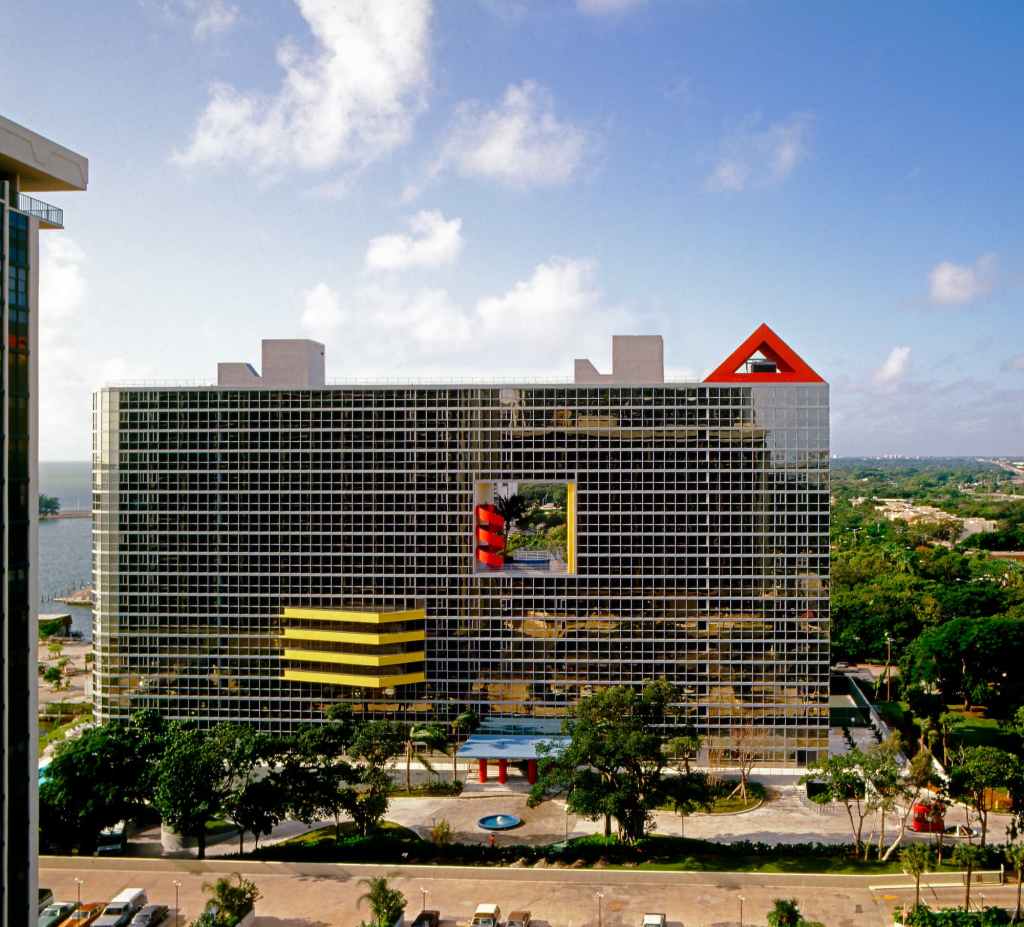
We have always embodied these principals and have approached each project with them in mind since the beginning. In the Atlantis, one of our first projects, we were confronted with a narrow site. We moved away from he long hallway and designed two cores which allowed for cross ventilation for most units. We converted the terraces into brise soleils by adding a grid structure on the façade. The hole we carved out in the middle of the building was as much about form as it was about function.
Because of the southeast winds and hurricanes, the depth of the building made the building vulnerable so we added the void to create a relief. We also added a nautical curve facing the wind to remove vibration while giving direction to the prism and kept the street front urban and orthogonal. Then we referenced the tropical location and incorporated modernist elements with bright colors and elements like the triangular mechanical enclosure, the spiraling access stair to the sky court, and the surprise triangular balconies over the entrance while keeping simplicity on the north side.
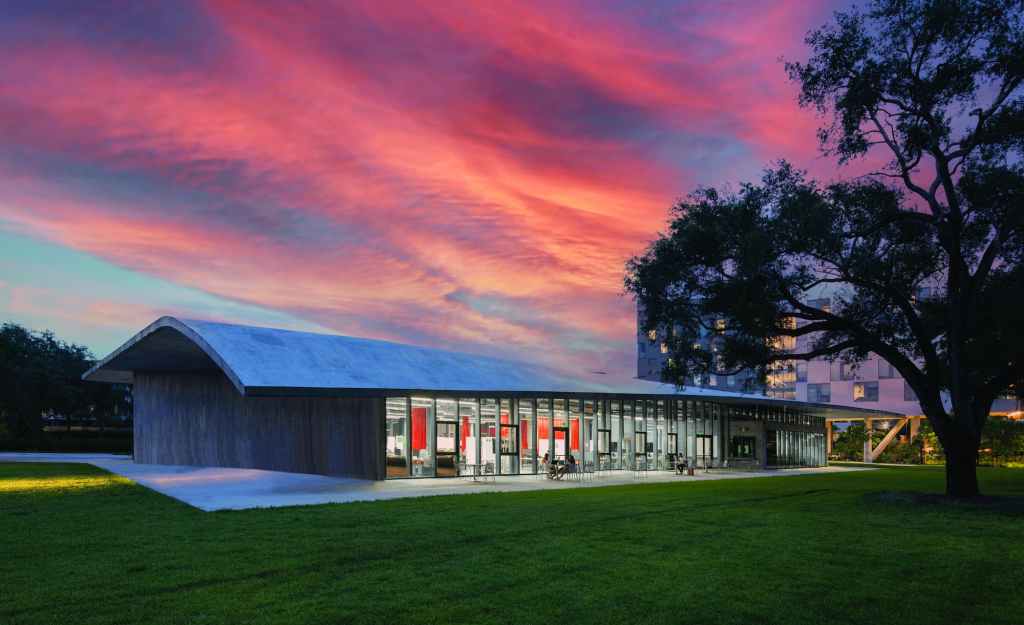
The same principles were used for one of the firm’s latest projects for the University of Miami School of Architecture building, designed by our son, Raymond. All structural and MEP systems are exposed, as much a design choice as a teaching tool. The roof shape is both sculptural and rational as it cantilevers to the south and slopes down to the southwest to block the late afternoon sun. The cantilever creates an outdoor studio and crit space with a cube projecting into it acting as a Cafecito window. The western wall curves to function as an outdoor classroom reflecting sound and the windows are operable to capture the trade winds and cool the space naturally.
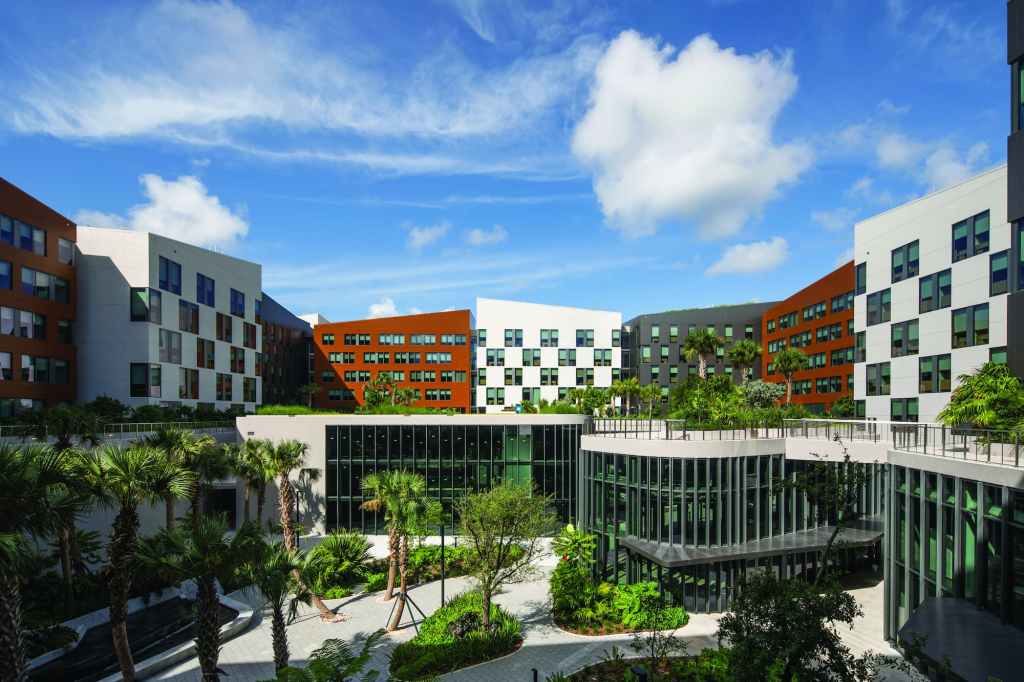
Another project at the University of Miami, Lakeside Village Student Housing, is a perfect example of the integration of landscape and the built environment. The entire ground plane is carefully designed with native plantings and hardscape that encourages gathering, sport, and ecological preservation. By raising the majority of the buildings off the ground plane it allows the landscape to be the main feature drawing people in.
What projects are you most drawn to?
We are most drawn to education and civic projects that serve our communities around the world and any project that aims to respect and seamlessly integrate with the natural environment.
What was your most rewarding collaboration?
Anytime we work together as a family. Integrating landscape design and architecture and having our children work on the project with us.
What’s one building you wish you had done?
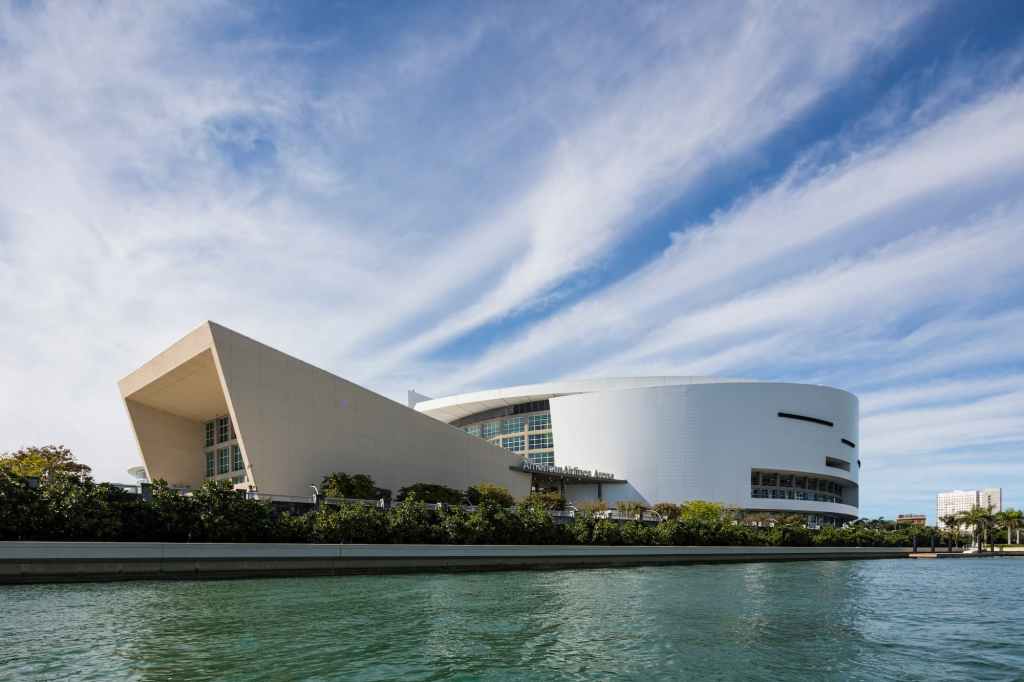
The performing arts center in Downtown Miami, but eventually we got to design the arena down the street which was an amazing opportunity.(Bernardo)
I wish our proposal for the Pink Link, the bay walk in Miami, had materialized. (Laurinda)
What is the greatest challenge facing architects and designers today?
The biggest challenge is construction cost. This is most evident in our quest to build quality workforce housing. It is the most needed, yet the most budget challenged. We do such work and are trying to get creative with new build systems while adding visual stimulation. Another challenge is to find a way to build less and build smart, finding ways to work with our existing building stock.
What is your favorite building?
Niemeyer’s hotel in Brasilia- Brasilia Palace Hotel. A pure structure with nothing wasted—serene and visually stimulating.(Bernardo) Katsura Imperial Villa. (Laurinda)
Which artists do you most admire?
Picasso—he kept evolving, redefining himself throughout his life. He once said his favorite period was his next one. The idea of having a ‘style’ is thrown out the window—this resonates with me.(Bernardo) Kaethe Kollwitz. (Laurinda)
Which book(s) are you currently reading?
Snow Country because it was mentioned in The Emperor of Gladness. (Laurinda)
What do you hope your legacy will be?
That we made some places better through our work and designed with conviction.
Sustainability is an important tenet of you firm’s philosophy. How do you integrate sustainable thinking within a residential development?
We first think of passive design elements where the building components react to the environment. Especially in our tropical projects, we find ways to naturally ventilate spaces and create habitable outdoor spaces that are comfortable year-round. We also strive to implement designs that encourage connection to public transportation and walkability.
You have projects in over 59 countries. How do you do it?(Bernardo)
We love learning about other cultures, visiting other places, and experiencing the natural environment of another location. The beauty that comes from the natural cross fertilization of working in so many places is what drives us. We learn from each project, and even more so when it’s in a new or distinct place. We also hope to leave some knowledge and innovation behind for that community once our project is complete. The exchange of ideas and cultures is fantastic.
Why did you start ArquitectonicaGeo? (Laurinda)
Because I felt we were missing a vital piece of our projects by not carefully considering the landscape component. Becoming a landscape architect and creating ArquitectonicaGEO was the most efficient way to consistently integrate the design of the natural environment into our projects.