The sustainable design movement has encouraged the use of biological metaphors. Inspired by nature, architects and engineers have speculated about how the built environment can function more like natural ecosystems. In the article “Buildings Like Trees, Cities Like Forests,” architect William McDonough and chemist Michael Braungart promote this idea as an antidote to Le Corbusier’s worldview of buildings as machines. Le Corbusier’s technocentric vision characterized most 20th-century building construction. “But what if buildings were alive?” ask the authors. “What if our homes and workplaces were like trees, living organisms participating productively in their surroundings?”
The notion of living buildings is sufficiently captivating that it has become a familiar theme. An example is the Living Future Institute’s Living Building Challenge certification program. But this idea remains metaphorical, as buildings—even sustainable ones—are not literally alive. But what if they were?
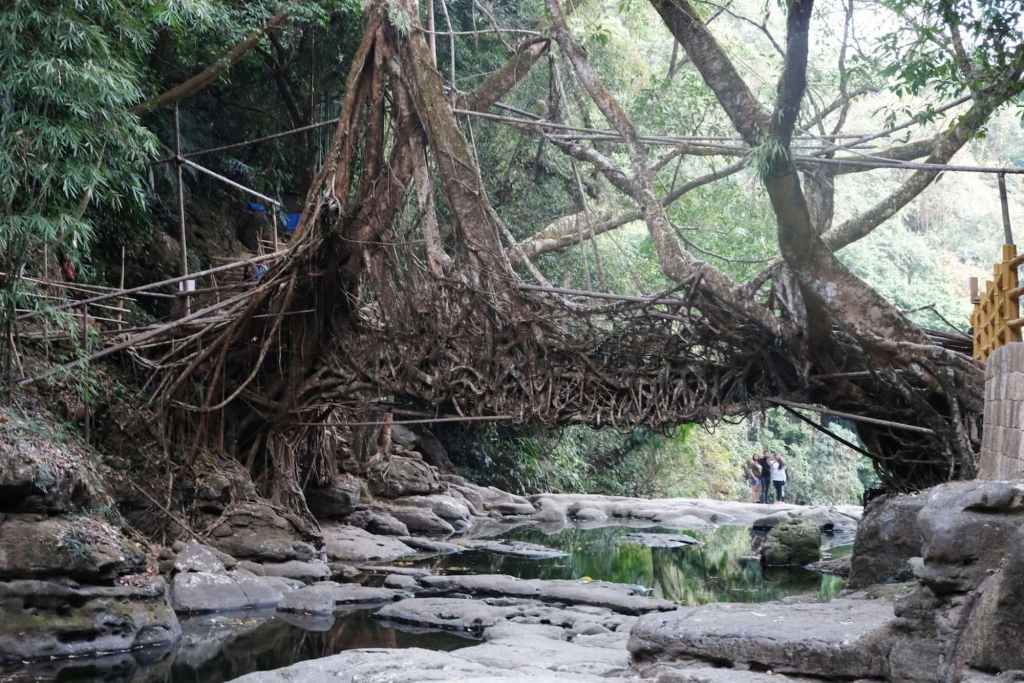
The idea of literal living structures is not new. The indigenous Khasi and Jaintia tribes have long crafted living root bridges in northeast India by directing the aerial roots of rubber fig trees across rivers and streams. The roots become more durable over time, anchoring the surrounding soil while the trees continue absorbing CO2 and providing habitat for multiple species. Other living structure precedents include the Native American bentwood structures formed with living saplings and the tree platforms and bridges constructed by the Korowai people in the forests of Papua New Guinea.
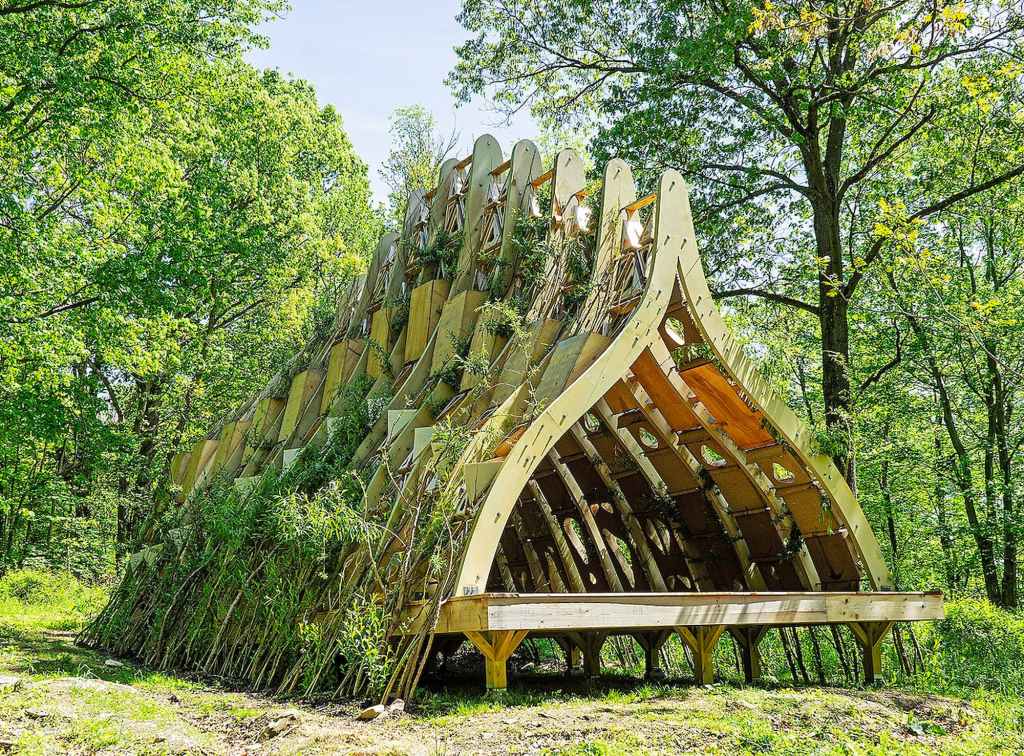
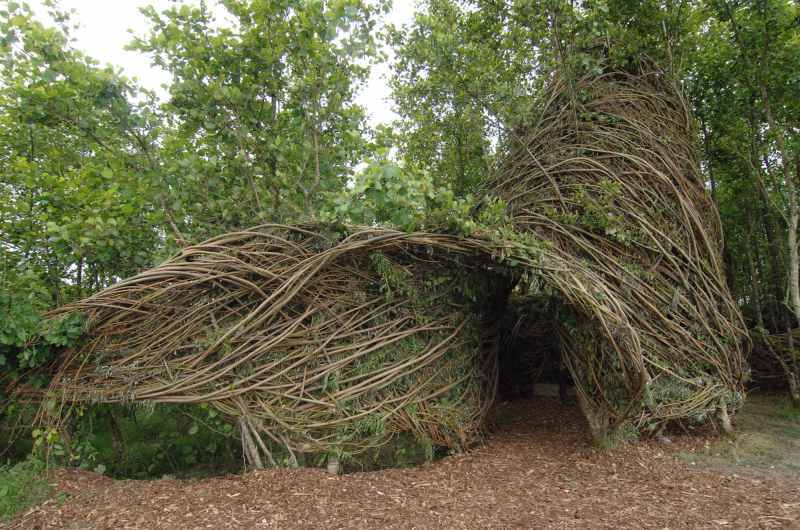
Contemporary land artists and architects have explored the possibilities of working with living media to create shelter. Italian artist Giuliano Mauri “grew” a vegetal cathedral by planting and training beech trees to mimic the columns and vaults of Gothic architecture. Sculptor Patrick Dougherty has constructed various occupiable structures made from tree saplings, including living specimens. Architect Marcel Kalberer crafted the Auerworld Palace in Auerstedt, Germany, using willow trees guided to form a dome shape. Terreform One constructed the Fab Tree Hab in New Windsor, NY, using a CLT scaffold as formwork for grafted trees.
Another design practice has attempted to take living architecture further via coupled structures. The Stuttgart-based Office for Living Architecture (OLA) has developed a construction method called Baubotanik, which joins live trees with inert structural components to create a “plant-technical composite” structure. The approach is inspired by inosculation (branches that grow together into a single entity) and ingrown non-living materials, such as fences, that become subsumed by trees over time. These coupling methods demonstrate how individual elements like branches can be intentionally fused to create more robust and stable structures.
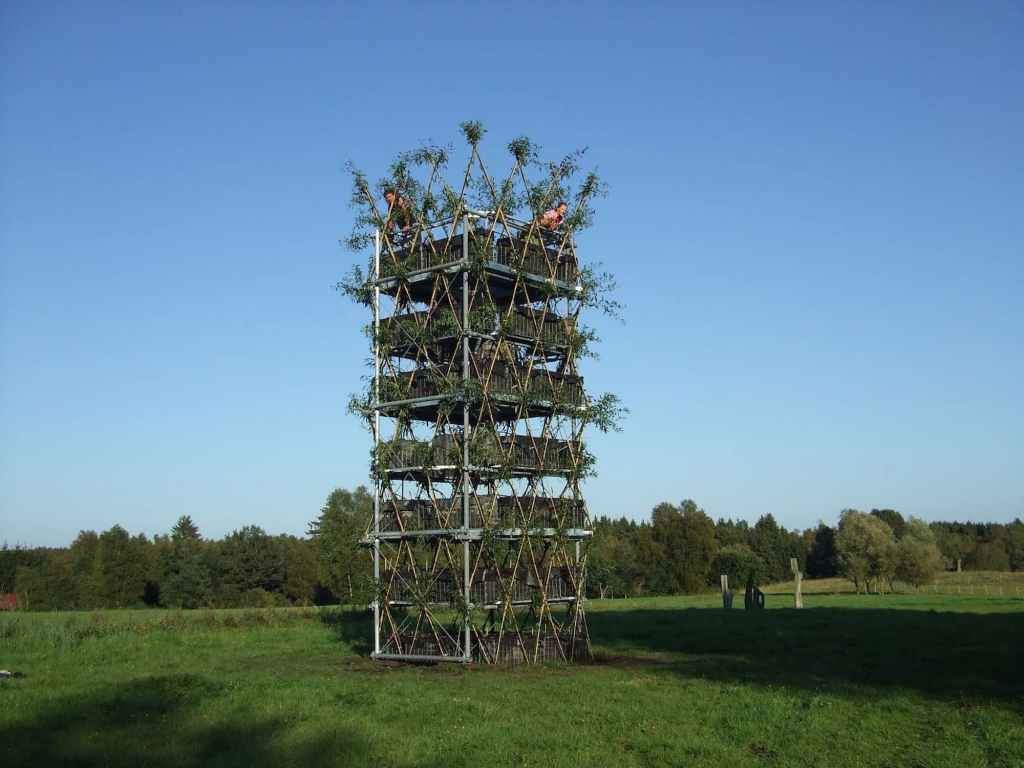
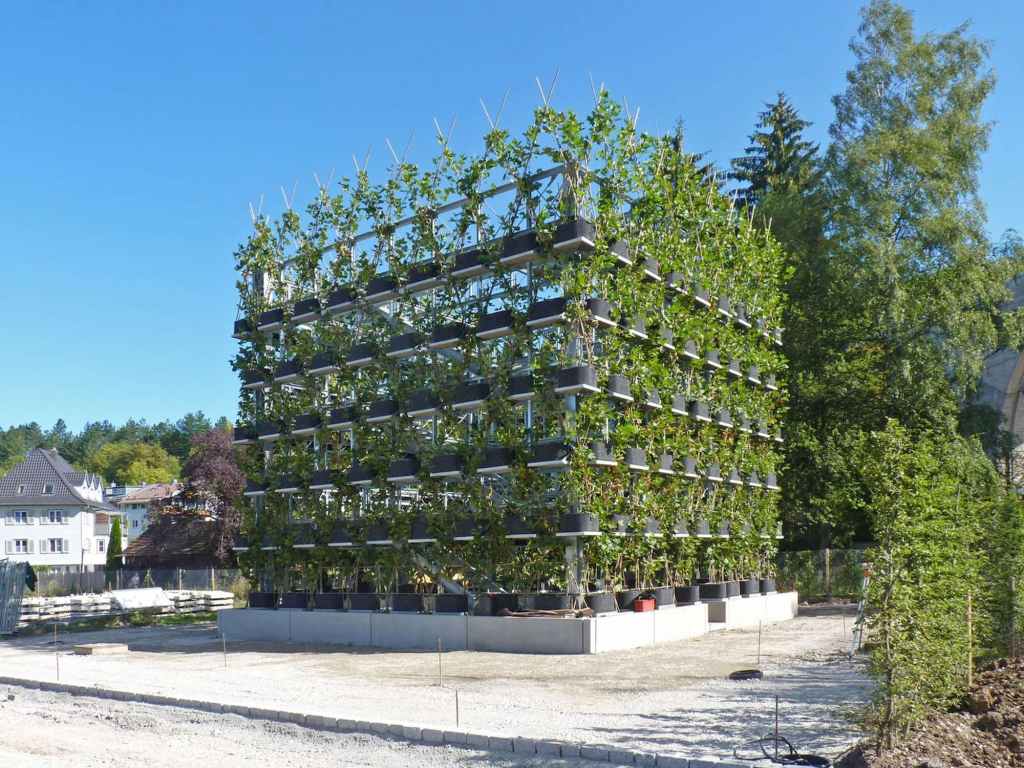
Like Mauri, OLA arrays young plants according to a desired growth pattern—but in this case, the firm also incorporates a three-dimensional scaffold of human-made materials for future bonding with the growing trees. The Plane Tree Cube in Nagold is a 33 x 33 x 33 ft (10 x 10 x 10m) installation that fuses London plane trees with a multi-story steel structure into a living diagrid pattern. Perimeter walkways connected to lightweight trusses are joined with the trees, transferring live loads through their trunks. Temporary steel columns that provided the original support were removed after the inosculation.
Other OLA works include the Baubotanik Tower, a nearly 30 ft (9m) tall structure, and the 72 ft (22m)-long Baubotanik Footbridge, both in Wald-Ruhestetten. The Green Classroom project in the center of Laupheim includes a vegetated roof as well as walls.
Unlike buildings composed of non-living materials, OLA’s experiments with living structures highlight the ever-changing nature of biological systems. “In contrast to technically constructed buildings, Baubotanik structures are in active exchange with their environment,” explain the architects. “They can maintain and repair themselves and change the microclimate of their immediate environment.” This responsive behavior makes site selection and maintenance critical since the local context must continuously offer resources for beneficial growth.
While these works of living architecture are all remarkable constructions, they are intrinsically limited in their practical use as buildings. The realization of a Baubotanik shelter that is entirely protected from the elements and offers thermally conditioned space and essential utilities is not infeasible. Yet, one could argue that the goal of fulfilling the occupancy expectations of typical buildings (e.g., plumbing, air conditioning, a dry interior) is not aligned with the spirit of living architecture, which is much more closely attuned to—and part of—its natural surroundings.
Nevertheless, this trajectory of architecture-meets-horticultural research highlights a promising direction in sustainable design that represents a literal manifestation of a commonly used term. As OLA summarizes: “Baubotanik gives rise to new building typologies that redefine the relationship between nature and technology, between inside and outside, between city and landscape.”