
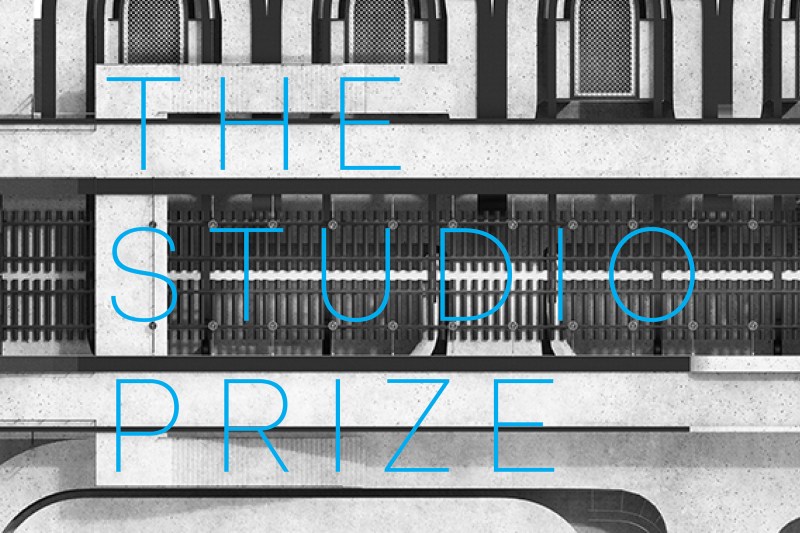
Studio Brief: To address Cairo’s severe traffic gridlock and lack of quality public space, this third-year master’s studio developed tactical designs that could transform the city’s existing transportation infrastructure into urban amenities. Focusing specifically on areas where bridges meet the edge of downtown, the students were tasked with proposing subtle but meaningful interventions to the built environment.
Investigation: Cairo has no shortage of urban challenges. “It’s a city that is completely suffocating because of traffic problems, bad infrastructure planning, no public spaces, no parks,” says Ferda Kolatan, an associate professor at the University of Pennsylvania, School of Design. “The pedestrians are a complete afterthought.” That’s part of the reason Kolatan was asked by the Egyptian Ministry of Culture in Cairo to develop a studio that could come up with solutions.
After talking with local residents, politicians, and planners, the studio decided to focus on three sites where a bridge over the Nile touches down in the city. On a trip to the Egyptian capital, students visited these areas and took photos and videos that they used to create almost-hyperrealistic renderings of the current conditions. These visuals are the basis for their projects—each of which rethinks use and usability.
The goal was to hybridize existing infrastructure with new architectural elements. Uniquely, the studio called on students to present these ideas as decontextualized “objects.” “Rather than suggest specific solutions, we wanted to present prototypes that can be implemented at different scales,” Kolatan says.
The jury cited this approach in awarding the prize: “It’s not just formal exploration, it’s tied to a brief that addresses economy and how different aspects of the city relate to each other,” said juror V. Mitch McEwen.
Student Work:
Pier Gardens
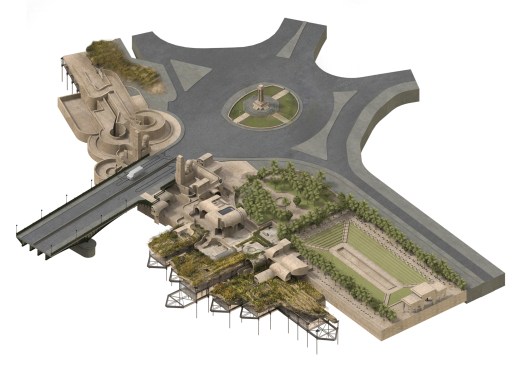
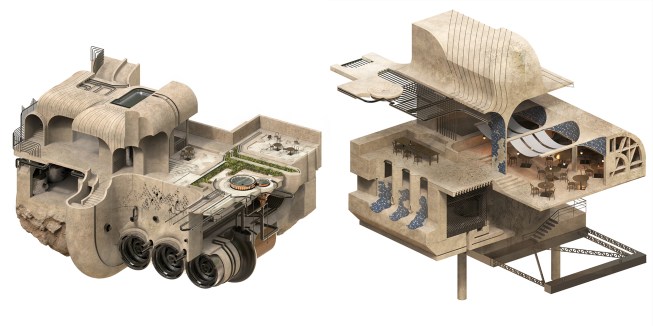
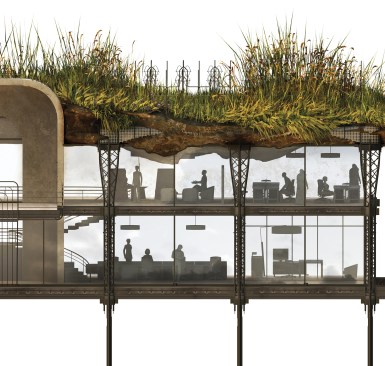
Alexander Tahinos and Angela Huang reimagined the western landing of the Qasr Al Nil Bridge, adding stairs and ramps to open up the existing waterfront promenade, which would be supplemented by cafés and retail (previous page). Decommissioned piers are recast as offices, topped by wild gardens irrigated by turbines in the river. Sited near a classical garden that limits public entry, this garden would be accessible to all residents.
Alexander Tahinos and Angela Huang
Alexander Tahinos and Angela Huang
Alexander Tahinos and Angela Huang
Section through office space

Alexander Tahinos and Angela Huang
Railway Bazaar
This proposal from Angeliki Mavroleon and Rosanne Pitarresi carves out space beneath the Imbaba Bridge that serves as a bazaar, both to add a second use to the railway structure and to provide safe pedestrian access across it, which does not exist today. Skylights bring natural light into a subterranean space, which sits at the point where the bridge meets the bank of the Nile.
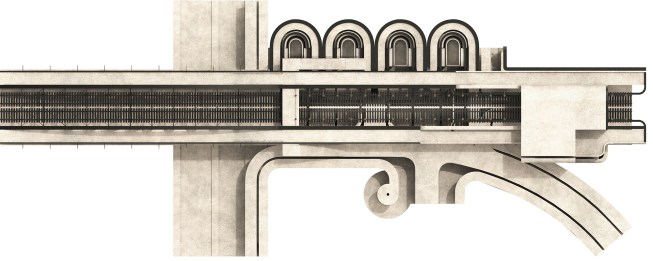
Angeliki Mavroleon and Rosanne Pitarresi
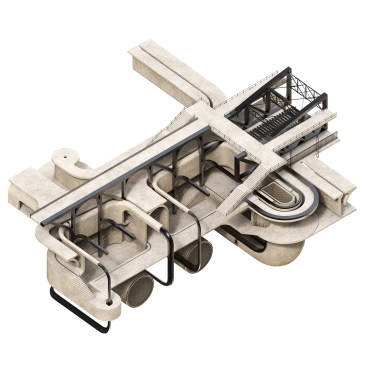
Angeliki Mavroleon and Rosanne Pitarresi
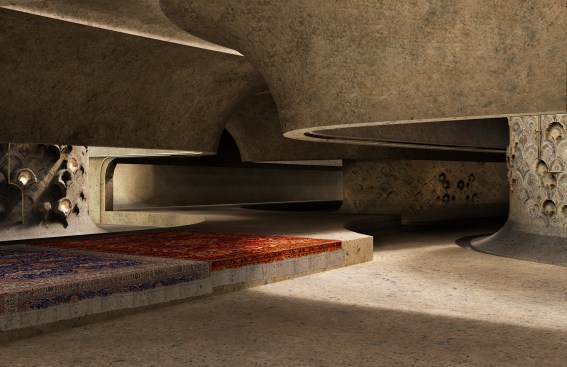
Angeliki Mavroleon and Rosanne Pitarresi
Rendering of skylit bazaar
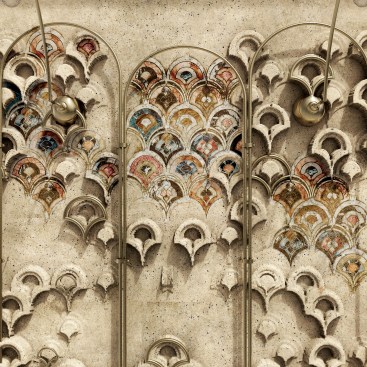
Angeliki Mavroleon and Rosanne Pitarresi
Over-Under Bridge
Meari Kim and Kyuhun Kim’s proposal reconfigures the landing of the 6th of October Bridge, a main vehicular artery into downtown Cairo. Their solar-paneled bus canopy provides shade and helps reorganize chaotic bus lanes; it sits at the base of a new office tower that connects the different levels of traffic and infrastructure, providing safer connections for pedestrians than the current conditions. An empty space under the bridge is converted into a new performance space that makes what is now a chaotic intersection into a cultural destination.
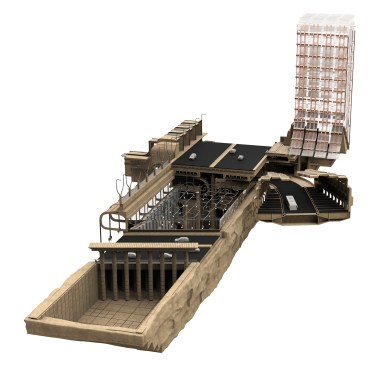
Meari Kim and Kyuhun Kim
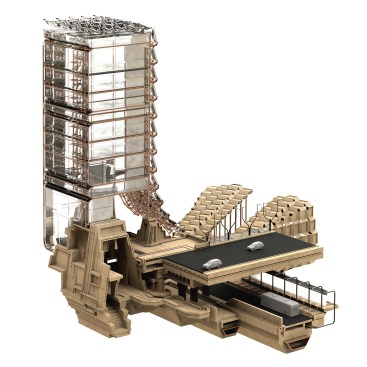
Meari Kim and Kyuhun Kim
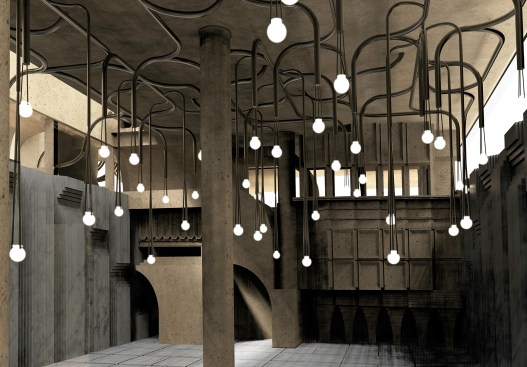
Meari Kim and Kyuhun Kim
Rendering of performance space
Studio Credits
Course: Real Fictions Cairo (Design Research Studio) School: University of Pennsylvania, School of Design
Level: M.Arch., without preprofessional degree (year three) and Master of Science in Design, Advanced Architectural Design, postprofessional degree
Duration: Spring 2017 semester
Instructor: Ferda Kolatan (associate professor of practice, coordinator of design research studies)
Teaching Assistant: Michael Zimmerman
Students: Alexander Tahinos, Angela Huang, Meari Kim, Kyuhun Kim, Angeliki Mavroleon, Rosanne Pitarresi (submitted projects); Aly Abouzeid, John Dade Darby, Carrie Rose Frattali, Angeliki Tzifa, Kaikang Shen, Jianbo Zhong Special Thanks: Eng. Ibrahim Mehlib, Dr. Laila Iskandar, Eng. Mohamed Abu Saeda, Dr. Gihane Zaki, Dr. Haby Hosney, Aly Abouzeid, Ahmed Zaazaa