
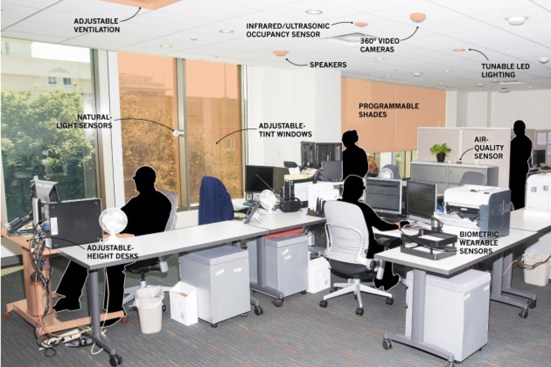
Courtesy Nature
The Well Lab, a collaboration between the Mayo Clinic, in Rochester, Minn., and New York–based design and technology firm Delos, is a chameleon-like 7,534-square-foot space that can be turned into an open office, disparate rooms, or apartments. The lab allows researchers to explore how indoor environments affect an occupant’s physical and mental health, as well as their productivity. Eight Mayo Clinic employees volunteered to take part in the experiment’s inaugural office environment, and so far, have experienced a deluge of disruptive conditions including: a too hot and too cold office climate, the sound of loud computer keys and a ringing phone, on loop, and the change in color temperature of the lights. Scientists observe the inhabitants from a two-way mirror, recording health statistics such as blood pressure and heart rate to determine how stress can be lowered in indoor environments. “We spend 90 percent of our time indoors,” says Brent Bauer, the Well Living Lab’s medical director. “If we don’t optimize that, we’re going to have a hard time optimizing wellness as a whole.” [Nature]
San Francisco–based company Flybrix is selling make-your-own-drone kits assembled with LEGO bricks. The finished product can be controlled through a smartphone app. [Tech Crunch]
Scientists at Berkeley Lab have discovered that using fluorescence (the re-emission of absorbed light) on dark-colored surfaces, such as roofs, can help them stay just as cool as lighter pigments. [Berkeley Lab]
How a trained architect who flunked chemistry classes in college became the CEO of a leading global company in separations technology. [Select Science]
Piscataway, N.J.–based cement and concrete technology company Solidia Technologies has successfully patented three production technologies that lead to better performing concrete than that made from conventional production methods, while simultaneously reducing carbon emissions and water consumption. [Venture Beat]
Using LiDAR technology to detect small changes on a surface or landscape through infrared light, archaeologists have uncovered a hidden city that dates back to the Khmer empire (A.D. 802 to 1431), in Cambodia. [The New York Times]