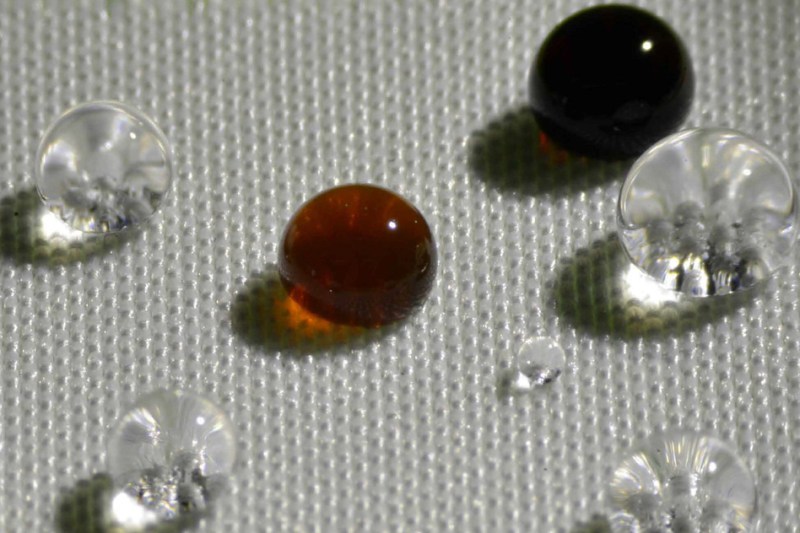
A group of MIT researchers has developed a new waterproofing process that could offer a nontoxic alternative to chemicals commonly used in water-repellent coatings. This coating, according to the MIT, “not only adds water-repellency to natural fabrics such as cotton and silk, but is also more effective than the existing coatings.” The team says that the long-chain polymers currently used as water-repellent solutions accumulate in the environment and in the human body. These chemicals typically include perfluorinated side-chains.
MIT’s coating uses shorter chain polymers that don’t persist in the environment and, according to the team, “confer some hydrophobic properties.” The team has enhanced these properties and used a coating process called “initiated chemical vapor deposition.” Existing waterproofing coatings are typically liquid-based, meaning that the fabric needs to be immersed in the liquid and then dried out. This clogs fabric pores and adds an extra step in the manufacturing process. MIT’s technique instead “produces a very thin, uniform coating that follows the contours of the fibers and does not lead to any clogging of the pores, thus eliminating the need for the second processing stage to reopen the pores.”
According to the team, the new coating remains water resistant after repeated washing and has passed a standard rain test and several abrasion tests. The tests have shown that the coating can repel a variety of liquids, including coffee, ketchup, soy sauce, various acids, and sodium hydroxide, or lye.