

Renovation work is on the rise. For the first time in the two decades during which The American Institute of Architects has collected data on architectural billings, renovation work has overtaken new construction as a percentage of total billings. As Zach Mortice reported recently in Bloomberg, “In 2005, toward the end of a pre-recession building boom, renovations made up approximately one-third of billings. That share has been increasing steadily since 2017, when it was 44.4%, up to 52% this year.”
This growth represents an evolution in how we value our existing built fabric, knowing that emissions avoided today are worth more than reductions promised in the future. While attention often centers on carbon-smart strategies for new construction, we will not build our way to an emission-free built environment; we must reuse existing building stock effectively. Renovating a structure usually has a much lower upfront carbon footprint than building new, because renovations typically reuse the emissions-intensive parts of the building—the foundation, structure, and envelope. Retrofitting an existing building can dramatically reduce its operating emissions.
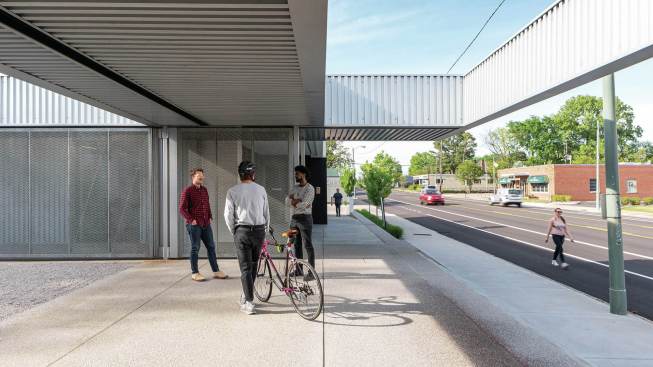
courtesy Archimania
Despite this intuitive knowledge, the building industry has lacked the ability to easily compare the variables of embodied and operating emissions over specific time frames for reuse and new-construction scenarios. This means that the potential avoided emissions associated with reuse are typically unaccounted for in design processes, owner requirements, and climate policies and regulations, representing a major data gap.
The Carbon Avoided Retrofit Estimator Tool is an online tool to help address this gap. The idea for the tool originated when Larry Strain, FAIA, founder of Siegel & Strain Architects, was asked by a building portfolio owner for a resource that could identify the carbon emissions avoided by choosing to reinvest in buildings rather than replace them. With no existing resource to point to, Strain drafted the first version of the estimator.
Now in partnership with Architecture 2030 and Goody Clancy, the CARE Tool empowers owners, developers, and design teams with the ability to quantify the environmental value of reuse decisions. Retrofitting an existing building to zero operating emissions will almost always be the lowest carbon option. But what if you can only reduce its operating emissions by 50%, or plan to replace it with a net-zero-operating-emissions building? And how do geography, grid intensity, and the condition of the existing building affect those considerations?
The CARE Tool estimates the avoided operational and embodied carbon emissions associated with reusing and upgrading a building or replacing it with new construction. Outputs are visualized as total embodied and operational emissions over a specified time frame as well as cumulative emissions over time, for three scenarios: the existing building, the renovated building, and the new construction. Results can be compared to determine the lowest total-carbon approach and the time frame in which that occurs.
The CARE Tool can also be used by policymakers, planners, building owners, developers, heritage building officers, architects, and others who are interested in a pre- or early-design, high-level assessment of the total emissions impact of building reuse versus replacement. With retrofits on the rise and the urgent need for climate action, tools like CARE fill a critical gap in our understanding and valuation of the existing building stock as an important climate asset.
Read more: Architecture has a critical role at COP27. | Sustainable design strategies that work. | Why sustainable practices must extend beyond the building and into the exterior built environment.

