
Project Description
Perkins&Will Completes New Central Hospital in Huzhou, China: Integrating Nature and a Wetland Park
The 242,000-square meter Huzhou Central Hospital breaks through the conventional healthcare design approach in China.
The Chinese city of Huzhou is a two-hour drive from Shanghai. Because of its rapid development, the city’s main downtown hospital, Huzhou Central Hospital, had been struggling to meet the growing medical needs of its city’s residents. Not only did the hospital need to relocate to a much larger site to serve more patients, it needed to transform itself into a more inviting and innovative healing space.
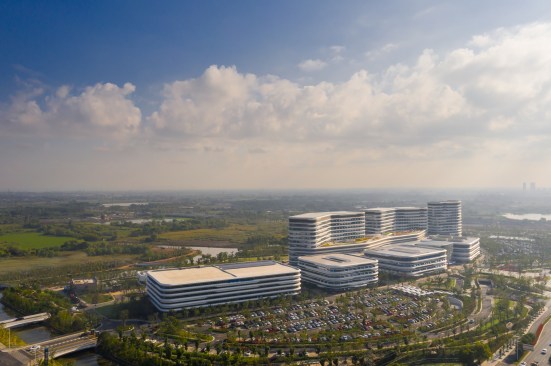
With a total building area of 242,000 square meters, with 90,500 square meters of open green space, the project houses 1,500 patient beds and has an outpatient capacity of 6,000 patients per day.
Challenging the norm
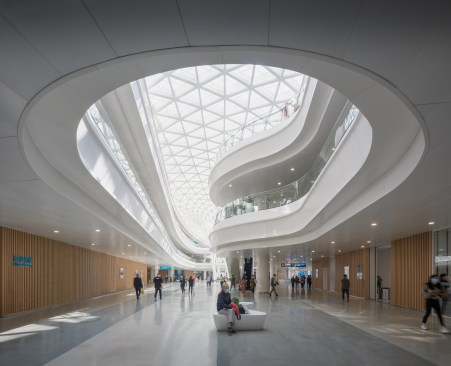
Central atriums and expansive open skylights are design features typically found in commercial retail projects with the purpose of placemaking and activating public gathering spaces. By implementing these strategies, we were able to break through the conventional healthcare design approach in China.
Patient centric focus
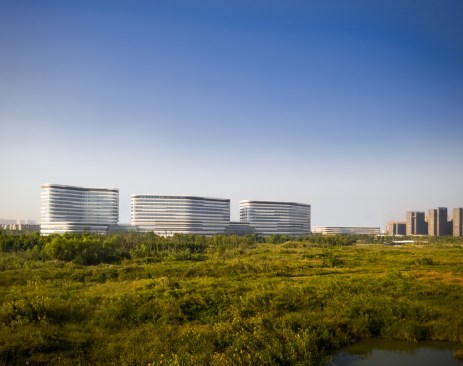
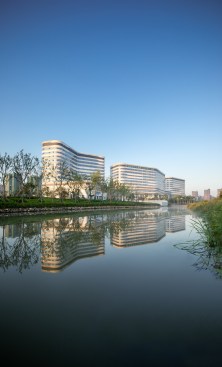
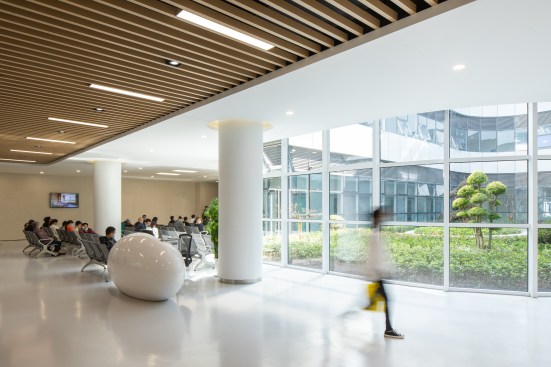
Bordered by natural wetlands, lush landscaping and a gentle river that runs around the perimeter of the site, a pedestrian-only zone was created on the northern end of the site for inpatients and their visitors, providing a calm and peaceful setting for healing and relaxation. At the southern end of the site, a pedestrian-only entry plaza is a car-free zone, where patients taking public transportation can easily enter the hospital without having to cross traffic.
A hospital in the park
In sharp contrast to its former downtown location, the new facility was designed as a “hospital in a park”, featuring lush landscaping and peaceful outdoor areas with the purpose of improving the healing experience. Located on the north end of the site adjacent to the river, the highlight of the landscape design is an extensive waterfront park that seamlessly integrates a multitude of green spaces such as art, yoga and aromatherapy gardens, outdoor physical rehab areas, and a free-standing island park in the middle of the river for even greater calm and privacy.
Inspired by life
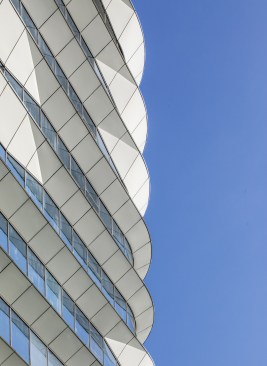
Chromosomes are reflected in the building forms and the fluidity of the surrounding river and landscape design. The orientation of the inpatient towers allows for expansive views to the park and beyond, while the ‘nucleus’ courtyards allow users to access to natural light within the outpatient ‘cells.’
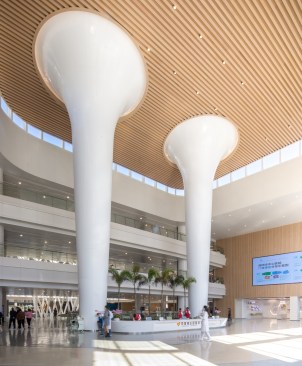
At the center of the hospital, patients are embraced by a four-story glass pavilion which serves as the main entrance to the building. The structure is supported by four inverted bell-shaped columns and acts as a welcoming gesture to all visitors. The clerestory windows and natural wood tones throughout the space further enhance the warm and inviting atmosphere.
In order to simplify the internal circulation, a “medical street” along the east/west axis connects the major medical departments within the hospital. Patients and visitors entering the street are immediately greeted by an impressive four-story tall sculptural “tree”, anchoring the central atrium. It is an uplifting and inspirational icon representing the hospital, as well as the intimate relationship between humans and nature. The canopy structure is seamlessly integrated with the expansive skylight above, flooding the space with natural light.
A focus on wellness and sustainability
The project employs a variety of design strategies with the goal of championing a more sustainable development and patient experience. As part of the nationwide “Sponge City” initiative, the exterior parking areas utilize permeable paving to reduce rainwater runoff and aids in replenishing groundwater resources. Extensive landscaping provides a stronger connection to nature while promoting a healthier environment. Outdoor roof gardens serve to shield the building from excessive heat gain while providing a more visually pleasant roofscape. The facades allow natural sunlight into the building which serve to improve the quality of the interior spaces and to reduce energy usage, while sunshading devices help to minimize excessive direct solar gain. The hospital also employed solar water heating systems to take advantage of sustainable energy sources and cut down energy costs.