

Project Description
Plans for renovations were revealed on Jan. 19, 2016.
FROM THE ARCHITECTS:
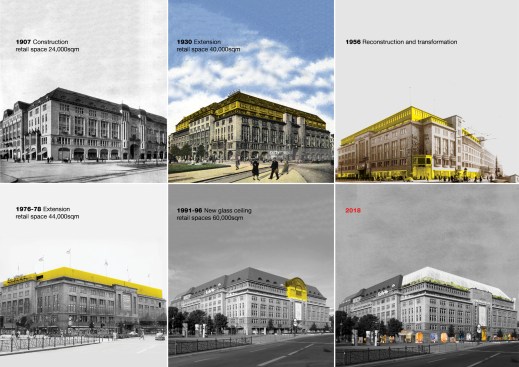
Late 20th century modifications, accelerating global economic shifts and the challenges brought by the digital revolution have turned KaDeWe’s current set up into an obsolete model. There is now a need to investigate an alternative to the established retail model – a model able to redefine the relationship of the department store both with its patrons and with its physical and urban environments.
Our proposal for the transformation of KaDeWe is tactical.
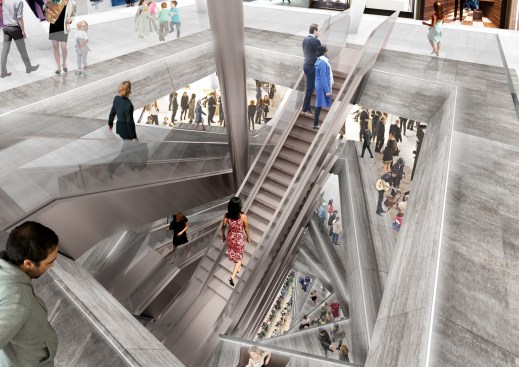
Rather than treating the existing building as a singular mass, the project aims to break it into four quadrants, each one with different architectural and commercial qualities, targeted at different audiences: classic, experimental, young, generic, etc…; four department stores under one single roof, fragmenting the original mass into smaller, easily accessible and navigable components – similar to distinct urban sectors embedded into a unifying city fabric.
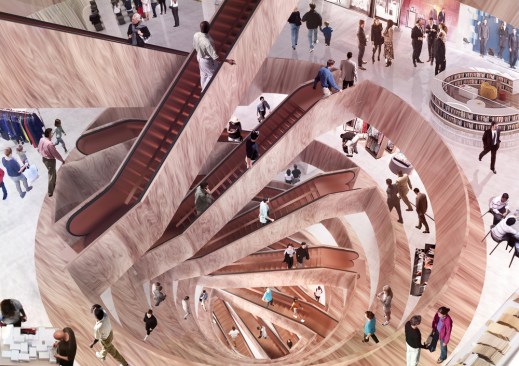
Each quadrant addresses a different street entrance and is organized around its core void acting both as a main central atrium and a primary vertical distribution space. Through a process closer to the one of curating rather than designing, each void is developed specifically to offer four kinds of distinct spatial experiences and four efficient models of organization. Throughout the nine levels of the building the voids transform in size and extension, avoiding any repetition and making every floor unique: they disappear on the ground floor, morph through the commercial areas, and – in one case only – reach the new rooftop.
A cross-shaped organizational system reinforces the presence of quadrants on each commercial floor, regulating the use of the spaces, the general circulation system, the transition between one quadrant and the other, the relationship between brands and curated spaces, while at the same time allowing the injection of unexpected programs, etc…It operates as infrastructure allowing for multiple conditions and uses.
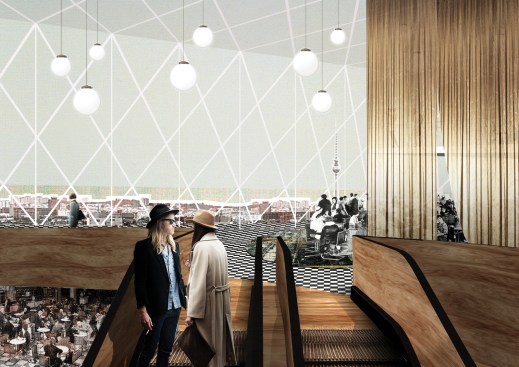
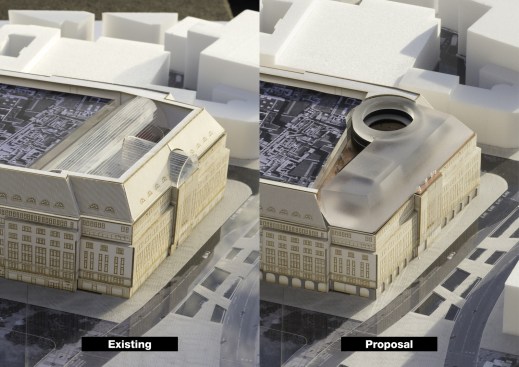
The existing vaulted rooftop restaurant is replaced by a new architecture – a compact glass volume, extending organically from the profile of the existing building. It is directly connected to the interior spaces through the most adventurous of the voids – the circular and concentric. The journey through the void culminates with a final escalator ramp releasing the visitors towards an expansive view of Berlin. Two ad hoc elevators, visible on the façade and acting as attractors, connect the public streets to the new level. The particular configuration of the new rooftop leaves an open air courtyard between the new architectural insert and the rest of the building. The resulting irregularly shaped courtyard provides a space for outdoor programs and unveils simultaneously the most exciting and yet most secret spaces of KaDeWe: its food laboratories…