Walking through the first (one hopes) Chicago Architecture Biennial last week made me realize, more than anything else, the gap between the weight of history and the future’s lightness.
Chicago is, more than almost any American city, present. The clarity of its grid, the region’s focus on downtown through its radial avenues and railroads, the articulation of its major buildings, and the scenography that comes out of those factors conspire to make you feel as if you are absolutely there. Stand at the corner where Michigan Avenue crosses the Chicago River, without a doubt the most beautiful urban moment in this country, and the city surrounds you in all its majesty. I had the pleasure of enjoying lunch with the architect Helmut Jahn, FAIA, in his aerie on the 40th floor in one of the buildings overlooking that corner, and I have rarely felt more metropolitan as the skyscrapers rose around me and the grid reached off into the distance.
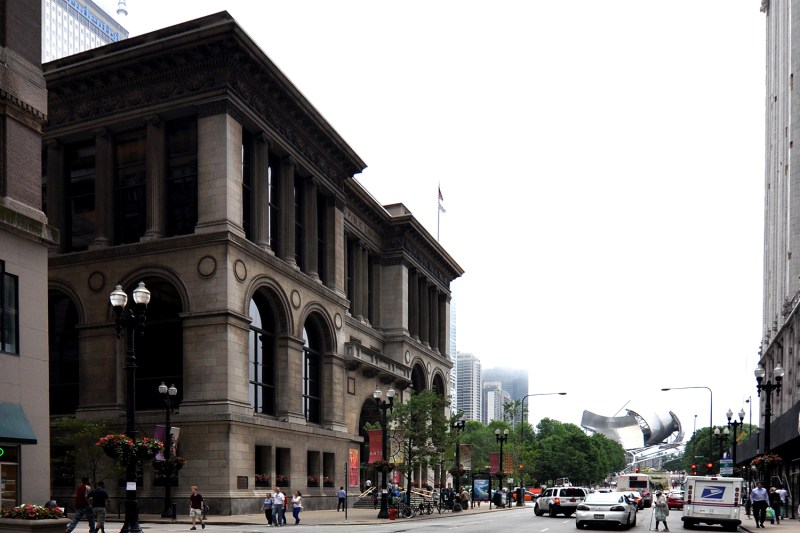
That reality is not a commercial and changeable one, and not always made out of individual masterpieces. Ironically, many of Chicago’s grand monuments, which should embody and preserve the city’s values, are second-rate. From the Art Institute to City Hall (do you even know which building that is?), to the Biennial’s home—the former library now known as the Chicago Cultural Center—mediocre classicized buildings sit awkwardly over railroad lines or squat next to the skyscrapers. Not that modernism produced better contributions: The Museum of Contemporary Art, completed less than twenty years ago, deserves to be torn down right now.
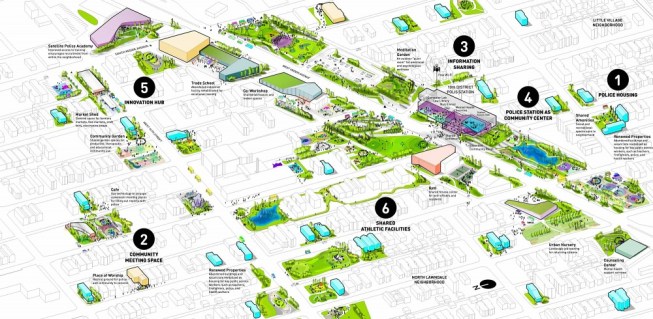
Polis Station proposes that police stations be reoriented toward their communities and become sites of social connection where officers and neighborhood residents can find many opportunities to interact.
The Cultural Center weighed heavily on the Biennial’s exhibitions, which where, more often than not, lighter than air. From Tomás Saraceno’s gossamer spider webs to SelgasCano’s pleasure wheel (in collaboration with Helloeverything), and from Moon Hoon’s fanciful doodling of manga landscapes growing out of what I assume is a Korean landscape to Studio Gang’s earnest re-imagination of police stations dissolving into community facilities spread throughout a neighborhood, the participants mostly provided images of an imagined future that defied the realities of both the present day and hovered rather meekly in the Center’s grand rooms.
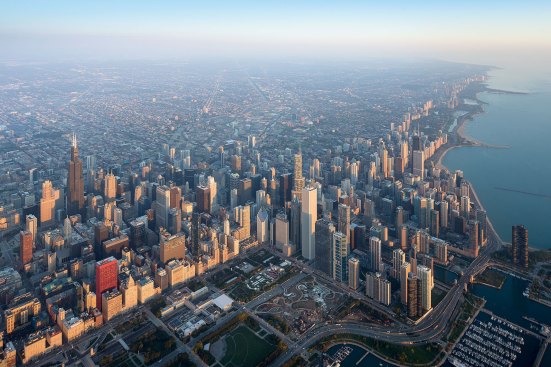
Aerial view of downtown Chicago.
At times, the exhibits were even hard to find: it took me several tries to locate Iwan Baan’s photographs, stuck in a corridor connecting two of the building’s halves.
Ironically, much of these imaginings consisted of collages of the past, with a strong penchant for 1960s and 1970s era utopianism permeating the work, including the proposals for civic in improvements to Chicago the curators collected in another difficult-to-find room in the Center’s core.
This Biennial did not focus on “real” buildings, which is appropriate: Such events work best when they present not postcards from reality, but visions of what could be. But it did produce a space between the real scenes in which it was set and the scenography for an imagined future.
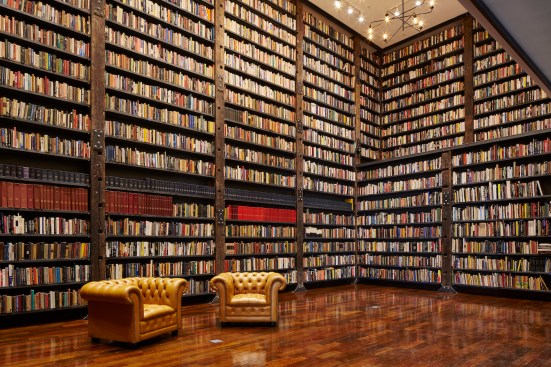
Stony Island Arts Bank
That is why I felt most happy, in the end, a few miles south of downtown, in the area where the artist/designer/activist Theaster Gates has been working. In his new headquarters, the Stony Island Arts Bank, he both carved away at and partially restored a modest bank structure, highlighting its former ambitions and making possible current reuse. A few blocks down, in the Dorchester Street house he had previously renovated, the self-proclaimed Marxist architect Xavier Wrona festooned the stripped-down, but beautifully worked, walls with a manifesto about how architecture could, in fact, change this real world.
The Chicago Architecture Biennial runs through January 3, 2016.