Project Description
Out along the Atlantic coast east of New York City, off the south shore
of Long Island, beyond the reach of the suburbs and the exurbs and not
quite yet at the Hamptons, you can find one of the country’s truly
special places. Fire Island is a collection of a few dozen
settlements—some still little more than camps, some almost now becoming
real towns—dotted out for 30 miles along the pine-covered dunes of the
barrier island. There is no access by car except for the few that crawl
over from time to time along the beach from Robert Moses State Park (his
plan for a highway through the island was never realized), and in most
towns the thoroughfares are no more than graying wooden boardwalks,
along which residents tote their supplies home in little wagons from the
ferry docks.
Not unlike some other East Coast islands—Martha’s Vineyard, for example,
where every one of the little villages has a unique personality—Fire
Island is a collection of very different places: shingly,
family-oriented Saltaire; the almost-hopping, almost-downtown Ocean
Beach; the exclusive Point O’ Woods; honky-tonk Ocean Bay Park. And then
there’s the Pines: The woodsy, beachy getaway that is New York’s gay
capital of summertime leisure-by-the-sea. Elegant by day, devil-may-care
by night.
Fire Island as a whole is a vulnerable place, little more than a sandbar
really, and from time to time hurricanes and winter storms will punch
through the few hundred yards between the ocean and the bay. Because she
made landfall just to the west, last year’s Superstorm Sandy did not
entirely wash away Fire Island, though it did significant damage. But
about a year before, there was another disaster—an off-season fire that
gutted the old Pavilion nightclub that was the beating heart of life in
the Pines, and one of the liveliest spots on the island.
“It could have been a lot worse,” says Matthias Hollwich, partner at New
York firm HWKN and chief designer of the new building that has risen up
from the ashes. “If the wind had been blowing the other way, they could
have lost the whole town.”
When you arrive at the little harbor at the Pines after a half-hour trip
across the Great South Bay, what you see are some houses—surprisingly
modern (many designed by the likes of Horace Gifford, Arthur Erickson,
Harry Bates, and Andrew Geller); some boats (among them on the day I
visited was a 40-foot sloop called, unforgivably, “Untidaled”); one
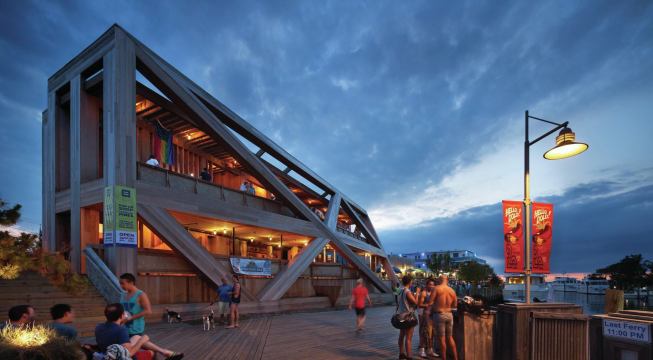
short five-building row of shops and hotels; and at the end of the line,
at the head of the harbor where the ferry docks, the Fire Island Pines
Pavilion.
It’s the heart of the town, with its club and bars and shops, and the
focus of after-hours revelry that starts early on summer weekend nights.
“It had to be iconic as a program,” HWKN’s other founding partner, Marc
Kushner, AIA, says. The fabled “high tea”—a weekly dance party, cousin
to the “low” and “middle” teas held elsewhere down the strip—had for
years taken place on the old Pavilion’s second-story deck, overlooking
the harbor and the town. When it burned, in November 2011, that beloved
ritual was interrupted. There was enormous pressure to bring the
building right back. And to bring it back right. And that meant a lot of
very interested parties—including the owners of each of the Pines’ 700
homes.
“It’s a very difficult assignment, in a way,” says developer Matthew
Blesso, one of the property’s owners and operators, about the marching
orders he gave his architects. “There’s no program for: How do you
design a gay nightclub at a seasonal gay beach community? It’s not like
you can look elsewhere and see how it has been done. The Pines is not
Mykonos. It’s not South Beach.”
The community took the result of the fire as an opportunity to rethink
the commercial strip, engaging Diller Scofidio + Renfro to design a
master plan. The new Pavilion, which opened in time for this summer
season, is a lynchpin, and looking at the structure that HWKN raised at
the end of the harbor, there is no doubt that it is pure Pines: elegant,
bold, and a little rough around the edges.
The takeaway from the community’s commentary, heard directly at several
public meetings, Hollwich says, was that the previous building—a typical
clapboard seaside shack—was “too neutral, too generic.” The residents
wanted the new building to be “supercharged,” he says. Music to the
ears, no doubt, of an architect at an emergent New York firm (designers
of the epically successful spiky blue folly named “Wendy,” the 2012
installment of the MoMA/P.S.1’s Young Architects Program) who spent four
years working in Rotterdam at OMA.
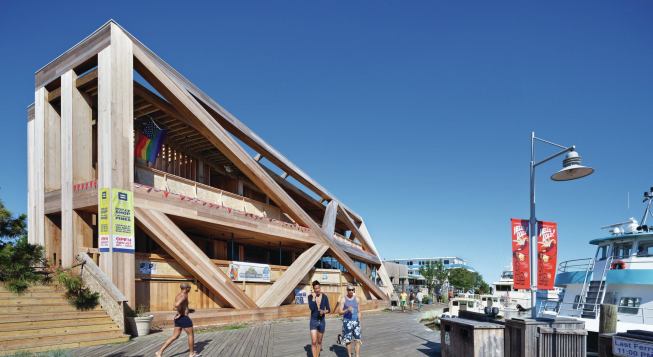
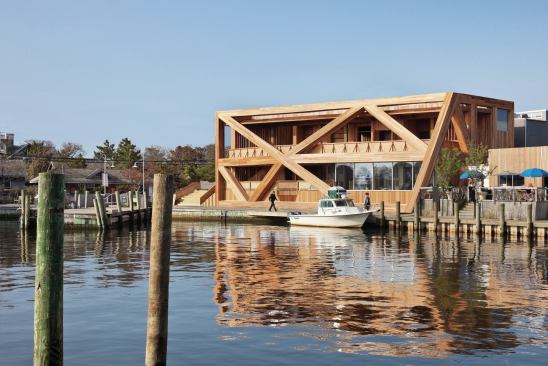
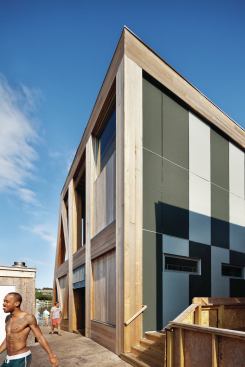
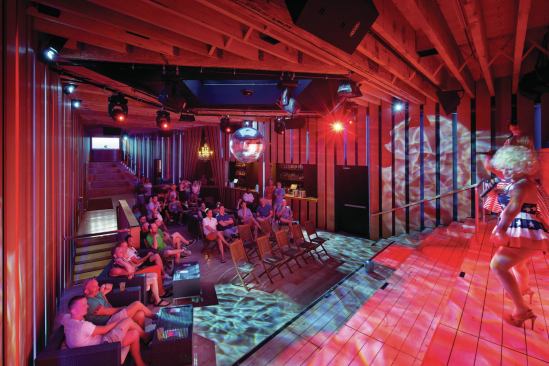
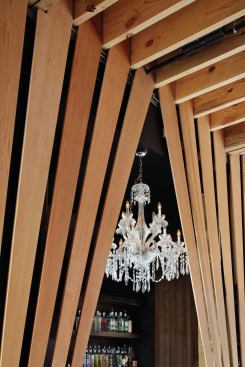
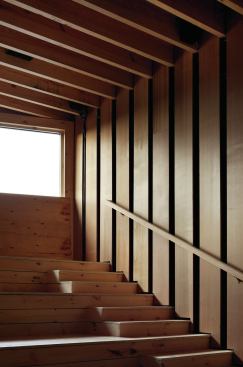
And there is something of Rem in the Pavilion, an attitude toward the
frank disposition of materials—in this case, cedar, everywhere—that,
like the spaces at OMA’s Illinois Institute of Technology (IIT) Student
Center in Chicago, still manages to border on the effete. And then
there’s the countervailing bold gesture, as in the train tube at IIT. In
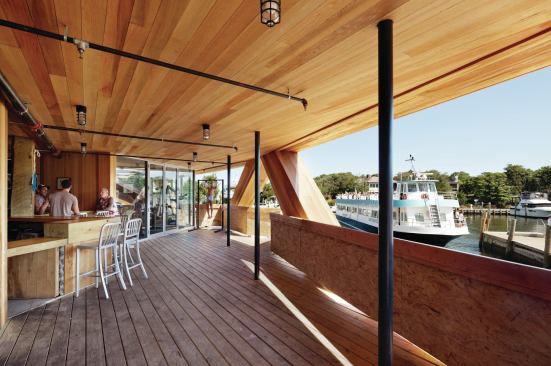
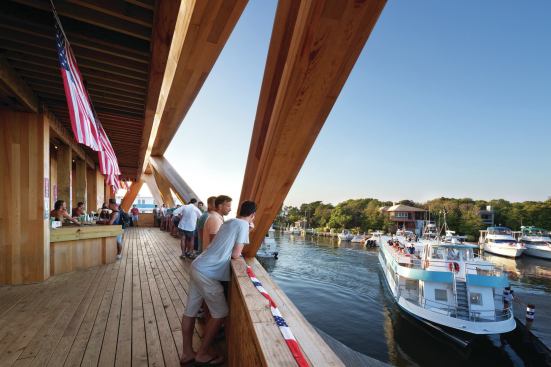
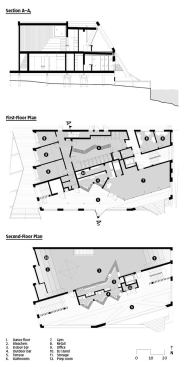
the Pavilion, this takes the form of an exaggerated,
not-quite-structural trestle across the front of the simply supported,
two-story structure. The Parallam beams are dexterously exposed
throughout, as are the cedar joists (on only 15-inch centers to better
fit the controlling dimensions). And the beautiful railings
rendered—temporarily, alas, until the steel subcontractor delivers that
final touch—in OSB, God’s very own favorite sheet material, of course,
but not quite the thing for a building left out to weather by the sea.
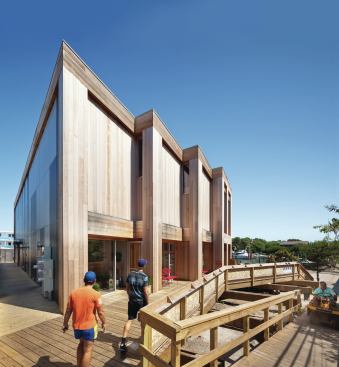
And the building is already weathering, as planned, toward the stone
gray that will fit it even better into the ocean-beaten context of the
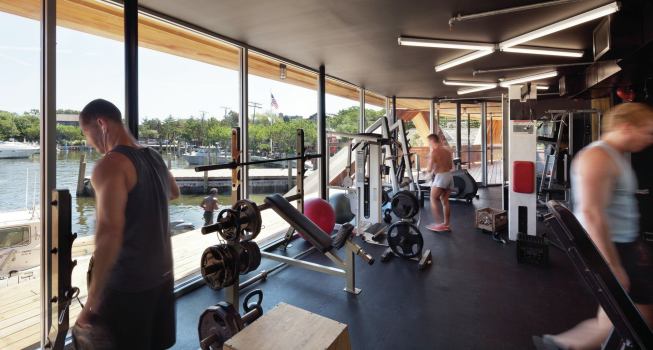
town. The building is well thought-out for its purpose, from the clever
steps and walkways leading from the board-paved plaza where the ferry
lands, to some of the most elegant public bathrooms imaginable
(gender-non-specific and cheekily free of mirrors), all the way up to
the operable skylight in the top-floor dance hall that makes it a very
pleasant place to be, even during the day. The building works. But it is
the delicate disposition of its almost-brutal materiality, that bold
new face for the Pines, that makes it a true success: It gives Fire
Islanders once again a proper place to dance away the night. The feel of
the building, its elegance, its boldness, and its roughness, more than
any single decision or detail, is what makes it so right.
“Historically, you have a group of men who have two lives,” Blesso
explains. “Life in the city, then life in the Pines. There’s a freedom
for people to really be themselves in a way maybe they can’t be
elsewhere. It’s a place where people can really express themselves—and
you see that architecturally as well. It’s normal there to go over the
top a little and be a little flamboyant. But at the same time it’s a
really casual place.
“We needed architecture that really embodied both of those things: It
needed to be warm, but also strong. And I think the design is very
masculine. Which is fitting.” —Philip Nobel