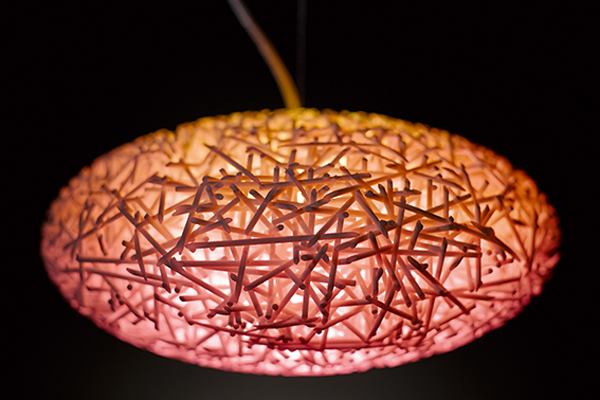
Three-dimensional printing is among a burgeoning suite of manufacturing technology that’s bringing a greater level of complexity to product design. For lighting, its proliferation in research labs and design studios is yielding new products ranging from luminaires to optics.
In March, Philips released two decorative luminaires that combine a 3D-printed form with the integrated controls of its Hue platform. German studio WertelOberfell collaborated on Entity, a table lamp and pendant that feature repeated circular perforations, while Danish Studio Strand + Hvass designed Tempest (above), a table lamp with a bird’s-nest like shade of 3,000-plus white plastic sticks. “This was translated into a complex design, only possible when 3D printing is combined with Philips Hue,” said Christina Strand of Strand + Hvass.
Other examples of 3D printing for decorative luminaires include a series of 6W LED lamps whose A19 form factor is, quite literally, a break from convention (Bullet Meet Bulb, below). From Swedish design studio Gässling, Breaking Bulbs replicates a lamp’s initial cracks and bursts upon impact in white nylon. “I wanted to challenge myself [to] create [an] object [that] would not be possible to produce using traditional manufacturing methods,” said Gässling founder Joakim Christofferss.
The technology isn’t limited to the superficial qualities of design objects. Optics also are getting a boost in efficiency thanks to 3D printing. Dutch firm Luxexcel, which prototypes and manufactures optical components, uses UV-curable ink to print smooth and transparent optics for LEDs. Ink droplets are distributed atop a transparent substrate such as PMMA or polycarbonate, with each droplet flowing into the next, eliminating the stacked layers frequent to most 3D-printing processes. This method aims to lower the cost of printed optics while allowing for customization, says Michiel Cremers, Luxexcel’s online marketing manager. “With 3D printing, the inventory is digital,” he says, which allows the number of and variations to the optics to be created on a per-job basis.
Researchers at Disney and at Carnegie Mellon University’s Computational Design Lab and Human-Computer Interaction Institute are working on a way to develop 3D-printed optical systems for interactive devices. The innovation would allow the devices to be printed in full, rather than assembled as a system of components, by integrating sensors, display interfaces, and illumination elements.