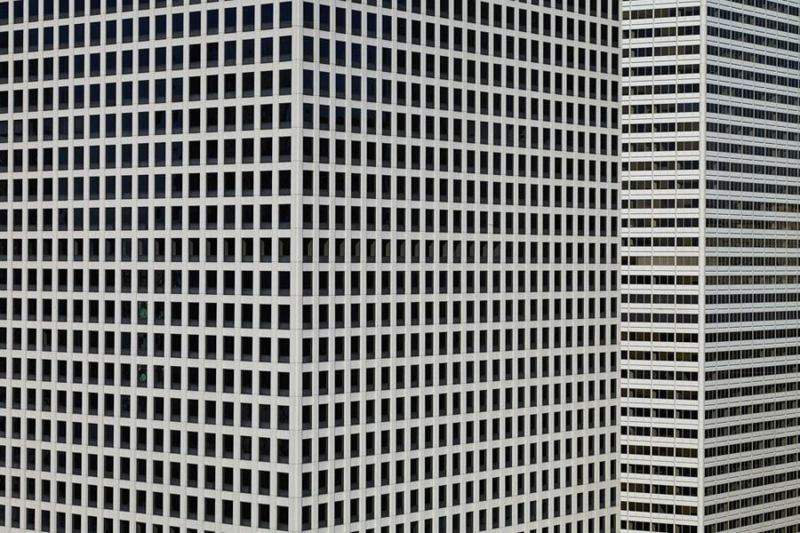
The days of documentation are over. If architectural photography used to be a question of showing buildings either in their best light (literally)—expanding on their most salient characteristics, and hiding their flaws—or of showing exactly what was there, now it is as much about myth-making: the creation of possible worlds that may have existed, may exist in the future, or are different versions of the world revealed through the mechanics of photography.
Several exhibitions currently open highlight the diversity and quality of photography that has architecture as its pliable subject. The most prominent is “Constructing Worlds: Photography and Architecture in the Modern Age,” co-curated by Elias Redstone and currently on display at the Barbican in London; Redstone’s Shooting Space (Phaidon Press, 2014), published simultaneously, makes the work available to those of us who can’t travel to the exhibition. Through Feb. 16th, the Metropolitan Museum of Art in New York is exhibiting a selection of work by German photographer Thomas Struth, who helped break down the barriers between “fine art” and architectural photography. In my hometown, associate photography curator Brian Sholis assembled “Eyes on the Street” at the Cincinnati Art Museum, which runs though Jan. 4th (I green-lighted the exhibition while I was still director of that institution).
These new ways of looking at architecture started developing around the turn of the century, and come in various categories. The most obvious is the use of the latest technology to heighten the power photography has to show us our world in minute detail and at a scale large enough to impress us. Struth is certainly a master at this, as is Michael Wolf, whose work is featured both in London and in Cincinnati, as well as on the cover of Shooting Space. Many of these photographers show us the spectacle of development at a scale and of a kind that astonishes us, especially in China and the Arabian Peninsula. Bas Princen is particularly good at large and dramatic views of housing developments in Asia and elsewhere. In these images, the transformation of our world in reality and in pictures come together to create a kind of sublime, both grand and terrible.
Others use technology to manipulate our environment. Struth’s contemporary and fellow “Düsseldorf School” photographer Andreas Gursky is the most well-known creator of such distorted, warped images that show how strange our world is becoming, while Olivo Barbieri uses shift/tilt to turn the landscapes of Las Vegas and other sites into what look like dolls’ houses we can comprehend at that smaller scale. A more recent generation goes further, Photoshopping fragments of various buildings together, as Filip Dujardin does most effectively in creating piles of buildings that teeter over serene landscapes.
While technology tends to perfection because it makes it possible for an artist to document and clean up reality to such an extreme degree, it also makes the medium more accessible as you can now take cameras anywhere, and the world is subject to exploration by millions who view our designed environment in distraction, catching its peculiarities as if on the fly. A class of haute snapshot photography was made famous by Wolfgang Tillmans, and has proliferated to the point where some artists, such as Jon Rafman, make work by just manipulating Google Street View images.
Against this kind of quick and dirty voyeurism stands the grandeur of the current king of architectural photography, Iwan Baan. His lush images can make ruins such as the Torre David in Caracas, Venezuela, and disaster areas like Manhattan after Hurricane Sandy look glorious, while turning the humble creations of architects such as Michael Maltzan, FAIA, into sexy superstars. That same kind of aesthetic, born of MTV as much as Hollywood—let alone architectural history—can also turn into harrowing imagery of a city inhabited by strangers, such as in the work of the older Philip-Lorca diCorcia, who first attracted critical notice for his haunting images of male sex workers in L.A., or in the haunting video by James Nares on display in the exhibition in Cincinnati, which shows isolated figures in crowds moving in extreme slow motion through New York’s streets.
Perhaps my favorite set of photographs in the Redstone book (and the exhibition he co-curated) are those by Alex Hartley, who shoots scenes at modern masterpieces like the Eames House—seen through foliage, as if by an intruder—or the roof of the Schindler House, or kids at Case Study Houses performing parkour through the houses’ intersecting planes, their faces carefully hidden.
Most of these photographs at all three venues tend towards the sublime, in both how they are made and what it shows about the power of human beings to create landscapes that are of a vast scale and complexity. The images make these places both seductive and frightening. Against that awe, the extreme manipulation at work here makes us realize the artificiality of what we make, and how thin and evanescent it really is. The work that collaborates with architecture, such as that by Nares and Hartley, to create a stage for actors who can stand in for us as viewers does the great service of putting the human act—from the making of the building, to the taking of the photograph, to the inhabitation of the scene—back in the picture.
Aaron Betsky is a regularly featured columnist whose stories appear on this website each week. His views and conclusions are not necessarily those of ARCHITECT magazine nor of the American Institute of Architects.