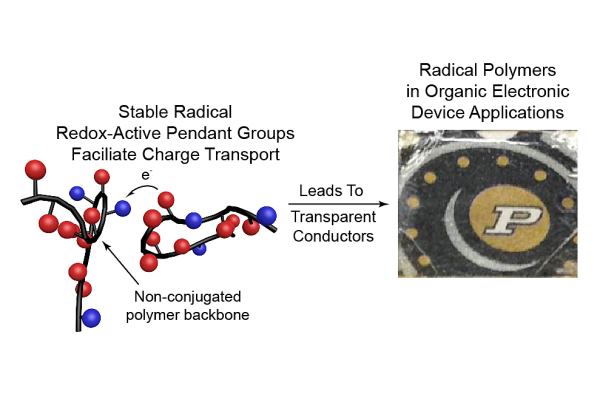
Plastics have several desirable material properties, including durability, flexibility, lightness, and colorfastness. A recent development at Purdue University now adds another characteristic to the list: high electrical conductivity. Although conductive polymers have existed for decades, the new, so-called radical polymers offer 10 times greater conductivity than typical semiconducting plastics.
Like many new materials, the novel polymer exhibits unexpected traits. “It’s a polymer glass that conducts charge, which seems like a contradiction because glasses are usually insulators,” said Bryan Boudouris, an assistant professor of chemical engineering at Purdue and a co-author of the related paper, in a press release.
Appearance-wise, the new plastic is resembles the transparent polymethyl methacrylate (PMMA)—commonly known by the brand-name Plexiglas—found in many building and consumer products. Because the material is otherwise similar to PMMA, it could be an advantageous replacement. “[I]magine if you could produce that same kind of material at that same scale but now it has electronic properties,” Boudouris said.
Radical polymers have the potential to bring electronic functionality to a range of products and systems, including solar-powered windows and coatings, thermoelectric materials that convert heat into electricity, and anti-glare and anti-static coatings for windows and displays.
One downside, however, is that current research on the topic is based on manipulating conventional fossil fuel–based plastics, which have a contentious environmental record. Therefore, it would be ideal for the scientists to focus instead on the electrical enhancement of environmentally responsible bioplastics, further developing that material’s appeal and commercial viability.
Blaine Brownell, AIA, is a regularly featured columnist whose stories appear on this website each week. His views and conclusions are not necessarily those of ARCHITECT magazine nor of the American Institute of Architects.