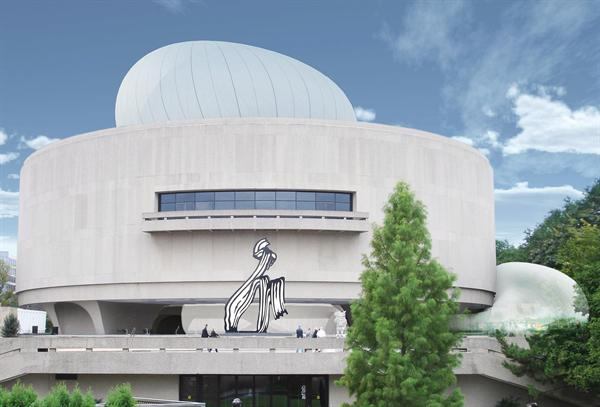
The Bubble may have burst. The Washington City Paper reported late last week that the board of the Hirshhorn Museum and Sculpture Garden in Washington, D.C., is deadlocked about whether to proceed with the Diller Scofido + Renfro project to seasonally inflate a bubble in the middle of the museum’s donut-shaped building. It is now up to the Secretary of the Smithsonian, G. Wayne Clough, to decide whether to proceed with the $15.5 million project—but the Hirshhorn’s director, Richard Koshalek, who initiated the project, has announced his resignation in the meantime.
It is a shame. The so-called Bubble, a blue-green blob billowing out over the top of the museum and leaking out under its raised galleries for two months a year, would have been a beautiful thing in the White City that is Washington. When Koshalek commissioned Doug Aitkin to create SONG1, a projection that covered every inch of the museum’s otherwise unadorned façade during the evening hours for a few weeks, he showed how this museum buried in a monument, which otherwise hides its purpose and its treasures so carefully, could be an open and active part of our capital’s cultural life. Koshalek had other ideas in the same vein, such as turning the ground floor into an education center. You get the feeling the Hirshhorn might now turn back into itself to become the mute enigma it has been for all too long.
The Bubble had its problems. Not only have its costs tripled since it was first announced four years ago, but it would have cost a lot to run as well, as an internal study made clear; it would operate at a loss under every scenario the wise men at the Smithsonian came up with, according to The Washington Post. As a museum director, I know how difficult it is to burden an arts institution, which almost by definition operates close to the financial edge even in the best of circumstances, with added costs whose full parameters the untested nature of this project would leave to a certain extent unknowable.
That does not take away from what I think is the fundamental gift the Bubble would have given us: It was a brilliant proposal to take an unused space at the heart of the Mall and turn it into a place of art and activity, a throbbing and open venue for performances, discussions, debates, and play that would have extended and enhanced the experience we got from the central act of seeing art. It offered an alternative to the tendency of everything in Washington to turn into stone, a monument, a memorial to past values and ideas, and an example of mediocrity. Its unpredictability and unknowability were essential to what made it so beautiful and so full of potential.
Mayor Mike Bloomberg of New York, the billionaire who says he believes only in God and data, understood that, and was willing to pay for a chunk of the Bloomberg Balloon’s cost. It is disappointing both that all parties involved could not find a way to bring the costs back in line, and that nobody else had the vision to join Bloomberg in his faith. We can only hope that Clough, the Smithsonian, and others with the means and the power will step up to inflate the bubble and give Washington the best new cultural facility that town will then have seen since East Wing of the National Gallery opened thirty-five years ago.