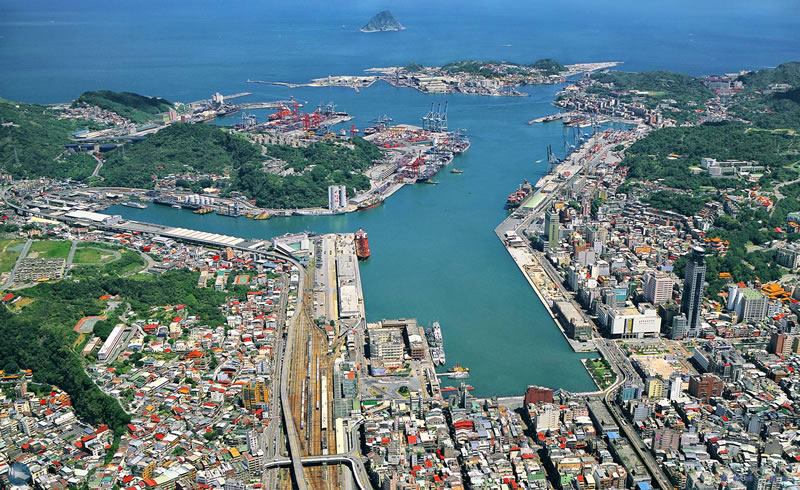
Keelung, Taiwan, is strange place. When I traveled there recently as a member of the jury to chose the design for a new Harbor Terminal Building, I was picked up at the airport South of Taipei, drove right through that not very pretty, but certainly exciting, metropolis of 2 million, dove into a tunnel, and suddenly found myself at the end of the expressway, plunging right into the middle of a harbor town packed in between hills and a rectangular basin. Only 15 minutes away from Taipei’s core, it felt like a different world. Once, Taipei’s main port, Keelung is now a relatively sleepy place. Taiwan’s largest port, Kaohsiung, is exactly on the opposite side of the island’s north–south axis. Keelung itself started a new port, Taipei Harbor, to handle larger-volume ships. Now the small basin is mainly home to some fishing, a naval station, and smaller transport ships. The city’s hopes are pinned on a new express-ferry passenger service to mainland China, which is supposed to join the existing cruise ships that travel to Okinawa and other ports in Japan in September.
In many ways Keelung’s past, present, and potential future mimic that of port cities around the world. As the shipping industry has become larger-scale, automated, and multimodal, ports have moved out of cities and onto purpose-built flats where robots load and unload thousands of containers between ships and trucks or trains. From Hong Kong to Genoa, and from New York to San Francisco, that has left the downtown harbor empty and available for redevelopment. More often than not, the new uses are consumer-oriented: cultural attractions, shopping experiences, recreational parks, and other ways to enjoy the city’s edge takeover from cranes, gentries, sea smells and rowdy sailors.
Keelung wants to join that trend, and it has the advantage of being a compact town with many excellent fish restaurants and the romantic remains of a few forts looming over the downtown. Rail and road links to Taipei are being improved. The problem is that part of what gives the place character will disappear as it is opened and cleaned up for consumers. Keelung will have to figure out how to develop its existing character, based on a history of forts, fishing, and shipping—and, as far as I could tell, not much else—into a future that partakes of international trends and is yet part of what makes the place particular.
The Harbor Terminal will be a big part of that project. It is a large project, projected to cost $140 million, and sited at the harbor’s heart. Several of us jury members argued that the Harbor Authority should try to preserve existing warehouses on the site as a step towards continuing the city’s legacy. I have to say that I was frustrated that none of the entries in this international competition sought to build on the existing fabric: all presented shiny new monsters rising up toward a future machined for consumer perfection. The five finalists we chose are all of great technical and aesthetic value. I just hope that, as they go into the next round, we will see some of Keelung’s past and present in these images of a shiny future.