Developments in LED light-source technology are being met with new research on lighting’s non-visual effects on human health. The resulting products and systems let users regulate the intensity of the light and the frequency at which they are exposed to it.
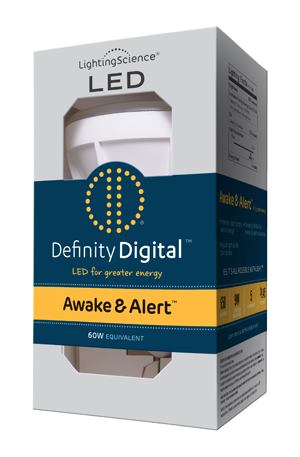
Lighting Science is bringing to market technology it derived from a partnership with NASA to develop a lighting system that regulates the sleep-wake cycle of astronauts who work on the International Space Station—where the sun rises every 90 minutes. The light spectrum of its Awake & Alert lamp uses a patented filter with blue-enriched white light to increase alertness. The lamp is part of the company’s Definity Digital series of A19, BR30, PAR30, and PAR38 lamps that are adjusted for tasks such as improving melatonin production, increasing alertness, and protecting coastal wildlife. So far, the Awake & Alert lamps have been used by members of the Los Angeles Dodgers and the U.S. Olympic Ski Team to fight jet lag when they compete internationally. Other beneficiaries include third-shift workers in healthcare and factory environments.
“We live in this kind of twilight environment where we’re indoors so much that we neither see day nor night,” says Rob Soler, director of research at Lighting Science. “We have this kind of flat-line signal that is not what we immediately evolved around. What these lights are trying to do is strengthen the circadian signal.”
Lighting Science isn’t alone in this endeavor to harness lighting with circadian synchronicity. This spring, Withings—a maker of Internet-enabled devices—released the alarm-clock LED luminaire Aura, which measures factors such as noise pollution, temperature, and light levels in the room during sleep and syncs with a wireless sensor beneath the mattress to track functions such as an individual’s movements. It uses blue light and soothing noises to wake its user, who can control the system and manage its collected data via a mobile app.
And earlier this year, Philips updated its LED light-emitting acoustic ceiling, developed in 2012 in partnership with building-products manufacturer Saint-Gobain’s Ecophon acoustic ceiling division. The new Soundlight Comfort Ceiling is designed for open-plan offices and features tunable white light at 3000K or 4000K and a CRI of 80-plus that can be adjusted via programmable lighting controls to balance electric light levels and daylight.