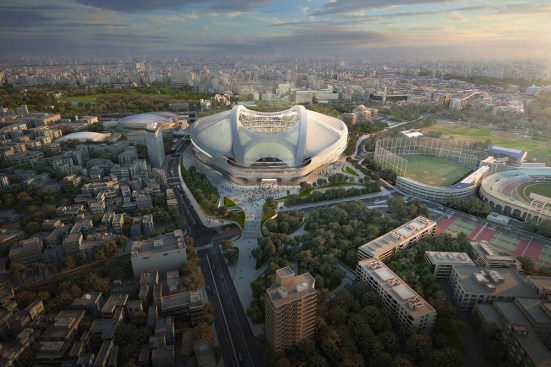
Last week, London-based Zaha Hadid Architects (ZHA) released a statement to “set the record straight” on its controversial design of the New National Stadium in Tokyo for the 2020 Olympics. The firm claimed that early appointment of contractors and escalating construction costs caused a rising budget and the ultimate cancellation of the design in July. In response to the shocking news that the project plan had been scrapped, ZHA wrote to Japanese Prime Minister Shinzō Abe, who is currently reviewing the stadium’s design, that the firm has always been and is willing to modify its plans to reduce costs, which it believes is a more effective solution than starting from scratch with a new design.
ARCHITECT caught up with Jim Heverin, ZHA director on the project, to discuss what went wrong and the firm’s future plans.
Zaha Hadid Architects
The revised proposal by Zaha Hadid Architects
ARCHITECT: How many ZHA architects worked on
this project?
Jim Heverin: It varied, but we were
only in a design supervisor role, so we had around 15
architects and we also had Arup Associates as a sports architect. Our role is
to supervise the work done by a Japanese design consulting group led by Nikken
Sekkei. They had over 100 architects and engineers.
What did the role of the supervisor
consist of?
The most basic task is just to review the
work that is produced by others to be in accordance with our original design
intent, but in reality, we produced a lot more. We wrote a brief and then we
developed a substantial part of the SD [schematic design] and the DD [design development] to give [Nikken Sekkei] sufficient design intent to be able to develop the plan.

Zaha Hadid Architects
After winning the international competition
in 2012 and throughout the design development phase in the following two years,
did the Japan Sport Council express any cost concerns?
We didn’t really start until the summer of
2013, not automatically after winning the competition. Once Japan won the bid
to host the 2020 games, it started in earnest. I can’t really go into specifics
about what the client said, but it was a normal iterative design process where
estimates were done and the client was made aware of the inflationary risks
which come with an Olympic project.
How did the firm work proactively to reduce
the estimated costs throughout that time?
By making suggestions on how the client’s
brief could change and how certain parts of the brief needed to be considered
in totality to make compromises and reach an overall balanced vision between
the brief design and the budget. We have exercises and proposals throughout and
some of those options were taken and others weren’t for various reasons.
When were the contractors selected? What
was the relationship like between those contractors and your firm?
They had a tender process last year and a few
of them came together as a joint venture in September or October of last year. Normally,
in what we call two-stage tendering work—or early contractual involvement—everybody
has to work together as a single team. The client needs to be flexible on their
brief, the designers need to be flexible on their design, and the contractors need
to be fully engaged and working with both clients and designers to reach a
target cost. That didn’t happen. It was more of a traditional, formal
relationship where contractors submitted prices at various stages. There was an
opportunity for them to continually assess the risk and review their prices,
but there wasn’t the benefit to the designers and the clients to actually work
together to achieve an overall target cost.
Was that restricted collaboration something
that the Japan Sport Council initiated?
No, it has more to do with how the
contractors viewed the set-up and how it developed. I really wasn’t party to
what type of agreement that they made together, but that’s how it transpired. We
told the client that if this doesn’t turn into a collaborative process, then
you’ll be heading into a situation in which you’ll be facing a reprice that you
will find quite difficult to find an alternative to, because it’s not working in
a collaborative manner.
Much of the criticism of the design has focused
on the steel arches of the stadium. How do those arches work within the design
and the budget?
Two arches go over the seating bowl in the
longitudinal direction as the primary structure of the roof. They sit on the
ground, not on the seating bowl. We proposed them to allow you to build the
seating bowl and the roof in parallel from the beginning, which saves construction
time, as opposed to a more traditional stadium where you have to build the
seating bowl first and support the roof of the seating bowl. You save at least three months of construction, which obviously has a cost
and a time benefit to the client.
A lot of the criticism is incorrect, particularly on the price. We’ve heard prices of 100 billion [yen], which is complete nonsense. The actual price of the arches is [approximately] 23 billion yen, which is under 10 percent of the overall construction cost and perfectly reasonable. The overall tonnage of the roof is comparable to multiple other stadiums in Japan. That tells us that it’s an efficient stadium that’s balanced between being a lightweight structure and the necessary structure that you require in a seismic zone. Comparing it to stadiums that are not in seismic zones is nonsensical, but comparing it to similar stadiums in Japan and in similar conditions, it’s an efficient design and is much quicker to build.
Why was there confusion as to the price of
the arches?
Because that’s how the press works, isn’t
it? Paper never refused ink. I can’t say why people misquote us, but I think
certainly there has been a lot of inaccurate reporting and also there were criticisms by [Japanese architect Fumihiko] Maki, [Hon. FAIA,]
because he just doesn’t like an 80,000-seat stadium on that site. That has
fueled a lot of discussion on the arches as if they are the villain of the
piece, but that’s an amateur assessment of the situation. If all that Mr. Maki
has achieved is that the arches go, there will still be an 80,000-seat stadium
on this site; he will have achieved nothing in that respect. The actual
footprint, the volume of this project, will remain unchanged, even if the
government goes for a new design because they’re not changing sites.
The firm’s recent statement says that it learned about the cancellation of its design from news reports. That wasn’t something that the Japan Sport Council had
indicated earlier?
No, it was a complete surprise on Friday. We
just heard about it through the news like the rest of the public. To put it in
context: a week earlier, the project and budget had been approved by the Prime
Minister and the government to proceed, so it was quite a turnaround.
What will be the
firm’s role in the project now that its design is scrapped?
It’s a good idea to do a review, but you
shouldn’t predict the outcome of a review by thinking that you know the
solution, so you shouldn’t rush to a new solution without actually really
thinking about the conditions that created the cost increase. When you really
look at it, we believe that you will see that the current design can be
modified, that there’s a lot of expertise and knowledge within it that has been
paid for by the Japanese taxpayer, and the best option is to modify the current
design to achieve a lower price rather than starting from scratch. That would
be a cheaper and a safer way to ensure value and that construction is still
achieved for 2020.
If the Prime Minister had asked us, we would have been perfectly willing and we’ve been saying that with the client for months that we should look at the design because the design is related to the brief, so the brief needs to change first and the design will follow. We’ve put forward many proposals to do so and we still think this is the most cost effective way to tackle a redesign and to achieve a reduced cost.
Who has the final authority on reviewing the
design of the project?
It’s the Prime Minister’s decision to cancel
and to do a review. We’ve written to him and we’re waiting for his response. We
remain optimistic that the option is still there.
The plan, as it sits now, is to host
another design competition, to get a new design within the next six months,
correct?
That’s correct. We don’t think that’s
necessarily the right idea and we don’t know how final that decision is, but
it’s not just a design competition, it’s a design/build, so it’s
contractor-led competition. We would question the certainty of what the design
will be and certainly we all know that until you’ve done considerable design
development, you won’t know for certain. You’re handing over that responsibility
to the contractor and in return for being able to achieve a budget and a time
scale, the quality aspect will be missed. There are lessons to be learned,
for example, from London where they did a similar procurement and a brief was
given to the contractor. I’m not criticizing them, but they designed a stadium
that was just focused on the Olympics. Afterwards, London spent a
considerable amount of additional taxpayer money to try and make it into a
stadium that works in legacy. This is something that the Japanese should think
about. It would be better to first have a design rather than give over complete
responsibility [to contractors].
Do you foresee the firm taking any legal
action against the Japan Sport Council or any other group involved in this
process?
At the moment, we are trying to get this
option [to modify the design]; this is our priority. We need to speak to the
Prime Minister and we’re not really focused on any legalities at this point in
time.
Read the firm’s full statement here.