
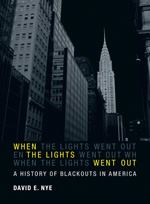
When the Lights Went Out

Historian David E. Nye explores the social history of blackouts in America.

1 MIN READ

A fascinating look at the history of blackouts in America, When the Lights Went Out ($27.95, MIT Press, April 2010) explores these events in a cultural and social context. It is written by David E. Nye, professor of American history at the University of Southern Denmark, who has previously written several books on the topics of electricity, energy, and 21st century technological innovation.

Nye divides the 292-page book into seven chapters: Grid, War, Accident, Crisis, Rolling Blackouts, Terror, and Greenout. This provides a framework for examining how the development and configuration of the U.S.’s electrical grid has contributed to the major large-scale power failures that have occurred since 1935. Nye highlights specific blackouts during World War II, the Great Northeastern Blackout of 1965, the 1977 New York City blackout, the 2000 California rolling blackouts, and the 2003 blackout that affected 50 million people from the Midwest to the East Coast and parts of Canada.

Depending on the circumstances that have led to each blackout—unanticipated, voluntary, or mandated—social response has varied widely. Some blackouts, such as the 1977 one in New York, caused chaos and social disruption. The blackout in 2003, by contrast, impacted an unprecedented number of people, but brought them together and created a sense of community. But no matter the circumstance, when we find ourselves without light and power, we become acutely aware of how dependent we have become on electricity.

“Blackouts are breaks in the flow of social time that reveal much about the trajectory of American history,” Nye writes. “Each time one occurs, Americans confront their essential condition—not as isolated individuals, but as a community that increasingly binds itself together with electrical wires and signals.”

About the Author

Elizabeth Donoff

Elizabeth Donoff is Editor-at-Large of Architectural Lighting (AL). She served as Editor-in-Chief from 2006 to 2017. She joined the editorial team in 2003 and is a leading voice in the lighting community speaking at industry events such as Lightfair and the International Association of Lighting Designers Annual Enlighten Conference, and has twice served as a judge for the Illuminating Engineering Society New York City Section’s (IESNYC) Lumen Award program. In 2009, she received the Brilliance Award from the IESNYC for dedicated service and contribution to the New York City lighting community. Over the past 11 years, under her editorial direction, Architectural Lighting has received a number of prestigious B2B journalism awards. In 2017, Architectural Lighting was a Top Ten Finalist for Magazine of the Year from the American Society of Business Publication Editors' AZBEE Awards. In 2016, Donoff received the Jesse H. Neal Award for her Editor’s Comments in the category of Best Commentary/Blog, and in 2015, AL received a Jesse H. Neal Award for Best Media Brand (Overall Editorial Excellence).Prior to her entry into design journalism, Donoff worked in New York City architectural offices including FXFowle where she was part of the project teams for the Reuters Building at Three Times Square and the New York Times Headquarters. She is a graduate of Bates College in Lewiston, Me., and she earned her Master of Architecture degree from the School of Architecture at Washington University in St. Louis.

No recommended contents to display.

Upcoming Events

  • Design Smarter: Leveraging GIS, BIM, and Open Data for Better Site Selection & Collaboration

    Live Webinar

    Register for Free
  • Slate Reimagined: The Surprising Advantages of Slate Rainscreen Cladding

    Webinar

    Register Now
  • The State of Residential Design Today: Innovations and Insights from RADA-Winning Architects

    Webinar

    Register for Free
All Events