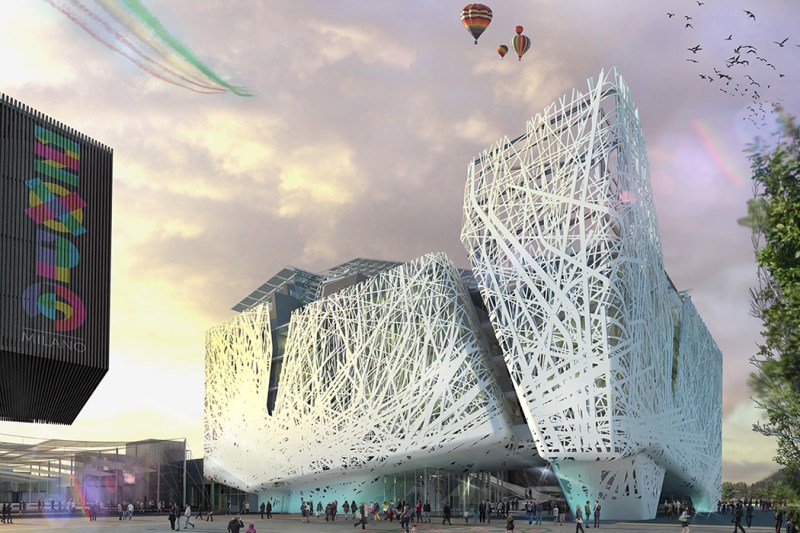
The Italian Pavilion at the Milan Expo, the disaster of a Fair that is proving to be a success as a crowd draw, is not quite at the heart of the exposition. It sits at one end of the decumanus. You might remember that phrase from your Intro to Architectural History class as denoting the cross road that, together with the cardo, or main street, that connected to Rome, divided every Roman encampment into four parts, and thus would lead you to expect Something Important here. This the Pavilion is—or could have been. It certainly is bigger than anything around it and, if the design by the Roman firm of Nemesi had been carried out, it would have been a significant piece of architecture. Right now it is an instant ruin that exhibits nothing so much as the utter bankruptcy of contemporary architecture practice in Italy.
Nemesi,
headed by Michele Molè, is one of a number of youngish architecture firms that
have been on the verge of breaking through for years, only to have their
attempts be stymied by an old guard who sees a continual line between
classicism and Aldo Rossi, Hon. FAIA, without understanding the critical contradiction that
continuity papers over. Architecture in Italy still means abstractions of
classical forms and monumentality carried out in the thinnest possible facing
stone.
It
was remarkable that Nemesi won the nationwide competition to design the symbol
of their home country with a box that sought to defy gravity with a mesh of
seven layers of a pollution-eating concrete, covering the Pavilion with scrim
that folded over the top and flowed down to turn an internal courtyard into an
impluvium, an atrium where the rainwater would be collected, channeled along a
monumental staircase, and then recycled.
Everything
that could go wrong did. Disorganization at the Expo, exasperated by the fact
that the Superintendent of Works went to jail for unrelated reasons, caused
delays and massive cost overruns. Then the functions inside changed. Then the
Italian organizers changed the program again, causing more delays and cost
overruns. It would a wonderful farce worthy of Fellini if the results were not
so disastrous.
Walk
up to the Italian Pavilion now and you will miss much. Whole parts of the
building’s original design are absent. The scrim is only half finished in
places, leaving the stub-outs of the steel structure behind it revealed. The
detailing is so clumsy as to make you feel as if the structure was put together
with chewing gum.
It
gets worse inside. None of the exhibits have anything to do with the building,
leaving potted plants and ropes to define circulation routes and computer
servers to stand blinking away against walls in some of the best spaces. A stucco
egg that was supposed to be a conference room hanging in space has been reamed
by giant beams and is useless. The whole top of the floor is not yet open.
It
is true that Nemesi was not able to control the situation. Perhaps if they had
been a more seasoned firm they would have figured out how to ameliorate the
situation and make the best of the cuts and changes—but the issues were of
such a scale that it is hard to believe that anybody could have done much to
save the original design. If even David Chipperfield can’t survive Italian building practices, how could this young and ambitious firm?
The
Expo might be drawing millions to Milan, but it is showing this country at its
worst: Devoid of its natural features, its focus on design, its ingenuity, or
its sense of style. The only part the organizers got right was—as I said in my
last blog—the food, and the restaurant at the Italian Pavilion has not yet
opened more than a month after it was supposed to. Shame on Italy and its architecture
culture. The talented young designers such Nemesi and others deserve a better
chance.