
More Coverage of Denise Scott Brown

Pritzker Architecture Prize Committee Refuses to Honor Denise Scott Brown

Pritzker Prize Jurors Decline to Discuss Denise Scott Brown at Ceremony
Architect Interview With Denise Scott Brown

Media Ratchets Up the Pressure on Pritzker Prize Jury

Reconstruction and Symbiosis: Fixing Past Mistakes

Pritzker Architecture Prize Committee Mulls Petition for Denise Scott Brown
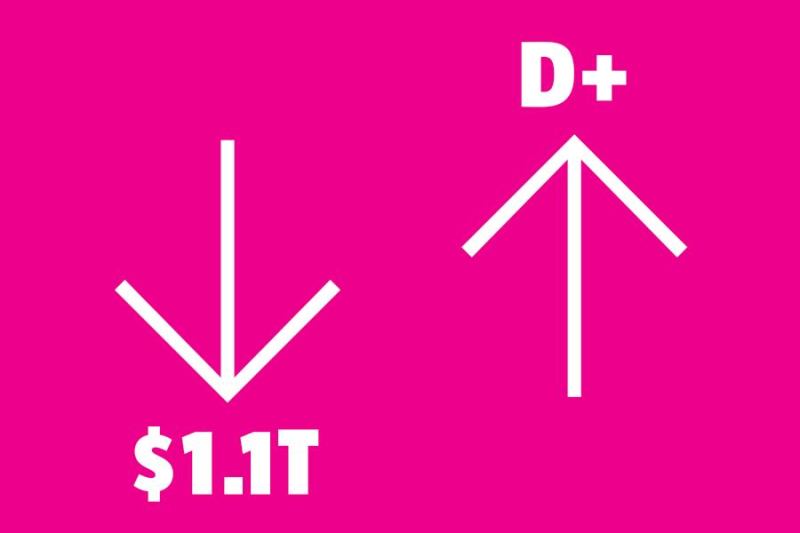
On Good Friday, President Barack Obama visited the Port of Miami, where, standing against an unwittingly ironic backdrop of Chinese-built cranes, he called yet again for the formation of a national infrastructure bank and other measures to help fund the renovation and construction of bridges, dams, parks, and the like. Just 10 days prior, the American Society of Civil Engineers released its quadrennial Infrastructure Report Card. Judging from the country’s GPA—which has risen from a D to a D+ since the last report—the president’s Miami proposal seems like a positively essential investment in our nation’s future.
Still, with our sovereign debt nearing $17 trillion, a call for increased government spending may seem like a strange, if not insane, idea. Yet spending is precisely what America needs, according to the president and economists such as Robert Reich and Paul Krugman. They believe that the best way to pay off the debt is to put Americans back to work. And what better work is there to be done than on projects that need to happen anyway?
The big banks are still reluctant to make business loans, so the government is the only entity with the cash to get cranes moving and workers working. What’s the holdup? Politics.
Stimulus is a dirty word these days, synonymous with government waste, despite all that the 2008 and 2009 stimuli did to temper the Great Recession. The $152 billion tax rebate under former President George W. Bush reportedly boosted consumption by 2.4 percent in the second quarter of 2008, while the Obama administration claims that its $831 billion mix of tax breaks and spending saved or created between 1 and 3 million jobs.
Granted, 9 million jobs were lost overall, but in truth, neither outlay was big enough to offset the massive loss of jobs and savings when the economy tanked in 2007 and 2008.
The government’s plan-by-default is to boost the economy by spending less. The “sequester,” a 10-year, $1.1 trillion cut in the federal budget, took effect March 1. It’s too early to measure the fallout, but we have seen just how well austerity is working in Europe—which is to say, it isn’t. Across the continent, riots have broken out, governments have fallen, and the collective potential of an entire generation is going up in smoke.
Nobel Prize–winning economist Joseph Stiglitz claims, “It will take 10 years or more to recover the losses incurred in this austerity process.” Infrastructure spending, by contrast, will boost the nation’s slow economic recovery. And if the investment is especially smart—i.e., low-impact and high-performance—we will save billions of public and private dollars over time, build safer and more livable communities, increase our global competitiveness, create a host of financial and creative opportunities for architects, and foster a shared sense of national purpose. So, let’s get to work.
A Facebook page and a petition on change.org are calling for Denise Scott Brown to be retroactively named as co-recipient of the Pritzker Prize that her husband and partner Robert Venturi received over 20 years ago.
Personally, I think it was shortsighted—even mean-spirited—of the 1991 jury to exclude Scott Brown, given her tremendous individual contributions to the fields of architecture and planning, as well as the epochal outcomes of her collaboration with Venturi. Where would any of us be without Learning From Las Vegas?
The fledgling, student-led movement was prompted by a pre-recorded speech that Scott Brown made for a luncheon last month in London. “They owe me not a Pritzker Prize, but a Pritzker inclusion ceremony,” she said (being far too modest, in my opinion). “Let’s salute the notion of joint creativity.”
Fans, colleagues, employees, former students, and luminaries such as Ole Bouman and Zaha Hadid have electronically signed the change.org petition. I did, and you should, too.
