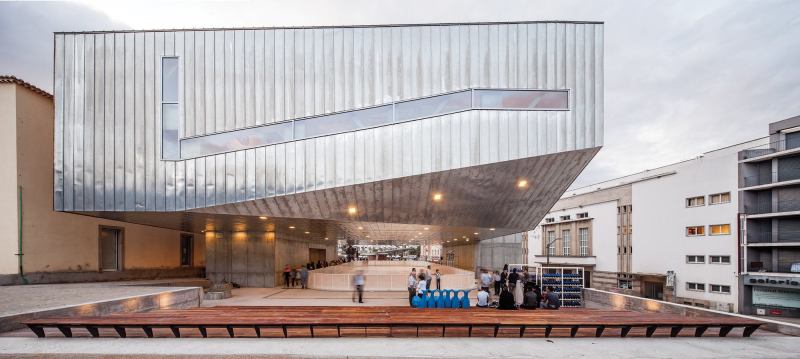
Optimize flow. That was the goal that drove Barcelona, Spain–based Mateo Arquitectura’s design of the Praça Largo da Devesa plaza in Castelo Branco, Portugal, and the 46,000-square-foot cultural center that floats above it on twin piers. Just as the plaza’s basalt cobblestones channel the flow of rainwater, an elegant, thin concrete ramp leads visitors between the cultural center’s two levels of exhibition space.
Stairs would have been easier to build, but principal Josep Lluís Mateo wanted visitors to focus on the art and not on their feet. “My dream was for people to move from one level to another without noticing,” he says. “I didn’t want the transition to be a moment in itself. I wanted it to be lost in the experience.”
The 115-foot-long ramp had to be as discreet as possible; a bulky structure supported by columns or cables would have broken the spell. Designing a wisp of a structure that could bear the weight of dozens of enthralled art admirers became the challenge.
As a result, the concrete ramp emerges imperceptibly from the exposed, smooth-finished concrete floor of the lower level to a thickness of 7-7/8 inches. It gradually curves up past sculptures and canvases to the mezzanine, varying in width from 6 feet 3 inches to 11 feet 10 inches.
Working with engineering firm Manuel Arguijo y Asociados, also based in Barcelona, Spain, Mateo Arquitectura minimized the ramp’s bulk with a cantilevered concrete structure supported by eight tapered European-standard wide-flange beams (HEB 320) that tie into steel girders in the building’s load-bearing walls. The concrete ramp itself is reinforced by a dense grid of steel rods, anchored by six large peripheral rods running beam-to-beam through openings cut into the wide-flange beams’ web. The entire ramp required about 26 cubic yards of concrete and was completed in a single pour.
Enhancing the ramp’s minimalism is an invisible safety railing made from 43-inch-tall glass panels—comprising a 3/4-inch-thick sandwich of tempered and laminated lites—bolted to the ramp with stainless steel hardware. Portuguese company Vidreira Ideal do Fundão supplied the glass.
The ramp has helped erase the spatial distinction between floors. Visitors to the cultural center, which was completed in December 2013, can confront the exhibit hall’s oversized paintings and sculptures from different angles as they rise or descend. “I chose the simplest ramp I could imagine,” Mateo says. “I wanted it to look like a floating canopy.”