
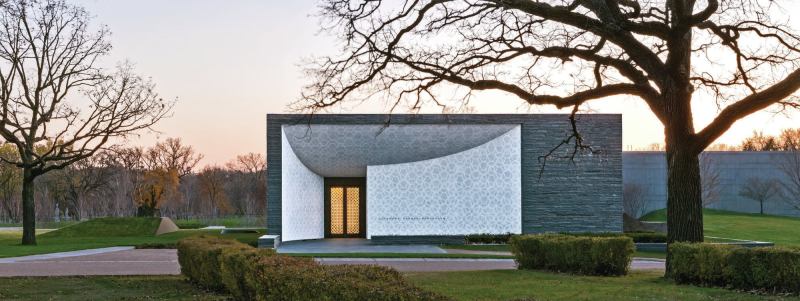
When several business leaders, originally from New England, founded Lakewood Cemetery in Minneapolis in 1871, their models were the “rural” or “garden” cemeteries popular on the East Coast. Surrounded by a bustling residential area next to Minneapolis’ popular Chain of Lakes, Lakewood’s 250-acre, rolling landscape includes beautifully maintained gardens, statuesque mature trees, famous monuments and memorials, and iconic artworks and architecture. It’s an oasis in the city for walks, picnics, historical tours and outdoor theater performances; a bucolic resting place for the dead and a bit of heaven for the living.
Like others of its building type, the modernist Memorial Mausoleum, constructed in 1965, sits heavily on the Lakewood Cemetery site, although not ornately. Following tradition, the building looks inward, rather than out, despite its 24 striking, 8-foot-high stained-glass windows. By 2003, Lakewood—non-sectarian and nonprofit—realized the building was running out of space, and commissioned a master plan with a new mausoleum for 10,000 of the departed. But only 25 acres were available for a new structure.
Joan Soranno and John Cook, of Minneapolis-based HGA Architects and Engineers and designers of numerous award-winning religious and cultural projects, decided that the new mausoleum shouldn’t intrude on the cemetery’s historic context and pastoral setting. So they buried three-quarters of the new Lakewood Cemetery Garden Mausoleum into a hill overlooking the extant mausoleum and sunken garden with an infinity pool.
“Historically, as a building type, mausoleums tend to be dark, introverted spaces,” Soranno says. “With this project, we did the exact opposite. We needed the rooms, especially those underground, to feel open and airy, with views to the beautiful landscape. So light was the most considered, studied component of the design, along with materials.”
The 24,500-square-foot mausoleum is clad in rough-textured, gray granite and white mosaic-marble. The dramatic contrast continues inside, with the juxtaposition of dark and light, rough and polished materials. Daylight floods the interiors through well-considered clerestories, floor-to-ceiling windows, glass doors, and skylights—all of which highlight the textures, colors, and finishes of the simple, yet rich palette.
The daylight also serves a spiritual purpose. “Light is crucially important in buildings with religious purposes, especially with regards to death and remembrance,” Soranno says. “Spiritual light comes in two forms. One is daylight brought in by windows, which we positioned to frame beautiful views of the historic cemetery. The second is more indirect light, where you can’t see the source, which we incorporated through methods like covelighting in selected areas of the building.” Moreover, she says, “When you’re designing for people who are grieving, you need to create warm, safe, comforting, and nurturing environments. Light is an effective way of evoking those feelings.”
The architects used electric lighting judiciously throughout “to balance the daylight and supplement its warmth,” says HGA in-house lighting designer Tao Ham. “Daylight is always the most beautiful source of light. It doesn’t matter how lovely the electric lighting design might be; you can’t compete with daylight. So except for spaces away from the windows, where there is supplemental lighting, the building is daylit.”
The two-level entry foyer, for instance, has a white marble floor, folded mahogany walls, and large window walls and clerestories. Daylight accentuates the curves and angles of the white, sculptural ceiling planes. Delicate cascades of 10W xenon crystal pendants drop from the ceiling and “add sparkle,” Ham says.
The foyer leads to a reception area with window walls facing west. Embedded in the ceiling coffers, in star-like constellations that correspond with the ceiling’s forms, are small-aperture 50W MR16 adjustable downlights. The modern furnishings include circular glass table lamps, each with three incandescent T10 lamps, that create small pools of light. The lighting control system’s settings include dimmers, a spotlight for the podium, and lighting for slideshows or movies projected onto a drop-down screen.
Also in the entry foyer, a stairway with LED steplights leads visitors past the window wall, to a solid wall of layered limestone, and then down to the garden level below. On the west side of the garden-level lobby, a curved Venetian-plaster wall guides mourners to the chapel where committal ceremonies are held.
In the chapel, nine vertical windows, which widen as they progress toward the back wall, are deeply angled to diffuse the daylight and ensure the privacy of mourners. As families leave the chapel, “the windows provide views to the soothing landscape, which reconnects mourners with the outside world,” Soranno says.
The architects juxtaposed the chapel’s curved ceiling and angled wall to create slots from which a soft light emanates. The “covelight also accentuates the ceiling’s curves while lending a sense of mystery to the room,” Soranno says. The covelight’s dimmable T6 fluorescents with a diffusing lens are integrated with the HVAC system. A grid of small aperture, MR16 adjustable downlights embedded in the ceiling “adds a jewel-like texture,” Ham says.
Extending east from the garden-level lobby is a 180-foot-long corridor that connects alternating bays or pods of six columbaria (with niches for cremated remains) and six crypts (for caskets). Three family crypts are also located here. LED light slots, every 20 feet, illuminate the corridor’s floating ceiling planes. The light slots also cast delicate sprays of warm light down the smooth, white marble walls to the north and accentuate the rough texture of the dark, limestone walls opposite.
To the north, the chambers are inserted into the hillside. “A lot of people choose to be buried in a mausoleum because they don’t want to be buried in the ground,” Soranno says. “So when we decided to bury the crypts and columbaria into the earth, we had to make sure the rooms didn’t feel subterranean. The primary tool to do that was light.”
Each columbarium has an oculus, and daylight enters via the 6.5-foot-diameter window in the building’s grass-covered roof, travels through a white-painted tapered cone, and then angles and expands through the 8-foot opening in the dark wood ceiling. To balance the diffused daylight, 22 MR16 wallwashers wrapped in custom wood recesses ring the ceiling and play across the marble niches embedded in the walls. Each of the crypts has a rectangular skylight positioned in the sculptural planes of the ceiling, with 6-foot-by-12-foot glass and a 3-foot-6-inch-by-9-foot opening. A row of 16 MR16 accentlights, recessed at the chamber headwall, balances daylight and illuminates the marble walls of each crypt.
The architects placed each oculus and skylight in a different position in each chamber. “Depending on the time of day, the light levels are different in each chamber,” Soranno says. “There isn’t uniformity from room to room.” The light also helps soften the marble. “Mausoleums, including this one, are mostly stone, which is beautiful, but cold and hard,” Soranno says. “So we countered that hardness and coldness with soft materials like rich, dark wood, with daylight, and with warm electric light.”
The crypts and columbaria have windows overlooking, or glass doors opening onto, the cemetery’s sunken garden with an infinity pool to the south. Also enhancing each chamber’s distinctive feel are subtle material variations, including floors of yellow, green, or pink onyx. The entire building is equipped with dimmable light sources and time-based preset lighting controls that respond to daylight levels in order to save energy and extend lamp life.
Throughout the mausoleum, light is exquisitely balanced, seamlessly integrated with singular architectural forms, and deployed to enhance the materials’ simple elegance. Open from dawn to dusk, the building is primarily daylit, but with small sources of electric light that emanate a warm glow as the daylight fades away. In designing a mausoleum that invites, shares, and transmits light, HGA has created a luminous resting place for the dead—and for the living.
Drawings
Details
Project: Lakewood Cemetery Garden Mausoleum, Minneapolis • Client: Lakewood Cemetery Association, Minneapolis • Architect and Lighting Designer: HGA Architects and Engineers, Minneapolis • Project Size: 24,500 square feet • Project Cost: $25.5 million (including landscape for the 4-acre site) • Lighting Costs: Withheld • Code Compliance: ASHRAE 90.1-2007—1.3W per square foot • Watts per Square Foot: 1.12 • Manufacturers/Applications: Acuity Brands/Hydrel (exterior LED inground luminaire) • Acuity Brands/Winona Lighting (exterior/interior LED steplights) • Bega (exterior LED inground luminaire) • Bocci (cascade pendants with 10W xenon lamps in the foyer) • Flos (25W G9 halogen sconces in the restrooms) • FontanaArte (spun-glass table lamps in reception and garden-level corridor) • Nippo Electric (25W T6 linear fluorescent wall slot in architectural detail in the chapel) • Nulux (50W MR16 recessed linear adjustable accent lights at the vertical headwall of the crypts) • Philips Color Kinetics (linear LED light slots in garden-level corridor) • Specialty Lighting Industries (50W MR16 recessed downlights and wallwashers throughout the building) • Williams (T6 linear fluorescent lamps throughout the project)