While architects and engineers fret over concrete’s contribution of roughly 7 percent of global CO2 emissions, food scientists have been targeting a much-worse culprit: meat. Estimated to be responsible for 18 percent of greenhouse gas emissions, livestock farming also occupies 70 percent of farm land, consumes 8 percent of global water use, and leads to deforestation and land degradation.
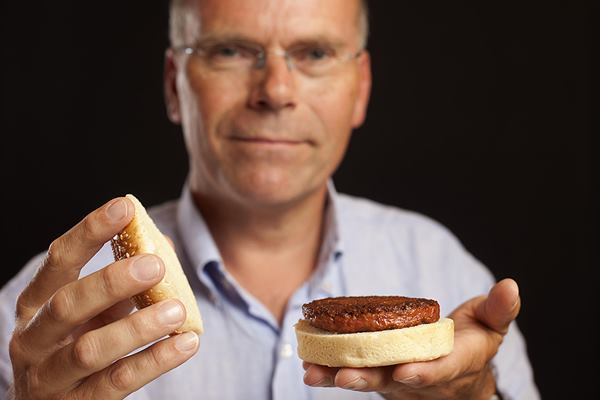
Anticipating that consumption of meat from livestock will lead to an inevitable environmental decline, Mark Post, a professor at Maastricht University in the Netherlands, and his team set out to grow meat in the laboratory. This month, they announced the arrival of the world’s first lab-grown hamburger.
After cultivating samples of bovine muscle tissue, the researchers grew meat strands—combining 20,000 of them to form a typical-sized hamburger patty. On August 5 of this year, Chef Richard McGeown of Couch’s Great House Restaurant in Cornwall served up the first “cultured beef burger” in London. Reportedly, the burger was meaty enough, but lacked the blood and fat that usually accompanies the muscle.
Although lab-grown meat will require more development to match the full flavor of a conventional burger—adding cultured fat cells may help, for example—the achievement is significant for the possible future it portends. With so many arguments in its favor, cultured meat will eventually find its way to grocery aisle shelves, and by then its taste may be more satisfying than burgers made from veggies. Given the choice, what will we decide—a patty grown in a petri dish, or a piece of a previously living being? The future of our environment may hang in the balance.
Blaine Brownell, AIA, is a regularly featured columnist whose stories appear on this website each week. His views and conclusions are not necessarily those of ARCHITECT magazine nor of the American Institute of Architects.