1
of 14
Casey Dunn
This weekend retreat reflects a blend of Texas’s architectural…

Casey Dunn
This weekend retreat reflects a blend of Texas’s architectural…
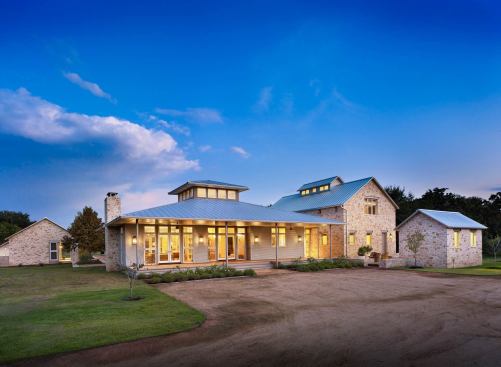
Designed as a weekend retreat for a Houston-based couple, Oak Road Residence stands about halfway between the owners’ Gulf Coast hometown and the Hill Country city of Austin. So it’s perhaps fitting that the compound of buildings reflects the inspiration of architectural traditions native to those two regions. But the house mixes things up in other ways too. Like an inspired fusion chef, architect Dillon Kyle counterposed nature with design, deployed both modernist and vernacular forms and materials, and balanced casualness with formality. The result—grounded in its rural context but utterly fresh—offers its owners and their friends a perfectly urbane respite from the urban life.
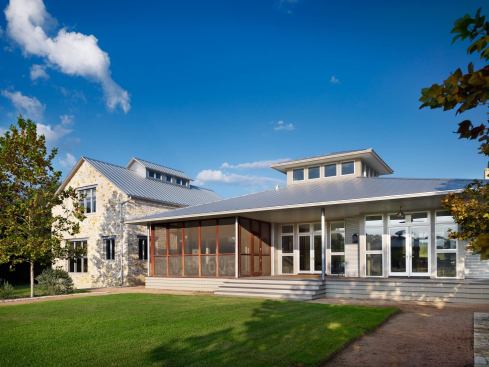
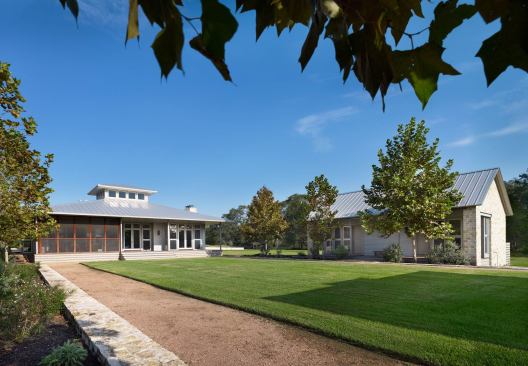
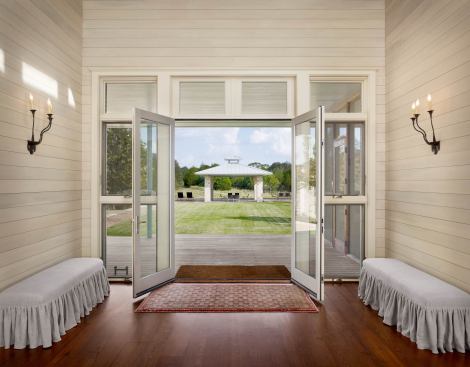
The area is a popular location for weekend homes, which typically focus on a distant view or a “tank” (a pond, in local parlance). On this contained, wooded site, Kyle says, “What we were after was creating an environment that was secluded and quiet.” A private drive meanders for nearly half a mile through woodland and clearings before reaching the house site, a tidy arrangement of buildings that suggests a polished abstraction of a classic Western ranch. But Kyle’s site plan complicates the agrarian reference by orienting the main house and guest house toward a manicured back lawn based on classical garden design. A beeline axis runs from the main house’s front porch steps, through the building, and down the center of the lawn, whose stone-bordered, rectangular form terminates in a swimming pool that overlooks the less manicured lower field.
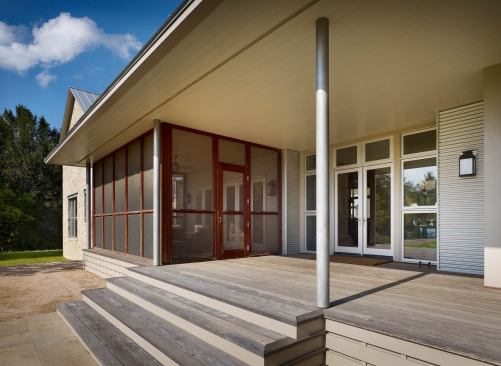
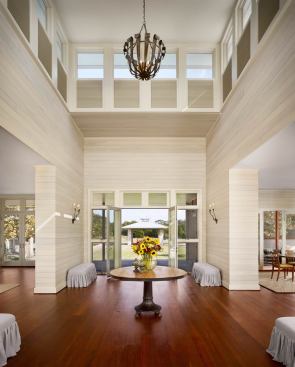
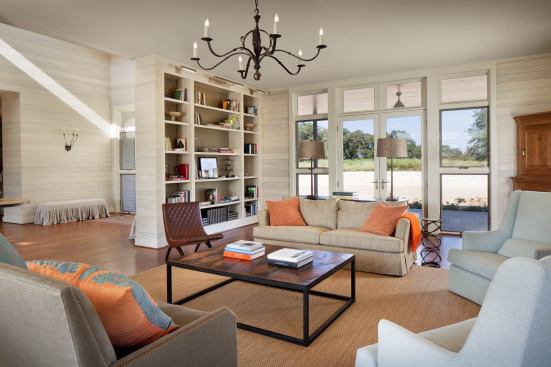
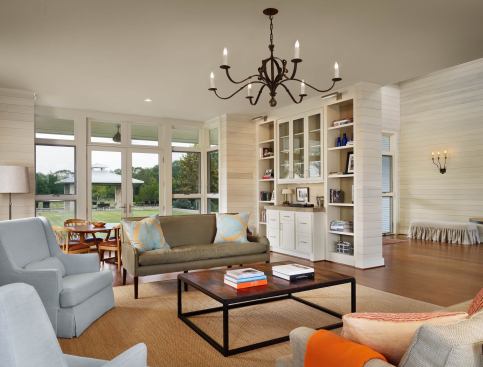
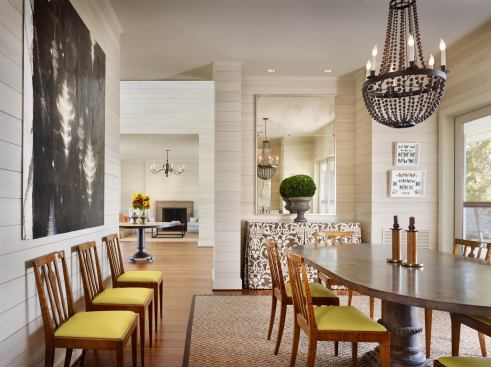
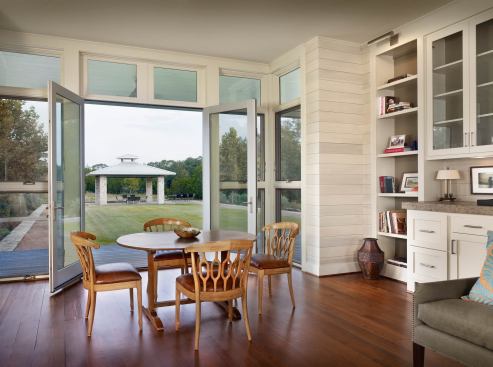
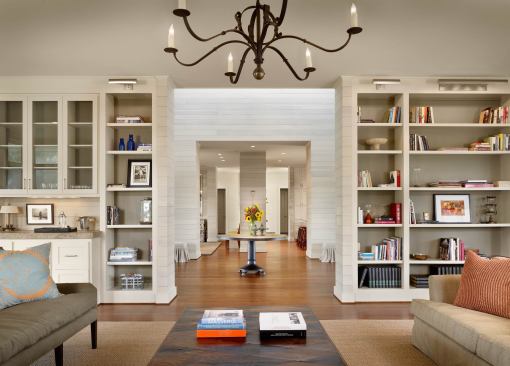
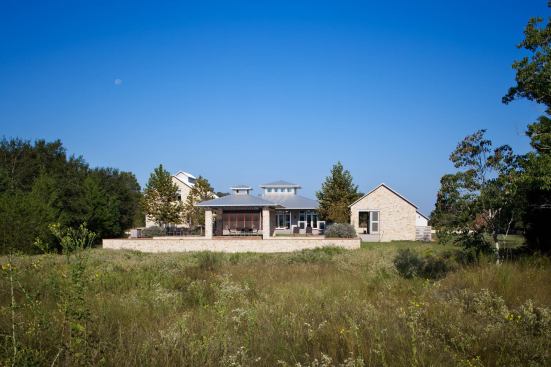
The house itself links two visually distinct structures with distinctly different jobs. Shared daytime spaces occupy a hip-roofed, corrugated metal-clad wing suggestive of a traditional Gulf Coast cottage. A broad metal roof shelters deep, full width porches at the east and west, overlooking the entry court and rear yard, respectively. The interior plan is simple, Kyle says. “It’s a three-part division, under this big roof with the cupola in the middle.” Two mirror-image volumes–a living room at the north and a kitchen-dining great room at the south–flank the central hall, which channels both traffic and daylight to its neighboring spaces. Poplar shiplap paneling lines the walls throughout. “The boards are a vernacular reference,” Kyle explains, but along with warmth and texture, they lend a sense of pinstripe precision that transcends the material’s farmhouse associations.
A glass-walled vestibule —“a classic architectural hyphen,” Kyle says–links the living pavilion with the bedroom wing, a gabled limestone structure loosely based on the bunkhouse model. The ground-floor is devoted primarily to a master bedroom suite, with a private office that opens onto the rear garden. Access to the housekeeper’s suite at the opposite end of the wing is limited to a door off the front patio, which is enclosed by a low limestone wall that links the house to a small outbuilding Kyle calls the “barbecue hut.” The second floor holds two suites for the owners’ frequent guests (those who aren’t staying in the detached guest house that borders the rear lawn). “They’re basically identical bedrooms,” Kyle says, “but one is furnished as a traditional guest room, and one is more of a kids’ room.” The latter has four built-in bunks, each with its own small window under the eaves.
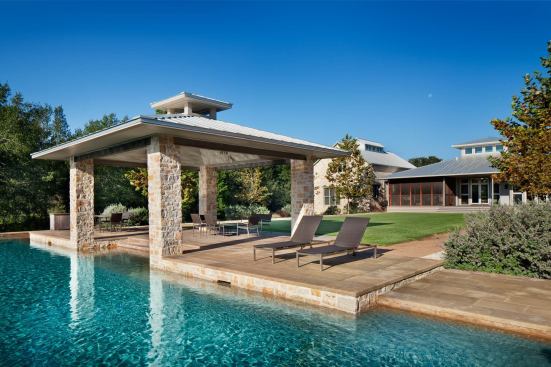
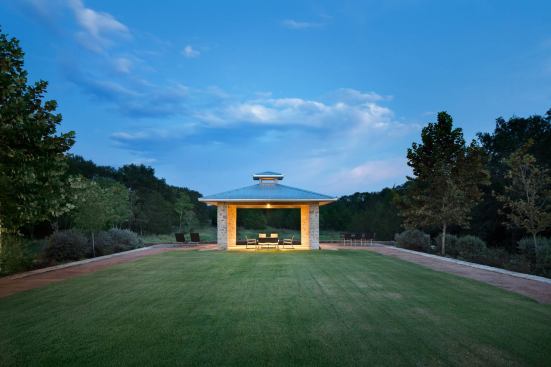
While the living pavilion and the bunkhouse express slightly different regional affiliations, their principal materials—corrugated metal and limestone—bleed into each other, unifying the composition. “We wanted to reference vernacular issues,” Kyle says, “but we didn’t want to pretend [the bunkhouse] was an old building and we were building the new house next to it.” Applied, in varying combinations, to each of the structures on the property, the two-part palette reaches equilibrium at the pool pavilion. A metal roof perched on four stout stone columns, the structure pins the far end of the back lawn, providing welcome shade for a pool that is deliberately remote from the living quarters. “We wanted it to be a destination,” Kyle says, “to stretch the activity out.”

No recommended contents to display.