A narrative of the history of glass would describe the story of a disappearing material. I’m not referring to disappearance in terms of the quantity of glass production or use. Rather, I’m talking about the optical dematerialization of glass, based on its technological trajectory towards invisibility.
One factor enabling this dematerialization has been the pursuit of absolute precision in glass-making processes—leading to a more geometrically-pure material. Another factor has been the microscaled manipulation of the surface of glass with the goal to minimize reflections.
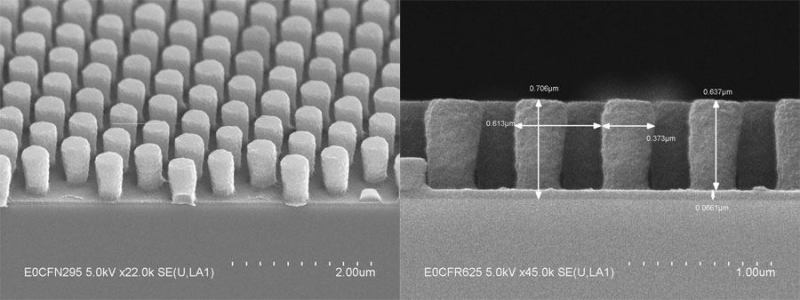
A recent partnership between Asahi Glass and Rolith has resulted in the development of a near-invisible glass, based on the use of a special nanostructured surface treatment. The process makes use of rolling mask lithography—a proprietary manufacturing method used to create arrays of microscopic structures that emulate the optically advanced composition of a moth’s eye. According to Rolith, the new glass exhibits superior performance to other antireflective glass technologies, such as PVD film coatings or polymer-based nanostructured films.
Invisible glass may bring benefits such as enhanced visual clarity, but it will also have drawbacks. As this and other nanostructuring techniques make glass increasingly immaterial, counter approaches will doubtless be required—depending on the application—to prevent a likely increase in bird deaths or human injuries due to an inability to detect the material’s presence.
Blaine Brownell is a regularly featured columnist whose stories appear on this website each week. His views and conclusions are not necessarily those of ARCHITECT magazine nor of the American Institute of Architects.