
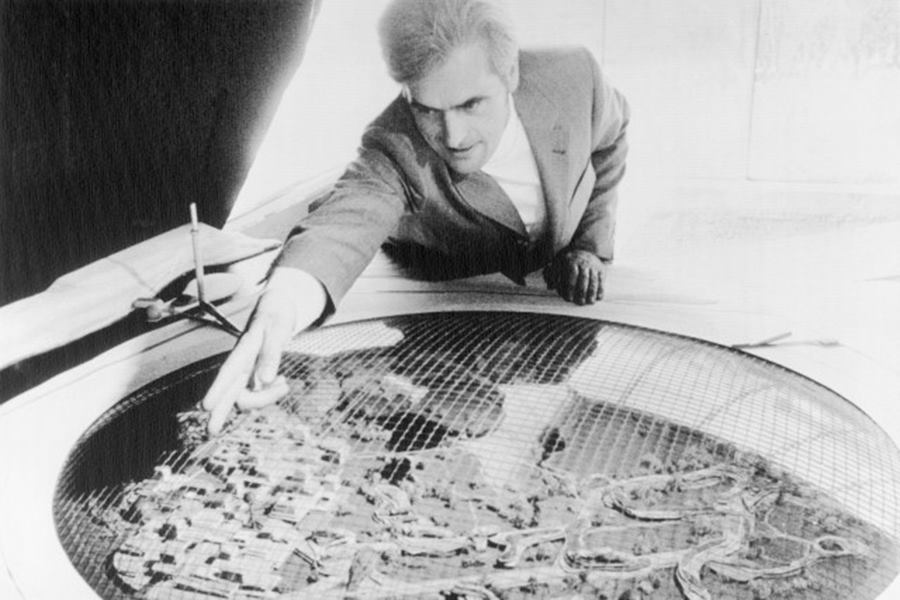
Today would have been German architect and engineer Frei Otto’s 91st birthday. Last year, Otto was named the 40th recipient of the Pritzker Architecture Prize for his lifetime of work as a “visionary, utopian, ecologist, pioneer of lightweight materials, protector of natural resources and a generous collaborator,” according to a press release. In honor of Otto’s birthday, ARCHITECT rounded up a few of his notable projects.
Hall at the International Garden Exhibition (1963)
Munich, Germany
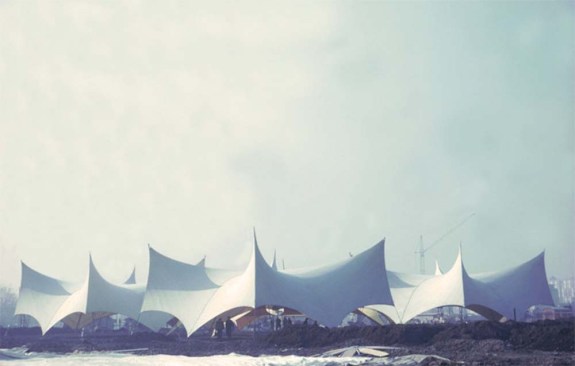
The Hall at the 1963 International Garden Exhibition is one of Otto’s most famous cable-net structures.
Institute for Lightweight Structures at the University of Stuttgart (1967)
Vaihingen, Germany

Otto designed the tents for the Institute for Lightweight Structures, which he founded at the university in 1964.
International and Universal Exposition (1967)
Montreal

Completed in 1967, the International and Universal Exposition by Atelier Frei Otto Warmbronn is an early example of the lightweight tent structures that Otto is known for.
Arctic City (1970)

Frei Otto
Otto and Edward Bubner’s concept proposal for Arctic City: an inflamed dome structure containing an artificially produced environment. The structure would act as a wind resistor, prevent the accumulation of snow, and use atomic energy to provide fresh air and heating.
Olympic Stadium (1972)
Munich, Germany
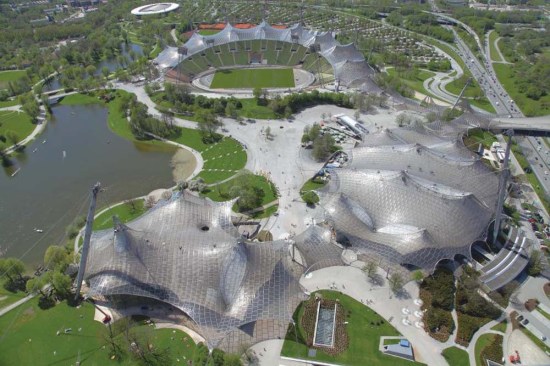
Otto’s Olympic Stadium for the 1972 Summer Games is remembered as the first large-scale tensile structure.
Mannheim Multihalle (1974)
Mannheim, Germany
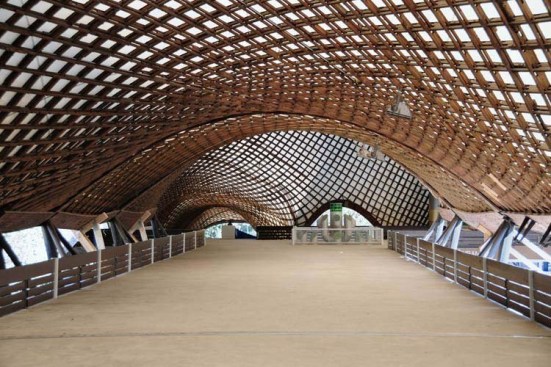
Mannheim Multihalle has been a historical cultural monument since 1988, and is known as the largest self-supporting timber gridshell structure in the world.
Umbrellas for Pink Floyd’s Concert Tour (1977)
United States

Built to resemble umbrellas, these canopies were designed for Pink Floyd’s 1977 “In the Flesh” tour.
Diplomatic Club Heart Tent (1980)
Riyadh, Saudi Arabia

Otto’s material choice of cable-net construction and tile cladding allowed the Diplomatic Club Heart Tent structures to blend in with the interior gardens of Tuwaiq Palace in Riyadh, Saudi Arabia.
Munich Zoo Aviary (1980)
Munich, Germany

Atelier Frei Otto Warmbronn completed a much-needed renovation of the Munich Hellabrunn, the world’s first “GeoZoo.”
Japan Pavilion for Hannover Expo (2000)
Hannover, Germany

Otto and collaborator Shigeru Ban Architects, a Tokyo-based firm led by another Pritzker Prize winner, aimed to recycle or reuse all of the materials that went into building this pavilion for the 2000 Hannover Expo after it was dismantled.