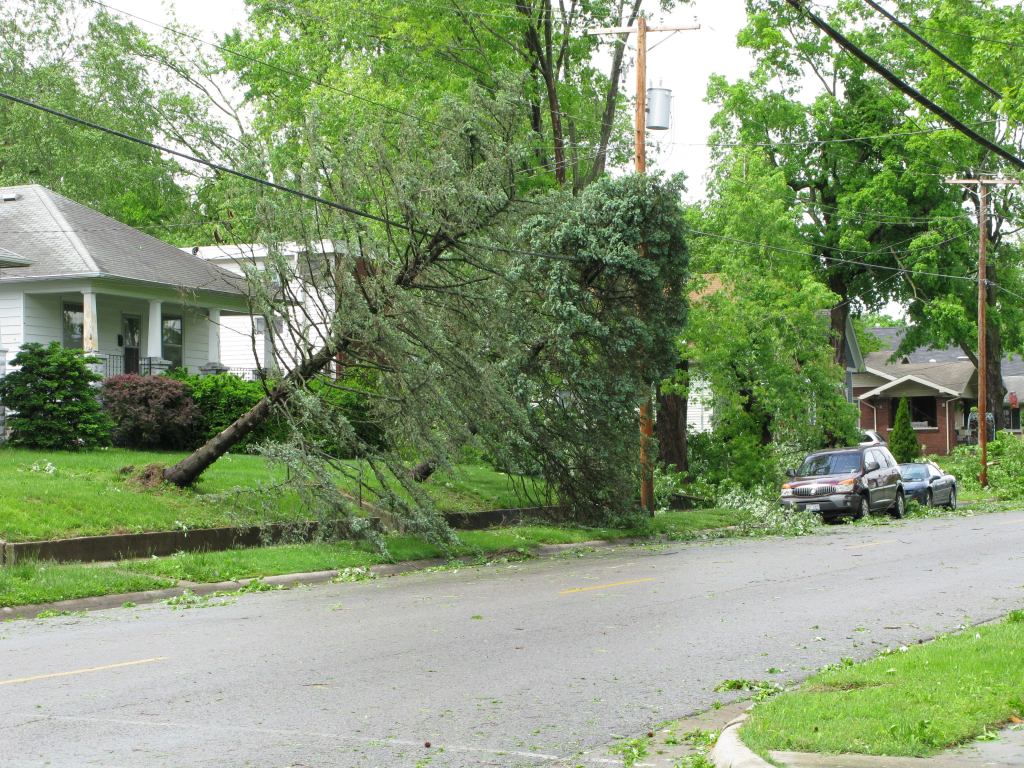
Like many people across a 600-mile swath of this country, we lost power last weekend. While I was still at work, I watched the landscape outside my window change from a lethargic triple-digit heat to one coming alive in swirls of trees and bushes under a sky for which the adjective “leaden” seemed invented. Lights flickered, lightning came, the wind reached a crescendo, died down, and a brief shower marked the passing of the “derecho,” as we now know to call such squalls.
At home, old trees fell, a power line snapped, and a transformer blew. For the next day-and-a-half we existed by candlelight and the hum of our neighbors’ emergency generators. We went to sleep when it was dark and woke when it was light. We tried to catch breezes through our clerestory windows and locked up when it became hot. Luckily, the storms brought the temperature down, at least until the middle of the day.
I never thought of the Midwest—especially southwestern Ohio—as a place of extreme weather, but for the almost six years we’ve lived here we have endured more and more violent storms. Scientists tell us these are becoming more common, as is the extreme heat of this summer and the mild winter we enjoyed this year (though storms in the winter will also become more extreme). Global warming is now something we are all experiencing.
This new reality is showing up in the shortfalls of the ways in which we have designed our environment. Traditional homes in this area had good cross ventilation and were sited to maximize breezes and minimize winter exposure. Now houses are designed for air conditioning. This was an area of forests, which helped to mitigate the problems, though now the trees are as much a hazard as they are a shield. My house is in a little dell, its roads not maintained by the city, and we need four-wheel drive several times every winter to get out. The things we need and need to do are spread throughout a large swath that is difficult to navigate with public transportation or on foot.
Of course, what we should do is face global warming. We need to move towards net-zero buildings, both in construction and in occupation. We need to develop land-use strategies that are sane and sustainable. We all need to reduce our carbon footprints.
In the meantime, we also need to think about how to design for global warming. We need to go back to some of the lessons we used to understand on how to create structures that are not completely dependent on air conditioning and other mechanical systems. We need to open up our houses and make them sturdier. We need better planning strategies.
I think this will lead to better architecture. It will move us away from flimsy boxes ballooning with air-conditioned rooms and festooned with decoration. It will lead to communities designed with, not on, the land. It will help us create spaces that flow and provide shelter, rather than those that show off and segregate.
In the meantime, at my house, we have installed an emergency generator. It wasn’t hooked up in time for the derecho, but next time we too will join those who deal with this issue the American way: by isolating ourselves as much as possible.