This summer, I have bathed in Turrell, swam in Turrell, seen L.A. from Turrell, been wheeled into Turrell, and just sat or stood and watched Turrell. The Jedi Knight of Light—no saber necessary—is having his moment. James Turrell enjoyed major retrospectives at the Los Angeles County Museum of Art and the Solomon R. Guggenheim Museum in New York, as well as smaller presentations at the Museum of Fine Arts Houston and in Easton, Md., where he maintains a home (and keeps a yacht called “Light.”).
Yes, it is all about light. Light above all else that just hovers through the miracle of Turrell’s particular artistry, in front of walls, in corners, or over your head. Light that pulses or changes color gradually, working through all stages of the rainbow. Light that produces effects that either make you aware of where you are, or confuse your sense of reality.
Lately, Turrell has gotten gizmoed-up. He uses the latest advances in lighting technology to create effects that are spectacular. At the LACMA retrospective, When I was wheeled into the dome that makes up Perceptual Cell (on view in the LACMA retrospective) on a hospital gurney guided by lab-coated assistants, I did not get an MRI, as the set-up might suggest, but instead an assault of strobes and flashes that were hallucinatory. At a much larger scale, his installation at the Guggenheim consists of Aten Reign, a cone of scrims a computer suffuses with an array of colors shifting continually through the spectrum. You lie back on the sloped-back benches Turrell perfected many years ago for his “sky spaces,” in which you usually look up at a knife-edged opening cut in the ceiling at the sky. For Aten Reign, the Guggenheim’s oculus is far away, and what you enjoy instead is the reds, blues, greens, and yellows becoming more intense and seeming to creep down toward you as they move from one hue to the other.
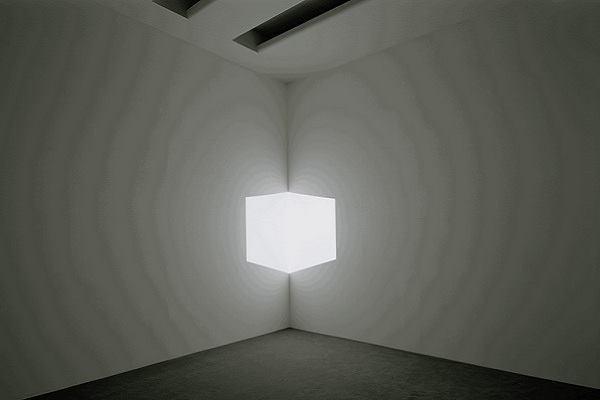
The more I see of these new products, which also include the eminently salable holograms included in the LACMA exhibition, the more nostalgic I become for those early works. Nothing Turrell has done lately is a powerful as the panes of light that seem to hover in front of the wall, but are actually the result of bathing a space beyond a knife-edged opening in the wall with completely even and invisible light. Equally beautiful is the cube that seems to hover in front of a wall corner, but is just another product of carefully controlled light.
The LACMA exhibition (reviewed in ARCHITECT by Carolina A. Miranda) features gallery after gallery of these tricks of Turrell’s trade. I found just about each version of illuminate nothingness to be breathtaking. After all that refinement, the disco trip of Perceptual Cell was jarring—but also a cathartic cleansing following so much contemplation of absence.
The Guggenheim exhibition (also reviewed in these pages, by Alexandra Lange), on the other hand, has only Aten Reign, a few prints, and two other installations. The first of those, in the double-height space at the ramp’s beginning, is successful in its dissolution of the space’s corner; the other one had such a long line I never got inside (which is a problem with most of Turrell’s exhibitions: My experiences are not usual, as my status as an art museum director let me jump some lines, though not all of them). I found Aten Reign to be a perversion, rather than an elevation, of the Guggenheim’s space, and the experience rather numbing. I would rather just watch the sun set.
The best experiences I have had with Turrell’s work have been in sky spaces, such as the Houston sky space reviewed by Thomas de Monchaux in ARCHITECT last year. In Napa Valley, I recently had the pleasure of diving into an infinity pool owned by the collectors Norah and Norman Stone, emerging inside a sky space that floats in that water. There you could lean back, floating in the water, and observe the night sky hovering as a black weight, seemingly inside the softly lit chamber.
Yet I wish I had not waited politely until after dinner, when it was dark, but had slipped away from the table, donned my suit, and dived in at dusk, when my experience of such spaces tells me that Turrell will let the sky and its light do their magic, transforming that cutout from a dome, to a plane shot through with different colors that keep changing as the sun sets, to the dark monolith of night. That is the essential Turrell: A frame, like a great piece of architecture, that makes you aware of the essence of our light-filled universe.